A DC district judge denied a Proud Boy member’s request to move his trial in connection with the Capitol riot.
Gabriel Garcia motioned in April to move his trial from DC to Florida, citing “an extreme level of prejudice” against Jan. 6 defendants.
In an opinion denying his motion, a federal judge cited a quote from the late iconic chef Anthony Bourdain.
A federal judge cited a quote by the late iconic chef Anthony Bourdain in a ruling rejecting an accused Capitol rioter’s request to move his trial out of Washington, DC.
Former US Army captain Gabriel Garcia, who is a member of the far-right extremist group the Proud Boys, was arrested on January 21, 2021, in connection with the attack on January 6, 2021, after the FBI said he uploaded live footage of himself saying he had just “stormed” the Capitol. He faces charges of violent entry and civil disorder.
Garcia was granted pretrial release last year on the conditions of being subject to curfew and fitted with an ankle monitor.
In an April filing, Garcia requested to change the venue of his trial to the Southern District of Florida, citing “an extreme level of prejudice exists in DC for January 6 Proud Boys defendants, like him.”
“Regrettably, in such a historic prosecution, any conviction of a Proud Boy or Oath Keeper by a D.C. jury will forever be tainted, questioned, and held to ridicule as vigilante-like justice, reeking of political comeuppance,” his motion said, per a report by CBS News.
The accused Florida Proud Boy, who pleaded not guilty to all six federal charges, included online surveys that he claimed upheld his motion. He also claimed jurors in DC are “friendly” to prosecutors.
On Friday, US District Judge Amy Berman Jackson denied his request, starting her 32-page written opinion with a quote made by Bourdain during an episode his show, “Anthony Bourdain: No Reservations,” filmed in the nation’s capital.
“DC is not just a city of dead presidents and cold marble monuments,” Bourdain said. “The people we see working here on our television screens, in the halls of power, and the plush seats of Sunday morning punditry, often have as little to do with the city itself, and the people who actually live here, as any creatures from another universe.”
The iconic TV personality added: “This is a city filled with actual living, breathing, eating Americans. Not vessels for one ideology or another, empty suits and empty ideas. Hard lives, hard struggles, and long roads to get here.”
Jackson also noted that Garcia’s motion to move his trial was “largely predicated on sweeping, unsupported assertions about a city he does not appear to know or understand.”
“None of the surveys support an assumption that any prejudice against this individual defendant is so great that he cannot receive a fair trial in this district; despite his grandiose claims, there is little evidence that D.C. residents know who he is at all,” the federal judge said.
Retinol is lauded as the gold standard of skin care. For years, this miracle ingredient has been included in topical formulas to reduce and delay the visible signs of aging; however, the benefits of conventional retinol come with plenty of uncomfortable side effects. If you’re ready to add retinol to your skin care routine but prefer to keep things natural, you’ve come to the right place. Read on for our guide to retinol in skin care and how to incorporate a natural alternative into your routine.
What Is Retinol?
Retinol is a synthetic derivative of Vitamin A, an antioxidant that is essential for healthy eyes and skin. Because the body cannot produce this vitamin on its own, it needs to be supplied by diet and/or topical skin care. It is often added to anti-aging products for its ability to promote skin cell turnover, build collagen, fight free radicals and erase fine lines and wrinkles.
How Does Retinol Work?
In order for the skin to benefit from retinol, enzymes in the body must convert it into retinoic acid (also known as tretinoin), the active form of Vitamin A. Retinoic acid works on a cellular level to optimize the following functions that improve skin’s health and vitality.
Speeds Up Skin Cell Turnover
Efficient skin cell turnover is necessary for skin growth and repair. When you are a child, your skin cells naturally turn over every two weeks; however, as early as your twenties, the turnover process starts to slow to every 28-35 days. By fifty, it takes as long as 45-90 days for dead skin to fully shed from your skin’s surface. As a result, skin becomes drier, thinner and more pigmented as you mature. Retinol prompts surface cells to turn over more quickly, enabling your skin to grow healthy cells and shed dead layers more efficiently.
Stimulates Collagen And Elastin Production
Over time, your skin’s stores of collagen and elastin begin to deplete. These proteins, which provide necessary support and elasticity, keep skin dense, plump and wrinkle-free. As their production declines, the skin begins to loosen and sag, and fine lines and wrinkles set in. Retinoic acid not only stimulates the production of new collagen and elastin, it also prevents their breakdown, keeping your skin strong, firm and elastic.
Neutralizes Free Radicals
Ninety percent of skin aging is caused by environmental factors like pollution, blue light and UV rays. These stressors expose skin to free radicals — highly reactive molecules that cause oxidative stress and damage healthy skin cells. Unchecked, this can degrade the skin’s structural integrity and lead to premature aging. A Vitamin A derivative, retinol’s antioxidant properties neutralize free radicals and reduce their reactivity, thereby improving your skin’s health and resilience.
Retinol Benefits And Side Effects
Through these actions, retinol provides the following benefits:
Removes dead skin cells
Clears congestion
Shrinks large pores
Smooths uneven skin texture
Minimizes fine lines and wrinkles
Keeps skin firm and plump
Fades dark spots
However, regular use of synthetic retinol can cause the following side effects:
Dryness
Peeling
Redness
Itching
Irritation
UV sensitivity
Most dermatologists advise that you skip retinol if you suffer from rosacea, eczema, psoriasis and other inflammatory skin conditions.
Natural Retinol Alternative
You can reap the benefits of retinol (and skip its side effects) by opting for a natural, botanical-based alternative. Our Natural Retinol Alternative is a complex that mimics the effect of chemical retinol by appearing to lift and tighten the skin. It improves skin firmness and elasticity and minimizes the visible signs of aging caused by free radical damage. Unlike synthetic Vitamin A, this alternative is derived from chicory root and tara tree extract, two natural compounds that provide the same results as conventional retinol — without the downtime.
How To Add Natural Retinol To Your Skin Care Routine
Add natural retinol to your skin care routine with our Monoi Age Corrective Exfoliating Cleanser. Infused with exotic monoi and made with our unique Natural Retinol Alternative, this refining cleanser rejuvenates skin for a smooth and lifted appearance. It also removes impurities and surface debris to encourage the appearance of smooth-looking skin.
You can also add natural options for retinol to your routine by using the Bamboo Firming Fluid. This silky concentrate is formulated with our Natural Retinol Alternative to smooth fine lines and wrinkles and tighten skin. Bamboo and coconut are additional ingredients that tone and condition for a complexion that appears firm and ageless.
Eminence Organics fan, George Z., says in his five-star review: “I love my Bamboo Firming Fluid … I’m 74 with pretty good skin, nevertheless, the laugh lines were bothering me. Now, after two months, they are disappearing, along with the frown wrinkles between my eyes.”
For best results, apply the Bamboo Firming Fluid after your favorite toner and before moisturizing your skin. Like all Eminence Organic Skin Care products, a little goes a long way! A thin layer is plenty to keep your skin soft, smooth and wrinkle-free.
Do you use retinol in your skin care routine? Would you switch to a natural and organic alternative? Share your thoughts with us in the comments below and join the conversation on social media.
We often have customers tell us they are confused with which model Plantronics (now Poly) wireless headset they own when they’re looking for parts. Plantronics do not label their model on the wireless headsets, the only label you will find is the model of the “base” labeled on the bottom of the wireless base. The same base are interchangeable for many wireless models, For example, Plantronics CS540 is labeled CO54, Plantronics Savi W740 is labeled WO2 on the base. So there is no distinction between some of the different Plantronics wireless models, other than the the style of the headset. Here are clarification of how the different Plantronics wireless models and how they’re label on the Plantronics wireless headset base.
F1 Goldendoodles are a cross between a purebred Golden Retriever and a purebred Toy, Miniature or Standard Poodle. Dog breeders refer to these dogs as “first generation” (F1) Goldendoodles and they get 50 percent of their genes from each breed. F1B Goldendoodles are a cross between an F1 Goldendoodle and a purebred Poodle or a purebred Golden Retriever.
Although all Goldendoodles will be part Golden Retriever and part Poodle, personality traits and appearance will differ based on how much Poodle or Golden Retriever the Goldendoodle offspring inherited. Dog breeders enhance certain temperament and appearance characteristics of the offspring by choosing to weigh more heavily on either the Golden Retriever genes or the Poodle genes.
Do F1 Goldendoodles have a different appearance than F1B Goldendoodles?
They can. F1 Goldendoodles have furnishings — the longer hair that surrounds a dog’s beard area and eyebrows — and gives the Goldendoodle the signature fluffy look. Poodles have the furnishing gene and Golden Retrievers do not. Furnishings are a dominant gene, so F1 Goldendoodles will always inherit furnishings from the Poodle parent. F1B Goldendoodles may not always have furnishings if two non-furnishing coat genes (also referred to as improper coat or IC) are present from a Goldendoodle crossed with a Golden Retriever. Breeders can test for these genes and share results with potential owners.
Are F1 vs F1B Goldendoodle personality traits different?
The F1B Goldendoodle’s personality traits will depend on which purebred was crossed with the F1 Goldendoodle. If a Poodle was used, the offspring may show a high sensitivity and alertness to its environment, high intelligence levels and an ultra-high trainability level. If a Golden Retriever was used, expect an extremely social and loyal dog, who needs lots of physical and mental stimulation through service jobs, socialization and retriever games.
The F1 Goldendoodle is a 50-50 combination of its parents’ purebred genes, so personality traits are less predictable as with any mixed breed.
How do I know if I’m getting an F1 or F1B Goldendoodle?
Goldendoodle breeders should be able to provide lineage. The Goldendoodle Association of North America, the Goldendoodle’s breed club, lists nationwide breeders they’ve accepted into their club.
Still unsure? Start by making a list of questions to ask Goldendoodle dog breeders. And take your time — patience will help you find the right Goldendoodle for your lifestyle.
When you’re thinking about a kitchen remodel, one question that is bound to come up is, “how long will my remodel take?” Defining the completion date for any home improvement project involves a variety of considerations and, of course, no two kitchen remodels are the same. For the average homeowner, understanding a little more about the overall scope of work of their project will result in a more accurate estimate of the time required for completion of the job.(more…)
This post contains links to products from our advertisers, and we may be compensated when you click on these links. Our recommendations and advice are ours alone, and have not been reviewed by any issuers listed. Terms apply to offers listed on this page. Read our editorial standards.
Cash back credit cards are some of the most flexible rewards cards you can get, returning anywhere from 1% to 6% cash back on all kinds of purchases — and often without an annual fee. For people who are just getting into credit card rewards, or who want to keep things simple, cash back credit cards can be a good choice.
See Insider’s picks for the top cash back credit cards for families, dining, intro APRs, and building credit below.
Best card for flat-rate cash rewards earning
Regular APR
16.49%, 21.49%, or 26.49% Variable
Recommended Credit Score
Good to Excellent
Regular APR
16.49%, 21.49%, or 26.49% Variable
Recommended Credit Score
Good to Excellent
Pros
Good welcome bonus for a $0 annual fee card
Straightforward 2% cash rewards on purchases with no categories to track
Strong benefits including cell phone protection, Visa Signature perks, and a 0% intro APR on purchases and qualifying balance transfers for 15 months from account opening (then 16.49%, 21.49%, or 26.49% Variable APR)
Cons
If you’ve opened a Wells Fargo card in the past 15 months, you may not be eligible for the bonus or intro APR offer
Earn a $200 cash rewards bonus after spending $1,000 in purchases in the first 3 months
Earn unlimited 2% cash rewards on purchases
0% intro APR for 15 months from account opening on purchases and qualifying balance transfers, then a 16.49%, 21.49%, or 26.49% variable APR; balance transfers made within 120 days qualify for the intro rate and fee of 3% then a BT fee of up to 5%, min: $5
$0 annual fee
No categories to track or remember and cash rewards don’t expire as long as your account remains open
Enjoy a premium collection of benefits at a selection of the world’s most intriguing and prestigious hotel properties with Visa Signature Concierge
Get up to $600 protection on your cell phone (subject to $25 deductible) against covered damage or theft when you pay your monthly cellular telephone bill with your Wells Fargo Active Cash® Card
Select “Apply Now” to learn more about the product features, terms and conditions
Best card for everyday spending
Regular APR
16.49% – 25.24% Variable
Recommended Credit Score
Good to Excellent
Regular APR
16.49% – 25.24% Variable
Recommended Credit Score
Good to Excellent
More Information
Intro Offer: Earn an additional 1.5% cash back on everything you buy (on up to $20,000 spent in the first year) – worth up to $300 cash back!
Enjoy 6.5% cash back on travel purchased through Chase Ultimate Rewards®, our premier rewards program that lets you redeem rewards for cash back, travel, gift cards and more; 4.5% cash back on drugstore purchases and dining at restaurants, including takeout and eligible delivery service, and 3% on all other purchases (on up to $20,000 spent in the first year).
After your first year or $20,000 spent, enjoy 5% cash back on Chase travel purchased through Ultimate Rewards®, 3% cash back on drugstore purchases and dining at restaurants, including takeout and eligible delivery service, and unlimited 1.5% cash back on all other purchases.
No minimum to redeem for cash back. You can choose to receive a statement credit or direct deposit into most U.S. checking and savings accounts. Cash Back rewards do not expire as long as your account is open!
Enjoy 0% Intro APR for 15 months from account opening on purchases and balance transfers, then a variable APR of 16.49% – 25.24%.
No annual fee – You won’t have to pay an annual fee for all the great features that come with your Freedom Unlimited® card
Keep tabs on your credit health, Chase Credit Journey helps you monitor your credit with free access to your latest score, real-time alerts, and more.
Best card for rotating categories and flexible redemptions
Regular APR
16.49% – 25.24% Variable
Recommended Credit Score
Good to Excellent
Regular APR
16.49% – 25.24% Variable
Recommended Credit Score
Good to Excellent
Pros
No annual fee
Generous bonus cash-back categories
Great welcome bonus
Cons
Booking through Ultimate Rewards portal can restrict outside earning potential
Varying percentages and rotating calendar categories require extra attention
Earn a $200 Bonus after you spend $500 on purchases in your first 3 months from account opening.
5% cash back on up to $1,500 in combined purchases in bonus categories each quarter you activate. Enjoy new 5% categories each quarter!
5% cash back on travel purchased through Chase Ultimate Rewards®, our premier rewards program that lets you redeem rewards for cash back, travel, gift cards and more
3% cash back on drugstore purchases and dining at restaurants, including takeout and eligible delivery service, and unlimited 1% cash back on all other purchases.
No minimum to redeem for cash back. You can choose to receive a statement credit or direct deposit into most U.S. checking and savings accounts. Cash Back rewards do not expire as long as your account is open!
0% Intro APR for 15 months from account opening on purchases and balance transfers, then a variable APR of 16.49% – 25.24%.
No annual fee – You won’t have to pay an annual fee for all the great features that come with your Freedom Flex℠ card
Keep tabs on your credit health – Chase Credit Journey helps you monitor your credit with free access to your latest score, real-time alerts, and more.
Best card for rotating cash-back categories
Regular APR
13.49% – 24.49% Variable
Recommended Credit Score
Good to Excellent
Regular APR
13.49% – 24.49% Variable
Recommended Credit Score
Good to Excellent
Pros
From July 1 to September 30, 2022, you can earn 5% cash back at restaurants and PayPal on up to $1,500 in purchases after enrollment, then 1%
Discover will match your cash back at the end of your first account year
No annual fee
Cons
Cap on how much bonus cash back you can earn each quarter
If the quarterly categories aren’t convenient for you, you can earn more cash back with a different card
Intro Offer: Unlimited Cashback Match – only from Discover. Discover will automatically match all the cash back you’ve earned at the end of your first year! There’s no minimum spending or maximum rewards. You could turn $150 cash back into $300.
Earn 5% cash back on everyday purchases at different places each quarter like Amazon.com, grocery stores, restaurants, gas stations and when you pay using PayPal, up to the quarterly maximum when you activate. Plus, earn unlimited 1% cash back on all other purchases – automatically.
New! Discover helps remove your personal information from select people-search websites. Activate by mobile app for free.
Redeem cash back in any amount, any time. Rewards never expire.
New Intro APR: Get a 0% intro APR for 15 months on purchases. Then 13.49% to 24.49% Standard Variable Purchase APR applies, based on credit worthiness.
No annual fee.
Click “Apply Now” to see terms and conditions.
Best card for families
Regular APR
15.49% – 25.49% Variable
Recommended Credit Score
Good to Excellent
Regular APR
15.49% – 25.49% Variable
Recommended Credit Score
Good to Excellent
Pros
Generous bonus rewards, especially at U.S. supermarkets
One of a small handful of credit cards that offer bonus rewards on select streaming services
Intro APR offer
Cons
Unlike many other cash-back cards, it charges an annual fee
If you spend more than $6,000 at US supermarkets each year, you’ll want to use another card once you reach that cap
Earn a $350 statement credit after you spend $3,000 in purchases on your new Card within the first 6 months.
Buy Now, Pay Later: Enjoy $0 intro plan fees when you use Plan It® to split up large purchases into monthly installments. Pay $0 plan fees on plans created during the first 12 months after account opening. Plans created after that will have a fixed monthly plan fee up to 1.33% of each purchase amount moved into a plan based on the plan duration, the APR that would otherwise apply to the purchase, and other factors.
Low intro APR: 0% intro APR for 12 months on purchases from the date of account opening, then a variable rate, 15.49% to 25.49%
6% Cash Back at U.S. supermarkets on up to $6,000 per year in purchases (then 1%).
6% Cash Back on select U.S. streaming subscriptions.
3% Cash Back at U.S. gas stations and on transit (including taxis/rideshare, parking, tolls, trains, buses and more).
1% Cash Back on other purchases.
Cash Back is received in the form of Reward Dollars that can be redeemed as a statement credit.
$95 Annual Fee.
Terms Apply.
See Rates & Fees
Best card for dining, groceries, and entertainment with no annual fee
Regular APR
16.49% – 26.49% (Variable)
Recommended Credit Score
Good to Excellent
Regular APR
16.49% – 26.49% (Variable)
Recommended Credit Score
Good to Excellent
Pros
No annual fee
Bonus cash back on dining, entertainment, and grocery store purchases
Long intro APR period for purchases and balance transfers
Cons
Other cards earn more cash back in certain bonus categories
Not the highest sign-up bonus among cash-back cards
Earn a one-time $200 cash bonus after you spend $500 on purchases within the first 3 months from account opening
Earn unlimited 3% cash back on dining, entertainment, popular streaming services and at grocery stores (excluding superstores like Walmart® and Target®), plus 1% on all other purchases
Earn unlimited 5% cash back on hotels and rental cars booked through Capital One Travel, where you’ll get Capital One’s best prices on thousands of trip options. Terms apply
Earn 8% cash back on Capital One Entertainment purchases and tickets at Vivid Seats
No rotating categories or sign-ups needed to earn cash rewards; plus cash back won’t expire for the life of the account and there’s no limit to how much you can earn
0% intro APR on purchases and balance transfers for 15 months; 16.49% – 26.49% variable APR after that; 3% fee on the amounts transferred within the first 15 months
No foreign transaction fee
No annual fee
Best card for automatically customizing rewards
Regular APR
15.49% – 25.49% Variable
Recommended Credit Score
Good to Excellent
Regular APR
15.49% – 25.49% Variable
Recommended Credit Score
Good to Excellent
Pros
Flexibility to customize rewards by earning 5x points on up to $500 per billing cycle in your top spending category (from a list)
Generous welcome offer for a no-annual-fee card
No rotating bonus categories to sign up for or track
Earn valuable Citi ThankYou points which you can redeem for cash back, travel, gift cards, merchandise, and more
Cons
Only earns 1% back outside of $500 in top spending category each billing cycle
Earn $200 in cash back after you spend $750 on purchases in the first 3 months of account opening. This bonus offer will be fulfilled as 20,000 ThankYou® Points, which can be redeemed for $200 cash back.
0% Intro APR on balance transfers and purchases for 15 months. After that, the variable APR will be 15.49% – 25.49%, based on your creditworthiness.
Earn 5% cash back on purchases in your top eligible spend category each billing cycle, up to the first $500 spent, 1% cash back thereafter. Also, earn unlimited 1% cash back on all other purchases.
No rotating bonus categories to sign up for – as your spending changes each billing cycle, your earn adjusts automatically when you spend in any of the eligible categories.
No Annual Fee
Citi will only issue one Citi Custom Cash℠ Card account per person.
Best card for choosing your own cash back categories
Regular APR
15.99% – 25.99% (Variable)
Recommended Credit Score
Good to Excellent
Regular APR
15.99% – 25.99% (Variable)
Recommended Credit Score
Good to Excellent
Pros
Generous cash-back earning and welcome bonus for a no-annual-fee card
Ability to choose the best 5% and 2% cash-back categories for you
Introductory 0% APR offer on purchases and balance transfers
Cons
5% cash-back category is capped at $2,000 in purchases per quarter
New! $200 bonus after spending $1,000 in eligible purchases within the first 120 days of account opening.
5% cash back on your first $2,000 in combined eligible purchases each quarter on two categories you choose
5% cash back on prepaid air, hotel and car reservations booked directly in the Rewards Travel Center
2% cash back on one everyday category, like Gas Stations/EV Charging Stations, Grocery Stores or Restaurants
1% cash back on all other eligible purchases
0% Intro APR on purchases and balance transfers for the first 15 billing cycles. After that, a variable APR currently 15.99% – 25.99%
No Annual Fee
Pay over time by splitting eligible purchases of $100+ into equal monthly payments with U.S. Bank ExtendPay™ Plan.
Terms and conditions apply.
Best card for balance transfers
Regular APR
15.49% – 25.49% Variable
Recommended Credit Score
Good to Excellent
Regular APR
15.49% – 25.49% Variable
Recommended Credit Score
Good to Excellent
Pros
No annual fee
Simple earning structure without confusing bonus categories
Cons
Some cards earn higher rates of cash back on rotating categories
No sign-up bonus
While it offers a 0% introductory APR for 18 months, that’s only on balance transfers, not purchases, so you can’t use it to fund a major expense without interest. After those 18 months, it’s a 15.49% – 25.49% (Variable) APR.
Earn 2% on every purchase with unlimited 1% cash back when you buy, plus an additional 1% as you pay for those purchases.
To earn cash back, pay at least the minimum due on time.
Balance Transfer Only Offer: 0% intro APR on Balance Transfers for 18 months. After that, the variable APR will be 15.49% – 25.49%, based on your creditworthiness.
Balance Transfers do not earn cash back. Intro APR does not apply to purchases.
If you transfer a balance, interest will be charged on your purchases unless you pay your entire balance (including balance transfers) by the due date each month.
There is an intro balance transfer fee of 3% of each transfer (minimum $5) completed within the first 4 months of account opening. After that, your fee will be 5% of each transfer (minimum $5).
Best card for fair or average credit
Regular APR
26.99% (Variable)
Recommended Credit Score
Average, Fair and Limited
Regular APR
26.99% (Variable)
Recommended Credit Score
Average, Fair and Limited
Pros
Earn 5% back on Capital One Travel hotel and car rental bookings and 1.5% on everything else
You’re eligible to apply with limited or average credit
You’ll automatically be considered for a higher credit line in as little as six months
Cons
No welcome bonus
Annual fee
High APR for purchases and balance transfers
More Information
Earn unlimited 1.5% cash back on every purchase, every day
No rotating categories or limits to how much you can earn, and cash back doesn’t expire for the life of the account. It’s that simple
Be automatically considered for a higher credit line in as little as 6 months
Enjoy peace of mind with $0 Fraud Liability so that you won’t be responsible for unauthorized charges
Help strengthen your credit for the future with responsible card use
Earn unlimited 5% cash back on hotels and rental cars booked through Capital One Travel, where you’ll get Capital One’s best prices on thousands of trip options. Terms apply
Monitor your credit score with CreditWise from Capital One. It’s free for everyone
Check out quickly and securely with a contactless card, without touching a terminal or handing your card to a cashier. Just hover your card over a contactless reader, wait for the confirmation, and you’re all set
Best card for lower credit scores
Regular APR
24.49% Variable
Recommended Credit Score
New/Rebuilding
Regular APR
24.49% Variable
Recommended Credit Score
New/Rebuilding
Pros
Offers cash-back rewards, which isn’t a given for secured credit cards
Discover matches cash back after your first account year
Cons
Other secured cards let you start with lower minimum security deposits
You must fund the security deposit from a bank account
No Annual Fee, earn cash back, and build your credit with responsible use.
Establish your credit line by providing a refundable security deposit of at least $200. That means a $200 deposit for a $200 credit line. Or a $500 deposit for a $500 credit line. Bank information must be provided when submitting your deposit, and the security deposit equals your credit limit.
Automatic reviews starting at 7 months to see if we can transition you to an unsecured line of credit and return your deposit.
Earn 2% cash back at Gas Stations and Restaurants on up to $1,000 in combined purchases each quarter. Plus, earn unlimited 1% cash back on all other purchases – automatically.
New! Discover helps remove your personal information from select people-search websites. Activate by mobile app for free.
Get an alert if we find your Social Security number on any of thousands of Dark Web sites.* Activate for free.
Click “Apply Now” to see terms and conditions.
Best card for students
Regular APR
16.49% – 26.49% (Variable)
Recommended Credit Score
Average, Fair, Limited
Regular APR
16.49% – 26.49% (Variable)
Recommended Credit Score
Average, Fair, Limited
Pros
Good welcome bonus with an easy spending requirement
Strong 3% cash back earning in popular everyday spending categories for students like dining, entertainment, eligible streaming services, and grocery stores (excluding superstores like Walmart® and Target®)
Earn unlimited 3% cash back on dining, entertainment, popular streaming services and at grocery stores (excluding superstores like Walmart® and Target®), with 1% on all other purchases. Plus, earn 8% cash back on Capital One Entertainment purchases and tickets at Vivid Seats
Limited Time Offer: Earn $100 when you spend $100 in the first three months
Enjoy no annual fee, foreign transaction fees, or hidden fees
No rotating categories or sign-ups needed to earn cash rewards; plus, cash back won’t expire for the life of the account and there’s no limit to how much you can earn
You can help build your credit with responsible use of a card like this
Be automatically considered for a higher credit line in as little as 6 months
Earn unlimited 5% cash back on hotels and rental cars booked through Capital One Travel, where you’ll get Capital One’s best prices on thousands of trip options. Terms apply
Whether you’re at a 4-year university, community college or other higher education institution, this card might be an option for you
Best card for Bank of America Preferred Rewards members
Regular APR
13.99% – 23.99% Variable
Recommended Credit Score
Good to Excellent
Regular APR
13.99% – 23.99% Variable
Recommended Credit Score
Good to Excellent
Pros
Decent welcome bonus
Generous 0% APR offer on purchases and balance transfers
You can earn up to 75% more rewards for your spending if you’re a Bank of America Preferred Rewards customer
Cons
3% foreign transaction fee
Other cards offer better travel and purchase benefits
More Information
The information related to the Bank of America® Unlimited Cash Rewards Credit Card has been collected by Business Insider and has not been reviewed by the issuer.
Earn unlimited 1.5% cash back on all purchases
No limit to the amount of cash back you can earn and cash rewards do not expire
Online $200 cash rewards bonus after making at least $1,000 in purchases in the first 90 days of your account opening
Introductory 0% APR for your first 15 billing cycles for purchases, and for any balance transfers made within 60 days of opening your account. After that, a Variable APR that’s currently 13.99% to 23.99% will apply. 3% fee (min $10) applies to balance transfers
Enjoy no annual fee while earning unlimited cash back on all purchases
Preferred Rewards members earn 25%-75% more cash back on every purchase. That means you could earn up to 2.62% cash back on every purchase.
The Wells Fargo Active Cash® Card is our top pick if you prefer a card that earns a flat rewards rate on everything. There are no bonus categories to keep track of, and you’ll earn 2% cash rewards on purchases.
It offers a substantial welcome bonus for a no-annual-fee card: $200 cash rewards bonus after spending $1,000 in purchases in the first 3 months from account opening. In addition, new cardholders get a 0% intro APR on purchases and qualifying balance transfers for 15 months from account opening (followed by a 16.49%, 21.49%, or 26.49% Variable APR), which is super useful if you have large expenses you want to pay off over time.
The Wells Fargo Active Cash® Card comes with a good array of benefits, which include cell phone protection, roadside dispatch, travel emergency assistance, and access to the Visa Signature Concierge. However, it does charge foreign transaction fees, so if you’re traveling outside the US, you’ll want to pack a different card.
If you’re looking for a card that combines strong bonus categories with a decent flat-rate earn rate on non-bonus spending, the Chase Freedom Unlimited® could fit the bill. It offers 5% cash back (5x points) on travel purchased through Chase Ultimate Rewards, 3% cash back (3x points) on dining and drugstore purchases, and 1.5% cash back (1.5x points) on everything else.
The Chase Freedom Unlimited® has no annual fee and offers a 0% intro APR on purchases and balance transfers for the first 15 months. After that, there’s a 16.49% – 25.24% Variable. If you have a major purchase ahead of you, that introductory offer can be useful.
If you also have an annual-fee Ultimate Rewards card like the Chase Sapphire Preferred® Card, Chase Sapphire Reserve®, or Ink Business Preferred® Credit Card, you can pool your points from the two cards. Then, you’ll be able to transfer the whole body of points to Chase’s airline and hotel partners or use them to book travel through Chase with a bonus.
Plus, the Chase Freedom Unlimited® has a substantial welcome offer: 1.5% cash back in addition to regular earning on everything you buy up to $20,000 spent in the first year (worth up to $300 cash back).
The Chase Freedom Flex℠ replaced the Chase Freedom in Chase’s lineup of cash back cards, and the good news is that it’s even better than the original. Unlike the Chase Freedom Unlimited®, it earns 5% cash back on up to $1,500 spent in combined purchases (then 1%) within certain bonus categories each quarter of the year (activation is required).
Sometimes there’s just one major category per quarter, while other times there can be a few different ones. Past categories have included gas stations, local commuter transportation, department stores, grocery stores, drug stores, restaurants, movie theaters, and even Amazon.
The Chase Freedom Flex℠ also earns 5% cash back on travel booked through Chase Ultimate Rewards, 3% back on dining and drugstores, and 1% back on everything else. These other bonus categories are exactly what you’ll find on the Chase Freedom Unlimited®.
Right now, the Chase Freedom Flex℠ offers a welcome bonus of $0. There’s no annual fee.
If you prefer a card that earns straight cash back, not points, and like the idea of rotating bonus categories, the Discover it® Cash Back could be a great fit. You can earn 5% cash back in popular rotating quarterly bonus categories when you activate, on up to $1,500 in combined spending (then 1%). You’ll also earn 1% back everywhere else (from July 1 to September 30, 2022, you can earn 5% cash back at restaurants and PayPal on up to $1,500 in purchases after enrollment, then 1%).
Instead of a regular welcome bonus, Discover rewards new cardholders in a different way. After the first 12 months, it will match all of the rewards you earn from the card through the Discover Cashback Match program. That means you can effectively earn up to 10% back in your first year — and if you’re a big spender, this can pay off handsomely.
Currently, the card offers a welcome bonus of $350 statement credit after you spend $3,000 in purchases on your new card within the first 6 months from account opening. It also comes with a handful of travel and purchase protections, including car rental insurance, purchase protection, return protection, and extended warranty.
Keep in mind there’s an annual fee of $95, so you’ll want to be sure you spend enough to justify paying it. If you prefer a no-annual-fee Amex cash-back card, check out the Blue Cash Everyday® Card from American Express instead.
The Blue Cash Preferred® Card from American Express offers the highest rewards rate available for grocery spending, although there is a $6,000 annual spending cap on that 6% rate. After that, you earn 1% (cash back is received in the form of Reward Dollars). Otherwise, the card earns 6% back on select U.S. streaming subscriptions, 3% back at U.S. gas stations and on transit, and 1% back on all other purchases.
Read more about the Amex Blue Cash Preferred card:
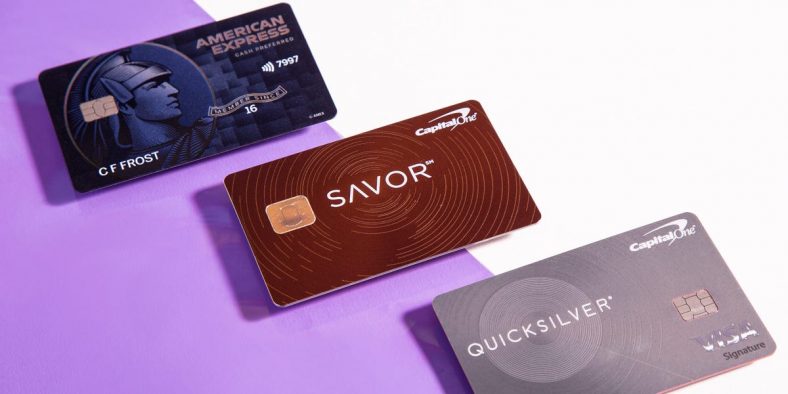
The Capital One SavorOne Cash Rewards Credit Card seems almost custom-made for folks who like to get out and experience life to the fullest. If you’re a foodie, love attending concerts and sporting events, or even enjoy entertaining at home, this no-annual-fee card can help you earn a lot of rewards for your spending.
Cardholders earn 3% cash back on dining, at grocery stores (excluding superstores like Walmart and Target), entertainment, and popular streaming services, and 1% cash back on all other purchases. The Capital One SavorOne Cash Rewards Credit Card recently began offering 5% cash back on hotels and car rentals booked through Capital One Travel and 8% cash back on Capital One Entertainment purchases, and there’s a promotion to earn 8% cash back on Vivid Seats purchases through January 2023.
The welcome bonus is generous, too: Earn a one-time $200 cash bonus once you spend $500 on purchases within the first 3 months from account opening. And if you’ve got big purchases coming up, a 0% intro APR on purchases and balance transfers for 15 months (3% fee on the amounts transferred within the first 15 months) (followed by a 16.49% – 26.49% (Variable) APR) can make it easier to spread out your payments.
This card offers a handful of good benefits, including extended warranty, travel accident insurance***, and travel emergency assistance services. As with all other Capital One cards, you won’t pay foreign transaction fees on international purchases, so it’s great to use when you’re out globetrotting.
Read more about the Capital One SavorOne Cash Rewards card:
For a more hands-off approach to maximizing your rewards, the Citi Custom Cash℠ Card offers 5% cash back on up to $500 in purchases in the eligible category you spend the most in each billing cycle (then 1%), and 1% on all other purchases. It also comes with a decent welcome offer for a no-annual-fee card: $200 in cash back, fulfilled as 20,000 ThankYou® Points, after you spend $750 on purchases in the first 3 months of account opening.
If your spending habits tend to change from time to time, this card is worth a look — especially because the list of eligible categories includes lots of common expenses.
While the Citi Custom Cash℠ Card is advertised as a cash-back credit card, it actually earns Citi ThankYou points. You can redeem your points for cash back, travel booked through Citi, gift cards, merchandise, and more at a rate of 1 cent per point.
However, you could potentially get more value from your rewards if you also have the Citi Premier® Card or Citi Prestige® Card
(no longer available to new applicants). That’s because you can pool your points in either of these card accounts and then transfer them to airline and hotel partners, including JetBlue, Singapore Airlines, Virgin Atlantic, and Wyndham Rewards.
One of the newer types of cards offers the ability to choose your own bonus categories, and they’re a great way to maximize your cash back by earning the highest rewards on the purchases you make the most. The U.S. Bank Cash+® Visa Signature® Card leads the way in this regard, because it offers 5% cash back on two eligible categories (from a list) of your choice, on up to $2,000 in combined purchases each quarter (then 1% back).
Cardholders also get to choose a 2% cash back “everyday” category from gas and EV charging stations, restaurants, or grocery stores, and earn 1% cash back on all other eligible purchases.
New cardholders can earn a $200 bonus after spending $1,000 in eligible purchases within the first 120 days of account opening, which is a solid offer for a no-annual-fee card. After opening your account, you’ll also qualify for a 0% intro APR on purchases and balance transfers for the first 15 billing cycles (then a 15.99% – 25.99% (Variable) APR).
As a Visa Signature card, it comes with additional perks including Visa Signature concierge and Visa Signature Luxury Hotel Collection access, travel and emergency assistance, and roadside dispatch.
The Citi® Double Cash Card was once our overall favorite flat-rate cash back card, but it’s since been overshadowed by the Wells Fargo Active Cash® Card, which offers a welcome bonus, more benefits, and the same effective cash rewards rate on purchases.
That said, the Citi® Double Cash Card has an advantage if you’re looking for a long intro 0% APR on balance transfers. New cardholders get a 0% intro APR on balance transfers for 18 months (then a 15.49% – 25.49% Variable APR).
This no-annual-fee card earns 1 point per dollar as you spend, and 1 point per dollar when you pay your bill (worth a total of 2% cash back).
The Citi® Double Cash Card doesn’t offer a whole lot of other benefits, so it makes the most sense if you’re specifically after a generous balance transfer offer (or want a card that earns Citi ThankYou points to boost your stash — yes, you can combine the points from this card with other ThankYou points-earning cards like the Citi Premier® Card).
If you’re new to credit or working on building (or rebuilding) your credit score, it’s quite possible you’ll fall into the “fair” credit range. Fair or average credit is defined as any FICO score between 580 to 669 on a 300 to 850 scale, and unfortunately, there aren’t as many good options for earning credit card rewards if that’s where your score lands.
That said, a handful of credit cards for fair or average credit do come with decent earning rates, albeit without a welcome bonus. The Capital One QuicksilverOne Cash Rewards Credit Card is among the best of the bunch, offering 1.5% cash back on all eligible purchases (with the exception of hotels and rental cars booked through Capital One Travel, which earn 5% cash back), with no caps.
As with many cards geared to those with lower credit scores, the Capital One QuicksilverOne Cash Rewards Credit Card charges an annual fee ($39). But, like other Capital One cards, it doesn’t add any foreign transaction fees to international purchases, so it’s a safe bet to use abroad.
If you have a bad credit score or a limited credit history, you may not be approved for some of the other cash back credit card options outlined in this article. In that case, the Discover it® Secured Credit Card could make the most sense.
Since it’s a secured credit card (meaning you put down money as a refundable deposit to “secure” your account), it’s easier to get approved for this card. With the Discover it® Secured Credit Card, automatic reviews start at eight months to see if Discover can transition you to an unsecured line of credit and return your deposit.
Applying for a credit card when you’re still in college can be a little tricky because most students don’t have a long credit history or high credit score. Student credit cards are more accessible because they typically only require fair or average credit to get approved.
The Capital One SavorOne Student Cash Rewards Credit Card is a great choice if your spending habits are typical of many college students. It earns 3% cash back on dining (including restaurants, bars, cafes, and lounges), at grocery stores (except superstores like Walmart and Target), entertainment (such as movies, professional sporting events, and amusement parks), and popular streaming services (like Netflix, Hulu, and Disney+).
It also earns 5% cash back on car rentals and hotels booked through Capital One Travel, 8% cash back on Capital One Entertainment purchases, and 8% cash back on Vivid Seats purchases (through January 2023). All other purchases earn 1% back.
This card comes with built-in travel and purchase coverage you don’t often find on student credit cards, including price protection***, extended warranty***, car rental insurance***, roadside dispatch***, and travel accident insurance***. There are no foreign transaction fees to worry about, so if you’re heading out on a study-abroad program or plan to travel during your summer breaks, using your card won’t result in extra charges.
Read more about the Capital One SavorOne Student card:
On the surface, the Bank of America® Unlimited Cash Rewards Credit Card
doesn’t particularly stand out. It earns 1.5% cash back on all purchases and comes with a welcome bonus of $200 online cash rewards bonus after making at least $1,000 in purchases in the first 90 days from account opening — a decent return, to be sure, but not more compelling than similar cards.
But the card has one feature that can make it a lot more appealing if you’re already a Bank of America customer. Bank of America Preferred Rewards members can earn 25% to 75% more cash back with this card, depending on their rewards tier. Effectively, Preferred Rewards members at the highest level can earn 2.625% cash back on all purchases, which is hard to beat for a no-annual-fee card.
The Bank of America® Unlimited Cash Rewards Credit Card can also be a good choice if you’re looking for an intro APR offer. New cardholders receive a 0% intro APR for your first 15 billing cycles for purchases, and for any balance transfers made within the first 60 days of opening your account, followed by a 13.99% – 23.99% Variable APR.
Read more about the Bank of America Unlimited Cash Rewards card:
Popular cash back credit cards that did not make our list
We evaluated dozens of cash back credit cards and chose 13 of the very best in the most broadly useful categories for our list. Several other cards were on our short list, and they’re all very good in their own right, but for various reasons they didn’t quite cut it.
Here are some of the cards that didn’t make it, and why:
Capital One Savor Cash Rewards Credit Card — While it offers a bigger welcome bonus and slightly stronger rewards rate than its sibling, the Capital One SavorOne Cash Rewards Credit Card, it also charges a $95 annual fee. You’d have put a lot of spending on the card to justify the extra cost, so for most folks the no-annual-fee version is a better deal. Here’s our Capital One Savor card review.
Bank of America® Customized Cash Rewards Credit Card — This card is good for choosing your own bonus categories, but you’ll only earn 3% cash back in the category of your choice, versus two 5% cash-back categories of your choice on the U.S. Bank Cash+® Visa Signature® Card. That said, if you’re a Bank of America Preferred Rewards member, this card could be a lot more lucrative. Read our Bank of America Customized Cash Rewards review to find out more.
Capital One Quicksilver Cash Rewards Credit Card— This card is a decent choice if you’re looking for a card that earns 1.5% cash back on most purchases, but other cards, like the Chase Freedom Unlimited® and Wells Fargo Active Cash® Card, offer opportunities to earn more rewards and benefits. You can find side-by-side comparisons in our Capital One Quicksilver review.
Blue Cash Everyday® Card from American Express — This is decent option if you want a card with no annual fee that earns bonus rewards on groceries, gas station purchases, and online retail purchases, but the 3% cash back it earns at US supermarkets only applies to the first $6,000 spent each calendar year (then 1% back). To compare, the Capital One SavorOne Cash Rewards Credit Card earns an unlimited 3% on groceries worldwide, plus on dining, entertainment, and eligible streaming. Here’s our Amex Blue Cash Everyday card review if you want to learn more.
Amazon Prime Rewards Visa Signature Card — If you’re an Amazon Prime member, earning 5% cash back at Amazon and Whole Foods with this card is hard to beat (and 2% back at restaurants, gas stations, and drugstores is nothing to sniff at, either). But if you’re not a Prime member or don’t spend a lot at Amazon, other cards are probably a better pick. Check out our Amazon Prime Rewards card review for a closer look.
About cash back credit cards
Cash back credit cards can be an easy way to break into the world of credit card rewards. They come in a few different types:
Flat rate — These cards earn the same rate of cash back on all purchases. For example, the Chase Freedom Unlimited® earns 1.5% back on most spending (the Freedom Unlimited also offers bonus cash back on eligible travel and drugstore purchases).
Select bonus categories — Many other cash back cards offer bonus cash back (more than 1%) on select spending categories. For example, with the Capital One Savor Cash Rewards Credit Card, you’ll earn 4% back on dining, streaming services, and entertainment, and 3% back at grocery stores.
Rotating categories — A few cards, including the Chase Freedom Flex℠, offer bonus cash back on a selection of spending categories that changes every quarter of the year. These cards have a cap on how much bonus cash back you can earn each quarter — with the Chase Freedom Flex℠, you’ll earn 5% back on up to $1,500 in combined purchases each quarter (then 1%).
Some cards are starting to offer yet a fourth format for delivering cash back rewards: pick your own bonus categories from a list of options. These cards include the Bank of America® Customized Cash Rewards Credit Card and the U.S. Bank Cash+® Visa Signature® Card.
If you’re willing to juggle multiple credit card accounts, there’s value in having both cash back and points-earning cards. If you prefer a single-card strategy, evaluate your goals and consider how much you’re willing to pay in annual fees to make the best decision for your situation.
If you’re trying to put money back in your wallet, our top recommendations are to transfer your cash back to a bank account or use it to reduce the amount owed on your credit card statement.
The best cash back card is different for everyone. To find the best one for you, you’ll want to look for a few things:
The cash back rate for your common spending categories. Extra cash back for gas isn’t much use if you don’t drive. Consider how you intend to use this card, and look at the rate for those spending categories.
How you redeem your cash back. Make sure you’re clear on what you’re earning. Is it statement credit? Cash? Points? If points, can they be combined with or transferred to other cards you have, or brands you like?
The annual fee. An annual fee may make or break your choice. Are you willing to pay one? And more importantly, can you afford it comfortably — or will it be effectively wiped out by the cash back you’ll earn in a year?
We don’t mention the APR because the rate only applies if you’re carrying a balance on your credit card. We recommend applying for a cash back credit card intending to pay off the balance in full each month. For other categories of credit cards, like balance transfer cards, the APR might be a more important consideration.
If this all sounds too complicated, you can’t go wrong by using the Wells Fargo Active Cash® Card, which has no annual fee and a flat earning rate 2% cash rewards on purchases.
Cash back credit cards are often best used in combination with cards that earn points to create a complete credit card portfolio that takes advantage of multiple types of rewards. If you’re trying to decide whether to open a cash back credit card, whether as your first card or one of many, bear these pros and cons in mind:
Pros of cash back credit cards:
They rarely carry annual fees
There are no restrictions on how you can redeem and spend the cash
You can earn airline and hotel status by booking with cash (but not points)
Cons of cash back credit cards:
If you have a cash back credit card or are considering opening one, you’ll want to make the most of it. Keep the following steps in mind to get the most value from your card:
Always pay the balance in full. Credit card cash back or points aren’t useful if you’re carrying a balance and paying interest charges each month. To make the most of rewards, use your card responsibly: Spend only money you have and pay your bill in full each month.
Read up on rewards rates for different spending areas. Some cash back cards offer elevated rewards rates on specific spending areas, like restaurants, gas stations, or supermarkets. Some of these cards even change those areas from quarter to quarter, meaning you’ll want to stay on top of where your card earns the most and when. If you’re using this card for every purchase, you don’t need to be as diligent, but if you’re using your card as one of many you’ll want to be sure you know how to maximize rewards.
Make sure to redeem your cash back. It might be tempting to let your cash back pile up just to watch the total tick up, but it’s more useful if you redeem it. You can generally apply the cash to your card balance or get it deposited in your checking account, and either one is a fine option.
Consider opening a “sister” card. As mentioned above, in some cases, you can transfer cash back to a points-earning card on which your rewards are worth more. Chase cards are an example of this: If you hold a cash back card like the Chase Freedom Flex℠ and a points-earning card like the Chase Sapphire Preferred® Card, you can transfer cash back earned on the Freedom Flex (which is technically earned in Ultimate Rewards Points) to the Sapphire Preferred, and unlock more redemption options. This strategy isn’t required to make the most of your cash back card, but it can help take rewards to the next level.
Insider’s methodology for picking the best cash back credit cards
In terms of flexibility, cash back is the king of credit card rewards. Many cash back credit cards give you the option to redeem your accrual as either cash, a statement credit, or a transfer to your bank account.
Remember that a credit card — cash back or otherwise — won’t be worth it if you’re paying interest or late fees. When using a credit card, it’s important to pay your balance in full each month, make payments on time, and only spend what you can afford to pay.
Cash back cards vary greatly in their return rates — you can earn anywhere from 1% to 6% back. Even better, many cash back cards have no annual fee, so you don’t have to pay for the privilege of earning rewards.
If you’re new to rewards credit cards and aren’t interested in earning travel points or miles, a cash back card is the best option for you. With cash back cards, 1% back will always be 1 cent back, no matter what, and you can use your cash back to lower your monthly bill or transfer it to your checking account, among other options.
The best cash back credit card for you depends on your spending habits and if you prefer a flat rate of cash back on all spending or earning bonus cash back on specific types of purchases. Flat-rate cash back cards are best for those who don’t want to keep track of multiple bonus categories and just want a simple earning structure.
But if you really want to maximize your rewards earning, choosing a card that earns bonus cash back in categories where you spend a lot — like groceries, dining, or gas — can make a huge difference in your rate of return.
We narrowed down the dozens of cash back credit cards currently available to new applicants by looking at a few factors:
Ease of use — Are there any hoops to jump through, like needing to be a member of a specific bank?
Cash-back earning potential — How much cash back can you earn with this card, and how broad are the bonus categories?
Annual fee — Many cash back cards waive an annual fee, but for the few that do charge a fee, is it justified based on the card’s rewards?
Options for various types of consumers — We wanted our top cash back card picks to reflect different types of users, from families looking to maximize grocery spending to those looking to rebuild their credit score.
Cash back credit cards frequently asked questions (FAQ)
How does earning cash back work?
Cash-back credit cards earn you a percentage of cash back — usually at least 1%— on every dollar you spend (or more with cards that have bonus cash back categories). You can transfer the cash back you earn from these cards to a bank account, use them to wipe charges from your credit card statement, or redeem them for gifts and merchandise.
Do cash back cards actually give you cash?
Cash-back credit cards do give cash, but that’s not to say you’ll necessarily see the physical cash. You’re typically awarded cash back as a credit that you can use to cancel out purchases from your credit card statement, or to redeem for gift cards or merchandise online.
What are the different types of cash back cards?
The different types of cash back cards are those with a flat rate, those with select bonus categories, those with rotating bonus categories, and those with pick-your-own bonus categories — a relatively new and somewhat limited option.
What credit card offers the most cash back?
The Blue Cash Preferred® Card from American Express earns 6% back on the first $6,000 you spend each calendar year at US supermarkets (then 1% back), and 6% back on select US streaming services, for example, and the Capital One Savor Cash Rewards Credit Card is the most rewarding pick for dining out with 4% back. Different cards earn the most cash back in different categories, so you’ll want to factor in your spending habits and preferences when deciding which cash-back card makes the most sense for you.
Is a cash back card better than a travel or rewards card?
A cash back card could be better than a travel or rewards card, depending on what you want to do with your rewards. If you primarily want to put money back in your bank account rather than earn rewards you can redeem for travel, a cash back credit card could be better — and you usually won’t have to pay a very high annual fee, if you have to pay one at all.
How to find the best cash back credit card
A good cash back card is one with generous bonus categories, since the goal is to earn as much cash back as possible on your spending. The more bonus categories, the better, and the higher the cash back rate, the better. The best card for you depends on the cash back rate for your common spending categories, how you want to redeem your cash back, and what you’re willing to pay in annual fee.
What are the pros and cons of a cash back credit card?
The pros of a cash back card include that they rarely carry annual fees, there are no restrictions on how you redeem and spend the cash, and you can earn airline and hotel status by booking with cash (but not points). The cons of a cash back card include that they rarely offer large sign-up or welcome bonuses, and that cash back is generally less valuable, dollar for dollar, than points.
How can you make the most of a cash back credit card?
To make the most of a cash back credit card, always pay the balance in full each month. Also, read up on rewards rates for different spending areas (some cards offer elevated rates in areas like restaurants, gas stations, or supermarkets). Make sure to actually redeem your cash back instead of letting it pile up, and consider opening a “sister” card from the same issuer to transfer points and miles to where they’re worth the most.
We named it Facial Recovery Oil, but our customers call it “Liquid Gold.” For adoring fans, this extraordinary golden oil is one of our most popular and revered products, holding a near-cult status. The benefits of this miraculous facial oil extend far beyond moisturization. This oil, made from organic and Biodynamic® ingredients, solves a whole host of problems on your face and body.
Need to know more? First, let’s take a glance at the reason this skin care product is so unique and effective. Then we’ll do a deep dive into the seven ways to use Facial Recovery Oil that you may not have known about.
One of the greatest overall benefits of Facial Recovery Oil? The fact that it is part of Eminence Organics’ award-winning Beyond Organic Collection. The products in this collection are made with certified Biodynamic® ingredients — meaning not only are they free from synthetic chemicals, as all of our organic products are, but they are also grown in a closed loop farming method to ensure a farm’s health and longevity.
Instead of approaching farming as a means to an end (like many modern-day farming practices), the Biodynamic® farm is a beautiful, intricate ecosystem buzzing with plants and wildlife. The Biodynamic® farmer works in harmony with the natural cycles of the sun, moon and stars to bring each plant to their highest nutritional potency. The farmer adapts sustainable practices to yield the healthiest crops while protecting and healing the earth, using only natural solutions from within the farm.
The result is the pure and potent ingredients found in our Beyond Organic Collection, like the age-defying clary sage, balancing ylang ylang and olive and sesame oils found in our Facial Recovery Oil. Each product contains nourishing ingredients that are even higher in vitamins, nutrients and active compounds than traditional organic ingredients. Studies have shown Biodynamic® ingredients on average contain 30% more antioxidants and 47% more Vitamin C.
In an In The Mix video below, our Lead Skin Care Trainer, Natalie Pergar, explains more about these precious facial oil ingredients as well as when and how to add facial oils to our skin care routine.
TV personality Whitney Port recommends the oil on her blog and podcast, With Wit. She says, “… the [product] that I’m loving right now is the Eminence [Facial Recovery Oil]. [It’s] a natural face oil that’s just so luxurious and radiant and I use it at the end [of my regimen] especially when I want even more of a glow …”
The oil’s skin care effects were also noticed by Hollywood star Cameron Diaz who recommends keeping her favorite oil in her beach bag: “A drop goes a long way to relieve any dryness in your skin from the sun and water. A drop on each cheek after your shower will do wonders.”
7 Ways To Use Facial Recovery Oil
1. Signs Of Aging In The Neck Area
The Facial Recovery Oil has many uses, and one of them is to moisturize and tone the skin in the neck area. Due to the oil’s olive and sage leaf ingredients, regular use improves the visible signs of aging on the neck, giving the delicate skin a plumped up glow.
2. Keratosis Pilaris
Have you ever worried about “chicken skin?” These bumps are formally known as keratosis pilaris, which build up in hair follicles, often in the arm, thigh or bottom area. A lack of sebum and fatty acids cause these protein plugs. Should you want to target this issue, a liberal use of Facial Recovery Oil melts the look of these bumps away.
3. Puffy Eyes And Crow’s Feet
Did you know that Facial Recovery Oil especially benefits the eye area? Its key ingredients hydrate the undereye intensely to reduce the appearance of fine lines and puffy eyes. A combination of clary sage oil, sage leaf extract, olive oil and ylang ylang calms and soothes the skin’s appearance while deeply hydrating the complexion. Since there are less oil glands around the eyes, the oil delivers the extra moisture needed in an area extremely prone to dryness.
4. Chapped Lips
Free from parabens, perfumes, and harsh chemicals, Facial Recovery Oil soothes dry, chapped lips. When environmental stressors or dry climate chafe your lips, the oil relieves your pucker with a single drop. Afterwards, plump up your lips with our Marine Flower Peptide Lip Serum for a smoother-looking pout.
5. Dry Cuticles
After applying facial oil to your complexion, why not rub the remaining traces into your cuticles as well? Soften irritated dry cuticles and ensure your nails stay hydrated, healthy and strong.
6. The Look Of Uneven Skin Tone
Vitamin E and the herbal ingredients in Facial Recovery Oil target the look of uneven skin tone on your cheeks. With regular use, skin appears smoother, more even and refreshed. Beauty editors at The Fashion Spot testify, “We discovered this oil three years ago and can’t imagine life without it.”
7. Stretch Marks And Surgical Scars
For skin issues like stretch marks and surgical scars, intense moisture from Facial Recovery Oil increases elasticity and improves the look of firmness in the skin. Clary sage oil, a key ingredient in this formula, contains hydrating properties which is important for improving the look of damaged skin.
How do you use your bottle of Facial Recovery Oil? Let us know in the comments below or join the conversation on social media.
This article was originally written in November 2015.
Photographs by Atul Kasbekar. Styling by Nisha Jhangiani. Make-up by Mahendra Gupta. Hair by Madhuri Nakhale. All furniture, from Eastern Treasure Lifestyle, Mumbai.
This feature was originally published in Verve Magazine’s Volume 12, Issue 4; September-October 2004.
Rust silk ruched gown, by Shantanu And Nikhil; white and brown diamond bracelets and earrings, all from Royal Orchid Jewellery, Mumbai. Silver heels, by René Caovilla, Venezia. Diamond solitaire ring, Sushmita’s own.
Forget her forgettable Bollywood roles; forget her impactful presence in Main Hoon Na — more lofty presentation than talent; forget her Miss Universe status as old hat; and the fact that we applauded her for adopting little Renee, against all odds…. And then, having peeled off these obvious layers, discover the goddess. Love the fact that she thinks about things with a quicksilver mind, that she quotes from popular songs that somehow add meaning to her life, that she smacks you with a forehead kiss the first time she sees you, that she throws herself wholly into whatever it is she is doing. And, that her rare beauty draws you in, warming instead of leaving you cold.
She does not see herself as a goddess until a naughty thought occurs — why not the deity of everything. Why not Ma Durga herself. She who is the amalgamation of seven gods, drawing into herself the power of every element that exists or does not exist. “For, from her brow arose the goddess Kali; her mind symbolises Saraswati, the goddess of learning….” Suddenly, she discovers herself among the pantheon of the elevated, the exalted, the divine…and isn’t she just loving it!
Earlier this year, she reaffirmed to herself, her select status of goddess incarnate. A freak accident on the sets at Films Division, saw her in hospital, thrown by a huge fan. The verdict, protrusion of the spine, of the worst kind. She dreamt of a black stone with a red tikka, so like a photograph, that ‘where is this place?’ she asked. Soon she was heading for Vaishno Devi — by chopper, since she could hardly walk. Bad weather and a VIP visit, however, ordained that she trudge barefoot, seven hours at a stretch. After some initial difficulty, “I was walking so fast that I unknowingly left my family behind. Mobbed by people, I could not see them anywhere and it took them 45 minutes to catch up. Back in Mumbai, the X-rays pronounced a near perfect spine. A miracle…?”
In the large and comfortable trailer that is her rarefied preserve, she is visited by a rapturous lady. Unbidden tears spring to the young fan’s eyes. “How wonderful to be free to emote what you actually feel,” says her idol. Making me think, more than anything, here is the goddess of illusion — in real life as much as on celluloid. Verve endeavours, through the power of the elements that represent the gods, to demystify the seraphic ‘Sush’.
Airy Faerie
“Air symbolises life, freedom, to me. In the last 10 years, I have valued nothing more than freedom. When I had (adopted) my daughter, my mom and dad sat me down and said, you now have a responsibility, you will have to curb yourself. But, being a mother does not mean that I sacrifice myself. I must live my life as I do and share it with someone else. Air, which has been shut in a room, goes stale. It must spread all around. In a strange way, air also symbolises to me the mind and dreams. Like air, the mind is free to go where it likes and where it is driven.”
Cream georgette pleated jacket, gold sequinned bra, tulle net horse-riding pants with shiny velvet embroidery, by Pria Kataria Puri; ‘Sassy’ three-row necklace in yellow gold with amethyst, pink tourmaline and freshwater cultured pearls, from Bvlgari’s Allegra collection, New Delhi. Freshwater pearl ring and Victorian pearl, blue sapphire and diamond ring, at Vipul Arts, Mumbai. Gold shoes, by Enzo Angiolini.
Grounded or in the air? I am an extremely passionate person. When I am grounded, I am one hundred per cent grounded and when I let go, there’s no grounding me.
Personal style Asleep at night, I must be as invisible as air. I am very delicate and vulnerable when I sleep. I wear things that are almost not there — soft satins and silks.
What blows me away A well-mannered man…A moment that overwhelms me…A child’s innocence…A rare, momentary feeling of helplessness…When a man loves a woman more than she loves him…And, if I decide to have a child biologically, outside of marriage, my mom will blow me away!
My autobiographyButterfly, with only the last line already written. ‘What the world calls the end of a caterpillar’s life, God calls a butterfly’.
Fiery Aphrodite
“Fire, to me, is courage, a killer instinct, the power to go for what you want instead of merely wishing for it. Determination, too, is very fiery.
I am a very romantic kind of person. Life becomes far more exciting to bear and to live, when you romanticise it.”
Unbeatable romantic fantasy I like abandoned places, when it comes to romance. Places that have a lot of silence so that when the man breathes next to you, you can hear it. Like the people who came with us, forgot to take us back.
Flaming attribute I never leave things halfway. I genuinely do not have a single thing in my life that I did not finish. Even like making a mistake, I make it completely.
Raging thoughts… I want to do La Femme Nikita, a French film, a classic, an action film…. I quite liked myself in Main Hoon Na…. My favourite painting, ‘The Sage’ by Prashant Hirlekar, gifted to my solicitor…. I collect old windows of churches; at Chor Bazaar, they call me as soon as they hear of one…. Hispanic men are hotter than Italian men, they have a soul…. I like designers Roberto Cavalli, Gianfranco Ferre; Neeta Lulla and Manish Malhotra for my films; Malini Ramani and Sabyasachi for myself…. Wearing a G-string is like being in a bad relationship.
Hottest part of my anatomy My mind because you can try everything with it and never really know it. Live with it, talk with it, stimulate it but it always remains free. My mind is a mystery to me also.
Favourite song Baz Luhrmann’s ‘Everybody’s Free (To Wear Sunscreen)’.
Golden halo Highlights by Adhuna Akhtar.
Electric quote from a mum (Shubra Sen) “She has always had this effect on people, that she draws them to her….”
Earth Mother
“Earth symbolises stability, the perception of being grounded. A sense of nurturing, of being a mother. Also, all our materialistic instincts and desires. Desires are an important aspect of life.
I love nature, I am very close to it and I am a big nature watcher. Nature, of course, symbolises earth. Earth is also a school that you learn from.”
Off-white and beige georgette blouse and skirt with satin belt, Gauri and Nainika Karan for Magnetic Rag; uncut diamond pendant with pink tourmalines (used as brooch) and uncut diamond purple ‘archery’ thumb ring, both at Vipul Arts; kundan, emerald and ruby pendant (used as brooch) and kundan and semi-precious stone kada, both at Jaipur Gems. All in Mumbai. Beige sandals, by Gucci.
Mother goddess Two months ago, I entered the kitchen for the first time. My daughter had insisted that I make breakfast for her. I was on the phone the whole time with a friend to figure the egg part of it. The kitchen was a mess. The breakfast, mediocre. My daughter loved it.
Standing tall Five feet, eight inches in my socks. With shoes, the sky’s the limit.
Personal style At home, I am very grounded…a very jeans and ganji kind of person.
Grounded thought A goddess must be very approachable. If you cannot reach her, how will you look up to her?
Earthy decision Rather than a wishy-washy heroine, I prefer to play the other woman and make it more exciting for everyone concerned.
Elemental calculation The beauty of all the elements is that they teach you that nothing is permanent. The nature of existence is momentary. Air can be vacuumed, earth consumed by water, water evaporated, fire extinguished. But, in their moment, their existence is complete, teaching you to live in the present.
The rock How dare the media credit some high-flying industrialist for giving me this ring! Surely I can buy it for myself.
Water Nymph
“The greatest part of being a woman is being a nymph. One of the joys of womanhood is being very light-footed. It is part of her poise to be nymph-like.
Younger, I had a very bad temper. I teased my mom that the temper side of me is Kali. Then, I thought that I should be rock steady as a mountain. Now, I realise that I would rather be flowing water, since water can cut through mountain. The temper part of me was mountain. The endurance part of me, that my daughter has taught me with her endless questioning and wonder of things, is flowing water.”
Aqua corset with bead, crystal and sequin embroidered net sleeves and layered georgette skirt (stole not shown), by Suneet Varma; Peridot and crystal silver and gold rings, at Vipul Arts, Mumbai. Diamond studs, Sushmita’s own. Blue beaded shoes, by René Caovilla, Venezia.
Water sign Scorpio
Teary moment I always wanted to be a princess. When I finally wore the crown (Miss Universe 1994), I held my mother tight all night long, howling and saying now finally I am a princess.
Seafood Sushi, my most favourite food in the world. I enjoy my sushi in a particular way — there has to be mayonnaise in it, caviar all around it….
Cool description of self I am a thin, lanky girl.
Personal style When I present myself to the world. I am like water — very ‘flowey’, very fluid.
Famous last line No one is perfect. I am the goddess of imperfection.
In the age of technology, focusing on our work or studies has become an increasingly more difficult task. There are countless distractions to throw us off from our work and lead to the dreaded effects of procrastination. A simple notification from social media or a text message from a friend can guide our attention astray for longer than we may intend. While there are countless tips and tricks to keep our focus on what is necessary, one scientifically proven method to aid in concentration is through music.
You have likely heard that music can help you study or work better. But why is that? Studies show that music has a variety of advantageous impacts on the human mind and body. Both the left and right parts of the brain are simultaneously stimulated by music, and this dual stimulation can boost learning capabilities and enhance memory.
Some of these advantageous impacts are as simple as improving our mood. We benefit from listening to our favorite songs while working or studying because music can boost the brain’s production of the hormone dopamine, resulting in decreased feelings of anxiety or depression, as well as relieving symptoms of stress. Think about how difficult it is to try to focus on work when you’re unhappy, frustrated, or in a bad mood. Music is processed directly by the amygdala, the part of the brain involved in mood and emotions, and by stimulating your amygdala, you are essentially putting yourself in a better mood and are therefore more likely to thrive in your studies.
During lengthy study sessions, it is often difficult to find the motivation to persevere on a particular task you’re working on. Having some background music may help with this as music can aid endurance, resulting in improved focus and greater motivation. In some cases, students have found that music helps them with memorization. This is likely because music not only creates a more positive mood, but it stimulates the brain which in turn enhances memory formation.
With a reduced amount of stress during an academic task, the brain is able to be more clear and allow for new information to flow in, thus helping to more easily process any information that requires thinking. This is also why music may help with memory; listening to music reactivates areas of the brain associated with memory, reasoning, speech, emotion, and reward. It is essentially a total workout for your brain. Research has shown that listening to music can enhance sleep quality, mood, mental clarity, and memory while lowering anxiety, blood pressure, and pain or discomfort.
Back in school, we learned various songs in order to memorize particular things. The 50 States Song, the US President’s Song, and none other than the ABC’s. Maybe you even learned one about the planets in our solar system, or perhaps a tune about math or grammar. Our minds can retain so much information when we add a little jingle to it.
Two recent studies — one in the United States and the other in Japan — found that music not only aids in the retrieval of previously stored memories, but also aids in the formation of new ones. It has also been found that music enhances the memory of Alzheimer’s and dementia patients, including a study conducted at UC Irvine, which showed that scores on memory tests of Alzheimer’s patients improved when they listened to classical music. Music evokes memories because when a piece of music is paired with an event or feeling, it can be an effective cue to bring back the strong emotion that was felt at that moment. Our senses are very powerful tools for our brain.
The best type of music to listen to for maximum benefits in study or work will depend on the individual. The reason we always hear that classical music or symphonies are great for studying is because they don’t have any lyrics, as lyrics can be distracting. It is also said that classical music helps fire off synapses, creating or re-energizing brain pathways previously left dormant, as well as improving hearing, spatial reasoning skills and even general intelligence. This is called the ‘Mozart effect’ and many parents believe playing their children classical music will significantly improve their cognitive abilities. Through a series of studies from scientists at UC Irvine, a group of children listening to Mozart and other music versus children with only silence were surveyed, and it was found that the Mozart group showed significantly increased spatial reasoning skills for at least 10-15 minutes.
However, the results of the study have proven to be controversial. Most of the criticisms of the findings argue that the ‘Mozart effect’ is due to the subjects’ enjoyment and appreciation of the music, rather than any mysterious effect Mozart’s music might have on the brain.
“Those who listened to music, Mozart or something else – Bach, Pearl Jam – had better results than the silent group. But we already knew people perform better if they have a stimulus,” Jakob Pietschnig, who led the study, told The Telegraph.
Relaxing music is a good choice for managing stress, whereas upbeat music might boost a person’s thinking processes. Perhaps opt for instrumental music without lyrics if you get easily distracted. If you want to work or study effectively with music, try reducing how distracting music can be, and increase the level to which the music keeps you in a good mood.
Whatever type of music you may like, it is pretty clear that listening to background music while working or studying has a host of benefits and may very well result in improved mood, memory, focus, and other cognitive abilities, as well as lessen the likelihood of stress, anxiety, and depression. Find what works for you and tackle that task with everything you got!
Phiaton offers a wide range of products suitable to help you study or work better. Check out some of the active noise cancellation products such as the 900 Legacy headphones, which feature memory foam ear pads to provide a comfortable fit and proper ear insulation for optimal sound quality. Oddict’s TWIG PRO earbuds are another great choice for minimizing the hustle and bustle of the outside world so that you can get your work done. TWIG PRO’s feature silicone ear tips which enhance sound insulation and provide a snug fit, all while delivering distortion-free sound reproduction. Lastly, Phiaton’s BonoBuds provide a custom made and true sounding listening experience that is perfect for travel, work, entertainment, and everything in between. With 20 hours of battery life, these buds are perfect for all day use when you need to sit down and focus. Power through procrastination with one of these fantastic options for music to get your work and studies completed.
Many dogs will be one-time offenders for pancreatitis, while others will struggle with symptoms for their entire lives. Understanding pancreatitis signs and symptoms, the diagnostic process, as well as dietary and holistic management, are important steps toward helping your dog manage the pain.
What does the pancreas do?
The pancreas is an organ located to the right of the stomach that plays an important role in the digestive health of your dog. It produces enzymes that aid in digestion and insulin to regulate blood sugar.
Pancreatitis is defined as inflammation of the pancreas and can present acutely or become a chronic disease over time. Many times, pancreatitis is triggered by dietary intolerance and the consumption of high-fat foods. This is why veterinary emergency facilities experience an increase in pancreatitis cases around holidays, when pets typically eat more human foods. Other causes of pancreatitis include genetic predisposition, cancer, obesity, hormonal imbalance like Diabetes mellitus and certain medications. Causes of pancreatitis are often unknown.
Top signs of pancreatitis in dogs
When considering whether your dog is suffering from pancreatitis, look for the most common signs and symptoms. Symptoms of acute and chronic pancreatitis will vary in length and severity.
Acute pancreatitis is a sudden onset of symptoms including:
Persistent vomiting
Abdominal pain
Inappetence or decreased appetite
Dehydration
Extreme lethargy
Chronic pancreatitis persists over a long period of time with symptoms including:
Decreased appetite
Abdominal pain
Intermittent vomiting
Diarrhea
Acute pancreatitis will present with severe symptoms and is more common in dogs than chronic pancreatitis. Chronic pancreatitis may present more subtly and worsen with time. Some dogs with chronic pancreatitis will have periods where they experience more severe, acute symptoms.
How do you diagnose pancreatitis in dogs?
If your dog has pancreatitis symptoms, take him to a veterinarian to determine next steps. During the diagnosis process, you can expect:
Examination. An exam including abdominal palpation will be the first step to diagnosing your dog with pancreatitis. Your vet will collect information about your dog’s diet, including changes in appetite, and history and frequency of vomiting. Before the visit, log these changes, so you are ready to present them during the exam. This timeline could help expedite your dog’s diagnosis and treatment plan.
Bloodwork. Because signs of pancreatitis are often non-specific, your veterinarian may run specific blood tests, which can hone in on a possible pancreatitis diagnosis and rule out other medical conditions and contributing factors.
Pancreatic Lipase Immunoreactivity (PLI) is the most sensitive laboratory test available for dogs with pancreatitis because it assesses lipase levels in the bloodstream. During pancreatitis, normal trace levels of lipase increase considerably. While PLI laboratory tests are highly specific, results take longer to receive than alternative in-house tests, which becomes important when treating a sick dog.
Abdominal Ultrasound. An abdominal ultrasound is a noninvasive diagnostic that assesses organs and structures within the abdomen. This test is around 40-70% sensitive for pancreatitis in achieving a formal diagnosis. Ultrasounds rule out non-related medical conditions that may be contributing to your dog’s symptoms, as well as pancreatic tumors.
Biopsy. If a pancreatic mass is found, it may need to be removed for testing. Biopsy is the most invasive diagnostic test and may be contraindicated (not suggested) for seriously ill patients. Discuss the details with your veterinarian and consider getting a second opinion.
What should my dog eat if he has pancreatitis?
Diet therapy is the most critical component to the prevention and management of both acute and chronic pancreatitis, and it starts with introducing a low-fat diet.
For acute pancreatitis, a low-fat diet will be an important part of your dog’s temporary treatment plan. For chronic pancreatitis, a low-fat diet will be a permanent change.
Such diet changes may include the following:
Low-fat prescription commercial diets. These diets will require a prescription from your veterinarian. Examples of low-fat dog diets include:
Low-fat commercial diets. Most common commercial dog food diets include low fat options. Discuss these options with your veterinarian before use. Some examples include:
Wellness Core Reduced Fat
Blue Buffalo Life Protection Healthy Weight
Canidae Pure Healthy Weight
Instinct Raw Boost Healthy Weight
Low-fat treats. There are many prescription and commercial low-fat treats available. Avoid high-fat table scraps or treats such as marrow bones and opt for homemade treats, such as dehydrated fruits or vegetables, instead. Examples include sweet potato, kale, green beans, carrots and apples. Avoid toxic foods such as onions, garlic and grapes.
Home-cooked diets. Home cooking for dogs with pancreatitis is a great option because you have control over ingredients and can adjust as needed. Using an online resource such as Balanceit.com you can create a home-cooked diet specifically supportive for dogs with pancreatitis that will provide necessary vitamins and minerals.
Communicate with the people in your dog’s life. Providing house guests, family members, pet sitters, veterinary staff, trainers and groomers with alternative, safe treats can reduce pancreatitis symptoms. Environmental management, such as removing access to trash and cleaning the kitchen to prevent counter surfing, is also important.
Are there holistic treatments for dogs with pancreatitis?
According to Dr. Angie Krause, holistic veterinarian and owner of Boulder Holistic Vet, there are some holistic approaches that may support your dog through pancreatitis symptoms.
Dr. Krause’s suggestions include:
CBD has natural anti-inflammatory properties and reduces nausea and pain. Start at the low end of CBD’s dosing range (0.25mg/kg twice daily). Find a reputable CBD product that does not include additional ingredients. Dr. Krause uses HempRx products.
While Dr. Krause suggests all dogs take a quality probiotic, this is especially helpful for supporting the gut health of dogs with pancreatitis. Alternating probiotic strains may be beneficial. Dr. Krause uses Thorne Bacillus and RxBiotics in her practice.
Chinese Herbs. Certain Chinese herbs can work to alleviate pancreatitis symptoms in dogs. Find a veterinarian who practices Traditional Chinese Medicine near you through the Chi Institute website.
Dr. Krause recommends starting with one diet or supplement change at a time, in order to carefully track results.
What online resources are available for pancreatitis in dogs?
Pancreatitis can be an extremely stressful disease to manage and may leave you feeling discouraged and isolated. Online resources, such as Dogs with Pancreatitis on Facebook, which has 5,000 members, connect you with other pet parents going through a pancreatitis diagnosis with their dogs. These groups are an excellent way to expand you and your dog’s team while also supporting other pet parents.
While pancreatitis is a very serious disease, many dogs who experience it will live long and happy lives! Because pancreatitis shares symptoms with many other conditions, it can be difficult to diagnose. Advocating for your dog and educating yourself will give your sick dog the voice he needs.



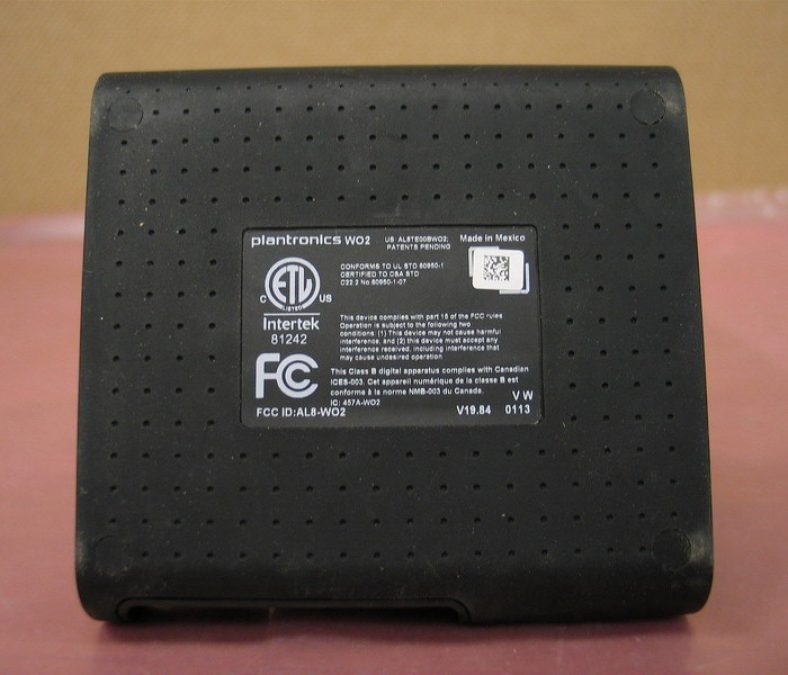
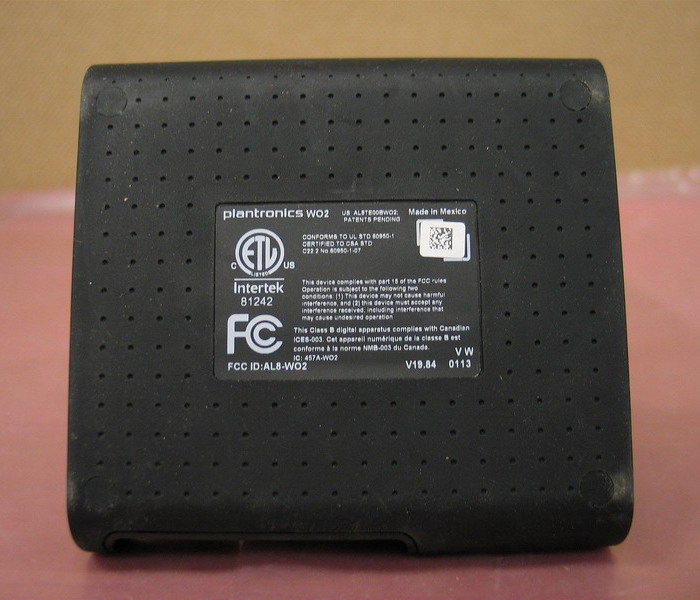



 REMODELED KITCHEN PHOTO CREDIT: