We will explain how to replace the battery on your Savi 8200 headset, this includes UC and Office families. Your battery has to be replaced every 3 years or 300 cycles, whatever comes first to get the best performance of your headset and avoid power downs in middle of calls.
A. Savi 8210 UC and Savi 8210 Office. On this particular model, the battery would be located on the side with only paddling of the headset, not on the speaker side.
First. We remove the paddling of the headset; this part is easy to take off by using a little of pressure as its designed to be removed.
Second, using the included removal tool that comes with the replacement battery we are going to take out both screws on the cover.
Third, with the gate off from the headset take the old battery out and unplug it from the headset.
Next, we install the new battery by plugging it first, then putting the battery inside the headset, following to place the gate with its designed screws and placing the paddling back in place.
B. Savi 8220 UC and Savi 8220 Office. On this model, the battery is located on the opposite speaker from the boom arm. A lot of time people can get confused as the mic boom arm has the call controls and it’s the designated side for charging.
First, we are going to turn the cover of the battery counter clockwise using your fingers only. Don’t use any tool or screw driver to try to open it, as it’s a common mistake that can cause this cover to break and no longer fit on your headset.
Second, using the included tool with your replacement battery, we are taking the tiny screws from the battery gate.
Following, we remove the battery from the headset and we unplug the battery from the connector.
Next, we install the new battery by plugging it first, then putting the battery inside the headset, following to place the gate with its designed screws and placing the cover back in place.
Important note: Make sure to order the proper battery for the headset as even if both headsets (8210 and 8220) share most of components, their batteries have different shapes and don’t fit on the other one.
Multidisciplinary designer Kustaa Saksi has unveiled In the Borderlands, an exhibition of jacquard textiles at the Helsinki Design Museum, which includes a piece featuring scenery generated by AI software.
Conceived as objects that straddle both art and design, Saksi’s large-scale textiles were hung from the ceilings and arranged across various rooms within a gallery at Helsinki’s Design Museum.
Ideal Fall is a duo of tapestries featuring AI-generated imagery
To create his pieces, the designer uses jacquard weaving – a technique invented in 1804 where patterns are woven with yarn using a loom to create a textile, rather than printed, embroidered or stamped onto fabric.
Ideal Fall is a single oversized tapestry featuring bright and abstract forms depicting waterfall- and plant-style forms.
Kustaa Saksi also created a series exploring migraines
Saksi created the colourful textile using AI software, which he instructed to generate images that would depict “ideal” scenes of nature. The designer then picked his favourite suggestions and used the imagery as a stimulus for the tapestry’s patterns.
“The exhibition explores moments between reality and illusion, which are the starting point for many of Saksi’s works,” said the Design Museum.
The tapestries were suspended from the ceiling at the Design Museum
Migraine Metamorphoses is another series of textiles featuring similarly bold designs, which Saksi created to refer to the various phases of migraines – intense headaches that the designer has suffered since the age of seven.
According to the museum, the soft texture of the textiles intends to “mitigate the painful subject matter”.
Monsters and Dreams is a series informed by stories about hallucinations
Often influenced by the boundaries between dreams and imagination, Saksi’s first-ever tapestry series was also on show at the Design Museum.
Called Monsters and Dreams, it is characterised by striking patterns that take cues from hallucinations experienced by one of the designer’s family members. These textiles were draped across or hung from the ceiling of a single room with dark blue walls, which had been painted to enhance the pieces’ dramatic theme.
Saksi has created his pieces in collaboration with Dutch studio TextileLab since 2013.
“The jacquard technique can be referred to as one of the early precursors to the computer,” said the Design Museum.
“It was the first mechanised technique which enabled the transfer of information about a particular pattern to a weaving machine with the help of a punched cylinder, to eventually become a piece of textile.”
The exhibition is on display in Helsinki until mid-October
Throughout the gallery, the textiles were illuminated with controlled levels of lighting in order to preserve their appearance, according to the museum.
Helsinki Design Week takes place from 8 to 17 September 2023 in Helsinki, Finland. See Dezeen Events Guide for an up-to-date list of architecture and design events taking place around the world.
A change may be coming to your streaming services, Warner Bros. Discovery CFO said.
The services have been undervalued, Gunnar Wiedenfels said, and “quality content has been given away”
That could spell price hikes. A bundle of the major streamers already cost 24% more than they did last year.
Thanks for signing up!
Access your favorite topics in a personalized feed while you’re on the go.
You’ve been getting a really good deal on your streaming services — and it may not last too much longer — Warner Bros Discovery’s CFO said.
“For a decade in streaming, an enormously valuable amount of quality content has been given away well below fair market value, and I think that’s in the process of being corrected,” Gunnar Wiedenfels said at the Bank of America Securities Media, Communications & Entertainment Conference last week. “We’ve seen price increases across essentially the entire competitive set.”
Wiedenfels noted what has become more and more evident to Hollywood in the last couple of years: The streaming model — as pioneered by Netflix and adopted by the likes of Hulu, Disney+, and Max — was never meant to last.
For years, the platforms offered libraries of content, including content that was very expensive to produce, for relatively low prices in the hopes of achieving subscriber growth.
As Insider’s Matt Turner summed up: “Streaming services have been underpriced in the name of attracting critical mass.”
It worked: Netflix currently has 238 million subscribers, while Disney+ has 146 million.
But profits have lagged. Disney’s direct-to-consumer offerings, which include Hulu and Disney+, reported a loss of $2.2 billion for the nine months ending in July. Paramount’s DTC business, including Paramount+, lost $424 million last quarter, while Comcast’s Peacock lost $651 million. Warner Bros Discovery posted a $3 million operating loss from its DTC segment in its latest earnings report.
Netflix has been an anomaly in the streaming market in its ability to record a profit.
The solution, Wiedenfels said, will likely be to increase prices — a move a number of streaming giants have already started taking.
The combined price of the major players in the space — Disney+, Hulu, Netflix, Max, Peacock, Paramount+, and Apple TV+ — grew from $76.43 a month to $94.43 a month in the past year, according to analyst Mark Schilsky, a sales specialist at Bernstein Research. This price shift represents a 24% increase, compared to a roughly 3% increase in US consumer prices generally.
In January, Warner Bros Discovery increased the price of an ad-free subscription to HBO Max for the first time since its launch in 2020. This increase arrived before HBO Max and Discovery+ merged to form Max, which costs $15.99 per month for an ad-free subscription.
“In our zeal to grow global subs, I think we were off in terms of that pricing strategy, and we’re now starting to learn more about it and to adjust accordingly,” Bob Iger, the CEO of Disney, told The Wall Street Journal in March.
“I don’t think these companies are done raising prices,” Schilsky told Insider.
Gua sha facials have become the latest viral at-home beauty treatment. Though it’s been trending in recent years, the benefits of gua sha have been observed for centuries. Often done with face oils, one of the benefits of the ritual is that it helps the nourishing ingredients absorb deeper into the skin, creating the look of a smooth, glowing and sculpted complexion. Read on as we explain the function of facial oils and suggest some options that you can incorporate to get the best out of your gua sha facial.
What Is Gua Sha And What Does It Do For The Face?
Gua sha is a traditional Chinese practice with numerous health benefits. And while it’s been around for centuries, the ancient, low-tech practice has never been more popular than it is today thanks to social media.
Let’s backtrack a little to exactly what the gua sha practice is. Gua sha first appeared in 22 CE in a Chinese medical text called the Shan Han Lun. It is a technique that, at the time, used the edge of a coin or a spoon to vigorously “scrape” parts of the body, inciting redness (blood flow) to the area. This stimulation of acupressure points encourages the healing flow of “chi” or energy.
Gua sha facials done using modern techniques are much gentler than the traditional approach. They are performed using a flat, contoured stone like rose quartz or jade, which is swept comfortably across your nicely oiled face and neck to boost the skin’s blood circulation. This is the secret behind the gua sha glow!
The treatment also helps flush out toxins by improving lymphatic drainage, temporarily diminishing any puffiness. Licensed esthetician Ali Tobia says, “Gua sha works to move those collected fluids into the lymphatic system where they get cleaned and mixed back into your bloodstream. Unlike the circulatory system, there is no pump for the lymphatic system … By performing gua sha techniques, you are giving your lymphatic system the boost that it needs to rid yourself of the fluids that are stuck beneath the surface of your skin and causing your face to bloat.”
Gua sha may have other benefits too. It appears to relax the fibrous, collagen-rich connective tissue called fascia, which covers the facial muscles. This helps smooth fine lines and wrinkles, and may even encourage collagen and elastin formation. Facialist and acupuncturist Ada Ooi says, “[Gua sha] has significant brightening, lifting and sculpting improvements for your face. It stops the face from holding tension and softens the look of any fine lines that may have occurred as a result.” Regular gua sha facials can help define the contouring of cheekbone and jawline, thanks to the upward sweeping motion “lifting” the face and neck.
What is undisputed is that gua sha facials are incredible de-stressors. The action of stroking a rounded stone over lightly oiled skin lifts your mood and reduces anxiety. Studies show that gua sha facials relieve sinus pressure, headaches and tension in the jaw. Easy to perform, gua sha facials come with many potential benefits.
Why Do We Need Oil For Gua Sha?
Facial oils give the skin some slickness, which allows your gua sha tool to glide over your skin with minimal friction. Shiri Sarfati, a Miami-based beauty expert and licensed esthetician, explains, “It’s important to have something that provides enough slip so that you can truly move the [tool] along the facial contours. For the job, oils tend to work better than serums.” The treatment also infuses the nourishing ingredients in facial oils deeper into your skin where they can work their magic — which is why choosing the right oil for your skin’s needs is important.
Which Oils Work Best For Gua Sha?
Not sure how to choose the right oil for you? Read on to learn more about some of the oils we recommend and how they can enhance the benefits of your gua sha facial.
Rosehip Oil: Rich in Vitamins C and E, beta-carotene and essential fatty acids, rosehip oil is a major multitasker. It improves your skin’s moisture, tone and texture, and is ideal for contouring.
Jojoba Oil: This “oil” is actually a wax ester, and wax esters are the main component in human sebum. Jojoba oil mimics the natural sebum in our skin, sealing moisture without clogging pores or exacerbating acne.
Seabuckthorn Oil: A super-nourishing oil packed full of powerful antioxidants, vitamins and essential fatty acids, seabuckthorn oil is another great gua sha facial oil because the treatment sends the oil’s benefits deep into the skin.
Camellia Oil: This dense, highly moisturizing ingredient revitalizes and rejuvenates the look of skin. A gua sha facial done with this oil gives your skin an incredible glow, leaving it feeling soft and supple.
Marula Oil: Rich in fatty acids, this super hydrator works in perfect tandem with camellia oil for soft, smooth, radiant skin. Marula oil also effectively combats visible signs of aging from environmental stressors.
Clary Sage Oil: Calming clary sage oil is a great choice for oily skin types as it balances your skin’s oil production.
Olive Oil: Not just for salads, olive oil soothes the look of dry skin by deeply hydrating it, giving it the appearance of plumpness.
Our intensely hydrating and skin-protecting Rosehip Triple C+E Firming Oil boasts three of gua sha’s favorite oils: jojoba, rosehip and seabuckthorn. Rich in essential fatty acids that help problem skin and promote hydration and elasticity, Rosehip Triple C+E Firming Oil not only feels good, it’s good for your skin.
Find camellia and marula oils in our ultra-sensuous Camellia Glow Solid Face Oil. Just a little of this skin-softening, super-hydrating floral concentrate goes a long way to a supremely relaxing and beneficial gua sha facial. Warm a quarter-sized dollop in the palm of your hands before applying to face, neck and décolletage. Customer Delena says in an online review, “I’ve been using this solid face oil for the past year and I am obsessed. It is amazing. I live in a very dry climate and it provides excellent hydration and a beautiful glow to my skin. A little goes a long way.”
Facial Recovery Oil fuses olive oil, precious herbs and clary sage oil in a luxurious formula that thoroughly tones and hydrates your skin.
Watch as our Lead Skin Care Trainer, Natalie Pergar, goes into detail about which oils work best for gua sha and why, and gives a 5-minute demonstration that you can follow at home.
Have you tried gua sha? Visit an Eminence OrganicsSpa Partner for a treatment and to find out more about gua sha techniques and oils.
When it comes to finding the ideal pair of headphones, it’s important to navigate the sea of specifications. Among the most critical are headphone sensitivity and impedance. Having a grasp of these specifications and their effects on headphone performance is essential for making an educated choice.
Headphone Sensitivity Explained
Headphone sensitivity is a measure of the Sound Pressure Level (SPL) generated by the headphones in response to a specific amount of input power. It’s typically measured in decibels (dB) per milliwatt (mW) and typically ranges from 90 to 110 dB SPL/mW. Headphones with higher sensitivity require less power to deliver the same volume as those with lower sensitivity. For instance, headphones with a sensitivity rating of 100 dB SPL/mW will sound louder than those rated at 90 dB SPL/mW when powered by the same amount of input power.
This sensitivity factor is of utmost importance, especially for individuals intending to use their headphones with portable devices like smartphones and music players. Portable devices usually have limited power output, and using headphones with lower sensitivity levels may result in disappointingly low volume levels, making it challenging to enjoy music while on the move.
Understanding Impedance
Impedance, on the other hand, is a measure of a headphone’s driver resistance to an AC signal and is expressed in ohms (Ω). Impedance can range from 16 to 600Ω or even higher. Headphones with lower impedance levels, typically falling between 16 to 32Ω, are easy to drive with portable devices like smartphones and music players. They don’t demand significant power to produce decent volume levels, making them a popular choice for on-the-go consumers.
In contrast, high-impedance headphones, starting at 100Ω or higher, require more power to drive effectively and may not work well with portable devices alone. In such instances, users may need to employ a headphone amplifier to power the headphones, potentially adding bulk to their setup and increasing costs. However, high-impedance headphones often provide superior sound quality due to their design, making them an ideal match for high-end audio equipment such as DACs and headphone amplifiers.
Finding the Right Balance
Selecting the right headphones involves striking a balance between sensitivity and impedance. Headphones with higher sensitivity levels are ideal for use with portable devices, ensuring you can enjoy your music without struggling with low volumes. Meanwhile, those with higher impedance levels are better suited for high-end audio equipment setups, promising exceptional sound quality.
In Conclusion
Sensitivity and impedance are critical specifications when purchasing headphones. Sensitivity dictates how loud your headphones can go, while impedance defines how much power is needed to drive them effectively. By understanding these specifications and their impact on headphone performance, consumers can confidently make informed decisions when selecting headphones tailored to their specific needs and preferences.
Congress needs to come to an agreement tofund the government by September 30, otherwise, it will once again shut down. The last government shutdown lasted for 35 days — the longest in US history — between December 22, 2018, and January 25, 2019. While a shutdown likely won’t be as catastrophic as the debt-ceiling crisis legislators flirted with in the spring, the government running out of fundingwould still have a big impact: Goldman Sachs warned a shutdown could contribute to falling GDP growth.
On September 17, Republicans in the House Freedom Caucus and the Main Street Caucus announced they had reached an agreement on a short-term continuing resolution that would keep the government funded for 30 days. According to the bill text, the legislation would continue funding for the 12 appropriations bills until October 31, while including an “across-the-board” 7.8% cut to discretionary funding — and it includes a number of provisions aimed at strengthening the border, which has been a point of contention on both sides of the aisle.
The House Rules Committee is expected to mark up the resolution on September 18, and it’s set to head for a full House vote on September 21. Still, the government is 13 days away from shutting down and it’s unlikely the Senate will approve this resolution. Even some House Republicans have said they will not support it, meaning that with the GOP’s slim majority in the House, Speaker of the House Kevin McCarthy can only afford to lose a handful of his party’s votes on this funding bill.
“It’s crystal clear a Gov’t shutdown is coming,” GOP Rep. Tony Gonzales wrote on X, formerly Twitter, on Sunday. “I represent 66% of the Texas-Mexico border – a hollow Continuing Resolution built to win a messaging battle does nothing to keep America safe.”
Meanwhile, the Biden administration wants more funding — not less — to help keep key programs afloat. In late August, the Office of Management and Budget released a document viewed by Insider that laid out where the administration thinks more money is needed. That included government benefits like SNAP and Social Security, both of which, per the Biden administration, would struggle to get benefits and customer service out in a timely manner without more funding.
The OMB did not immediately respond to Insider’s request for comment on Republicans’ proposed continuing resolution.
While the OMB has contingency plans for every federal agency to help them determine which areas of service should be prioritized, thousands of federal employees would be furloughed at the outset of the shutdown, constraining many government operations and putting programs Americans rely on at risk.
Another sticking point for some Republican holdouts is an impeachment inquiry into President Joe Biden — if the government shuts down, their ability to investigate the president would be put on hold. Even some GOP lawmakers in the Senate have previously said that while they might not agree with the impeachment inquiry, they think it might be the push that House members need to keep the government funded through the next month.
“It seems like it’s maybe part of the bargain over there to keep some folks in line on maybe the budgetary stuff,” GOP Sen. Mike Braun told Politico last week.
Even Biden has said he doesn’t “know quite why” Republicans want to impeach him, saying in remarks at a campaign reception: “The best I can tell, they want to impeach me because they want to shut down the government.”
The home in the leafy Clinton Hill neighbourhood was bought by a family of four with roots in India and required a complete gut renovation to open up the spaces to the outside.
The overhaul of Z House involved a significant rear extension, comprising cube volumes clad in pale brick
“They wanted a house that exhibited a strong connection to nature, featuring a more seamless integration between inside and out,” said Light and Air.
The project involved extending the building one level vertically, bringing its total number of storeys to four, as well as pushing it out significantly at the back.
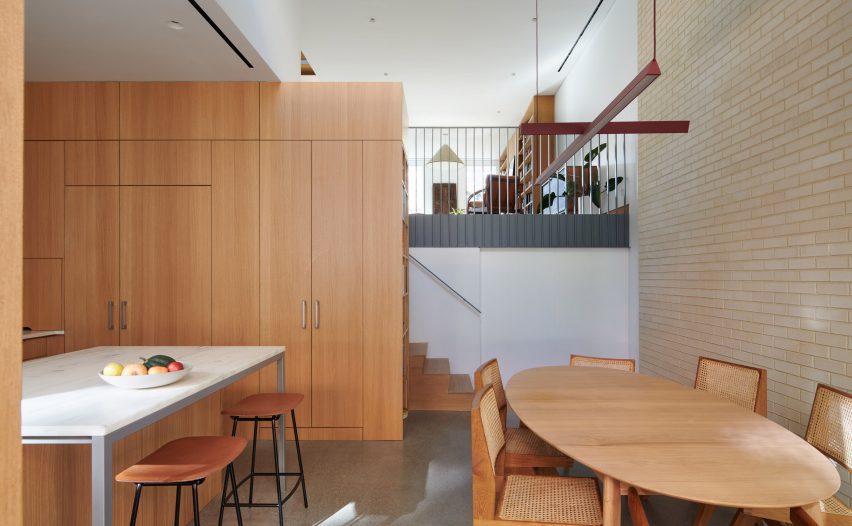
The brick continues into the kitchen and dining area on the lower floor
While the historic front facade was carefully restored, the rear elevation now presents as a contemporary stack of pale-brick cube volumes.
The interior was completely reorganized to allow sightlines between the original spaces, the new extensions and the outdoors.
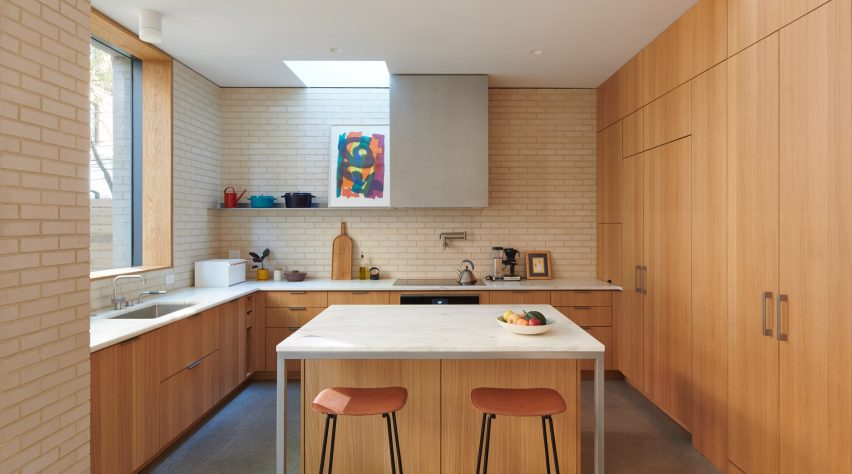
Oak millwork in the kitchen continues through the minimal interiors
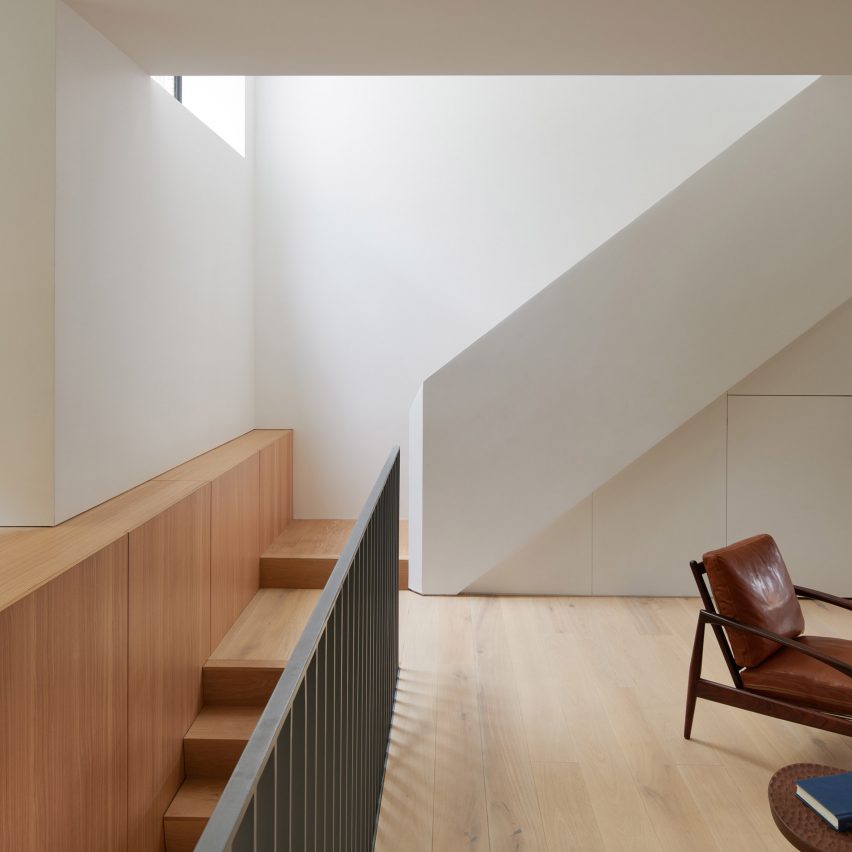
The most dramatic change involved swapping the stacked staircase with a switchback configuration – a similar approach taken by the studio at another Brooklyn townhouse in 2018.
This arrangement allows for improved visual connections between the levels and gave the project its name, Z House.
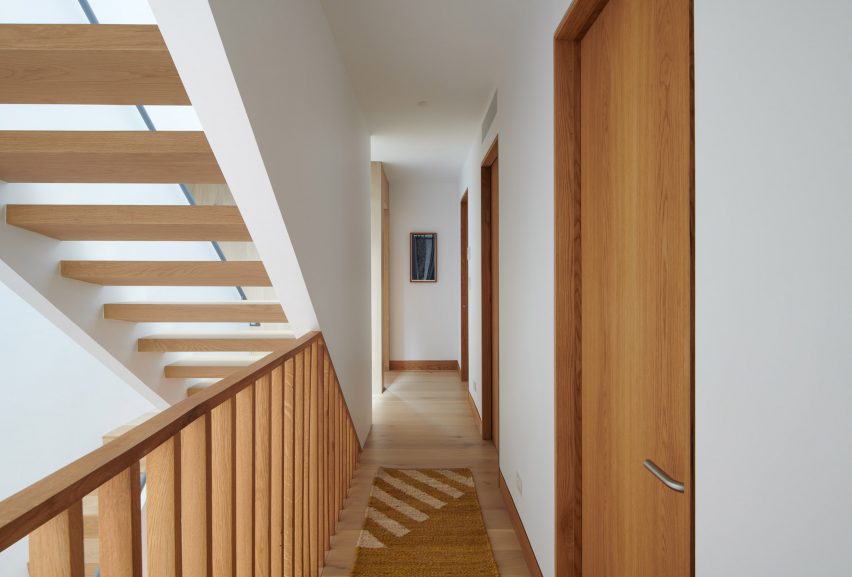
Reconfiguring the house involved swapping the stacked staircase for a switchback arrangement from the parlour level to the top floor
In addition, an angled skylight was added above the staircase void, bringing in light all the way down to the parlour 40 feet (12 metres) below.
“Filled by light and air, the stair’s drama is heightened by the placement of large windows punctuating the rear facade, allowing the vertical space to open to the exterior,” said the studio.
A skylight over the staircase void brings light down into the home
Of the home’s four storeys, the lower levels are occupied by the public spaces including the kitchen, dining, living and media rooms.
The top two levels are reserved for the children’s rooms and the primary suite respectively. The uppermost floor also accommodates a home office and provides access to a roof terrace created by the rear extension.
“This private, elevated, exterior space offers a unique domestic experience not typically found in most Brooklyn rowhouses,” Light and Air said.
Interiors throughout are clean and minimal, with white walls and custom oak millwork, built-ins and furniture.
The primary bedroom on the top floor features a custom oak bed and built-ins
The pale brick of the rear facade is also expressed inside the double-height kitchen and dining area, which is open to the back patio.
“Located above the garden level addition is a green roof that buffers sightlines from the parlor floor, creating the effect of a floating garden beyond,” said Light and Air.
The historic street facade of the Clinton Hill townhouse was also restored as part of the renovation
Founded by Anne Diebel in 2018, the studio has completed many staging and interior design projects across New York City.
These include a Brooklyn apartment retrofitted with ample custom cabinetry and a spiral staircase and a Financial District loft where partitions were removed to create an open, inviting space.
Ukraine likely made “a significant tactical breach” on the southern front, a new report says.
The report was published Saturday by the US think tank Institute for the Study of War.
The advance comes after a successful week for Ukrainian forces.
Thanks for signing up!
Access your favorite topics in a personalized feed while you’re on the go.
Ukraine has likely made “a significant tactical breach” along Russia’s multi-layered defense on the southern frontline, beyond the village of Robotyne, a Saturday report from the US think tank Institute for the Study of War says.
The offensive of Ukrainian forces has been widening a gap in the frontline for several weeks, the report adds, clarifying that “Ukrainian forces have yet to complete a breakthrough of this defensive layer” with heavy armor and vehicles.
Ukrainian officials have indicated that the series of Russian defensive positions ahead of the Ukrainian advance may be less challenging than the initial Russian defensive layer that Ukrainian forces broke through to the north, said the ISW.
Ukraine announced it had seized back control of the village of Robotyne in early September.
This recent success comes after a week of notable military actions by for Ukraine.
On Thursday, a video came out appearing to show Ukrainian soldiers entering and liberating the village of Andriivka, near Bakhmut.
“Capturing and holding Andriivka — is our path to a breakthrough on the right flank of Bakhmut and the key to the success of the entire further offensive,” said Ukraine’s Third Assault Brigade, which took part in the push, according to Reuters.
Russia denied Ukraine’s advances, saying Ukraine was “unsuccessfully trying to oust Russian troops from the population centers of Klishchiivka and Andriivka,” according to Al Jazeera.
ISW’s Saturday report, however, states that geolocatedfootage posted on September 15 confirms that Ukrainian forces have advanced in the Bakhmut area, not only around Adriivka but also the nearby villages of Rozdolivka and Klishchiivka.
Devstating strikes by Ukraine on land and sea
A video captures the moment an S-400 explodes in Crimea.
Screengrab/Main Directorate of Intelligence of the Ministry of Defence of Ukraine
Also on Thursday, an attack in Crimea destroyed Russia’s advanced S-400 “Triumf” air-defense system, which is worth over $500 million, using modified Neptune naval cruise missiles.
ISW said this may signal Russia’s air defenses in Crimea have “systemic tactical failures” and that Russian forces were “unprepared to intercept missiles with the system or were unable to do so.” It was the second strike to obliterate S-400 in Crimea in a few weeks.
On Friday, Ukraine struck and damaged a Russian missile ship off the coast of Crimea. Ukrainian forces told Reuters and Ukrainian media that an experimental sea drone called Sea Baby, was used as part of this attack.
Russia’s defense ministry denied any damage and said the attack was repelled and the drone was destroyed, Reuters added.
Ukraine also claimed that its marine drones had struck at lease on of two Russian corvettes in the Black Sea, according to the newspaper Ukrainska Pravda, per ISW.
BlackSky imagery captured the damage caused by a Ukranian cruise missile attack on the Sevastopol Shipyard dry docks in Russia occupied Crimea on September 13, 2023.
Courtesy of BlackSky
Earlier in the week, a major Ukrainian strike, using missiles and marine drones, on a Crimean naval base likely dealt a serious blow to the operation of Putin’s Black Sea fleet, according to UK intelligence.
Ukrainian forces launched an attack on Wednesday on Russia’s Black Sea Fleet base at Sevastopol, striking a submarine and a landing ship, per the UK’s Ministry of Defence.
In its latest intelligence update published on Friday, the UK MoD said the two vessels — identified as the landing ship Minsk and the Kilo 636.3 class submarine Rostov-on-Don — were hit while undergoing repairs in dry docks at the Sevmorzadov shipyard.
The attack also put the dry docks vital for maintaining the Black Sea fleet out of action for the foreseeable future.
“The complex task of removing the wreckage from the dry docks will also place the facility out of use for many months,” said the UK MoD.
On Saturday, a NATO admiral told the military alliance that “history books will show Ukraine has transformed modern warfare. And they are moving forward every day. Every success is one step closer to victory.”
Rep. Lauren Boebert of Colorado and her husband, Jayson Boebert, got married in 2005.
In March, Boebert announced the oldest of their four sons, Tyler, 18, was going to be a dad.
In May, Lauren Boebert filed for divorce, citing “irreconcilable differences.”
Thanks for signing up!
Access your favorite topics in a personalized feed while you’re on the go.
In May, Rep. Lauren Boebert announced that, “with a heavy weight on my heart,” she had filed for divorce from her husband, Jayson Boebert, citing “irreconcilable differences.”
The split comes two decades after the couple first met while she was working at McDonald’s at the age of 16, and he was 22.
Boebert, a two-term Colorado Republican, and Jayson married in 2005 and have four sons together. In March, she announced that their oldest son was expecting a child with his girlfriend, making Boebert a “36-year-old grandmother.”
Here’s a timeline of the Boeberts’ 20-year relationship.
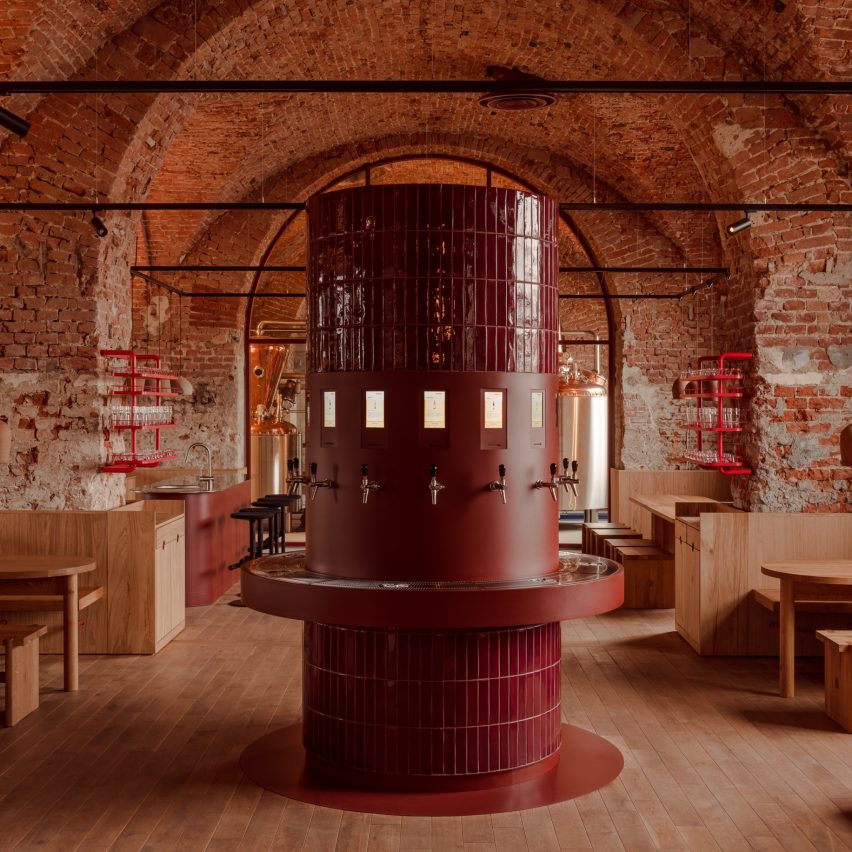
The 150 longlisted projects, which are in the running for awards in nine different interior project categories, are by studios located across 32 different countries including India, Slovakia, Belgium, Canada, Denmark and Latvia.
The top three represented studio countries are the UK, with 27 longlisted entries, followed by the US with 23 and Australia with 15.
The top project city locations are London, with 18 longlisted entries, followed by Shanghai with seven and Sydney and Paris tied with four each.
All Dezeen Awards 2023 longlists revealed this week
Dezeen Awards 2023, in partnership with Bentley Motors, will reveal all longlisted projects this week. The architecture longlist was published yesterday and the design longlist will be announced tomorrow, followed by the sustainability longlist on Thursday.
Longlisted projects have been selected from over 4,800 entries from 94 countries for the sixth edition of our awards programme, which celebrates the world’s best architecture, interiors and design, as well as the studios and individuals producing the most outstanding work.
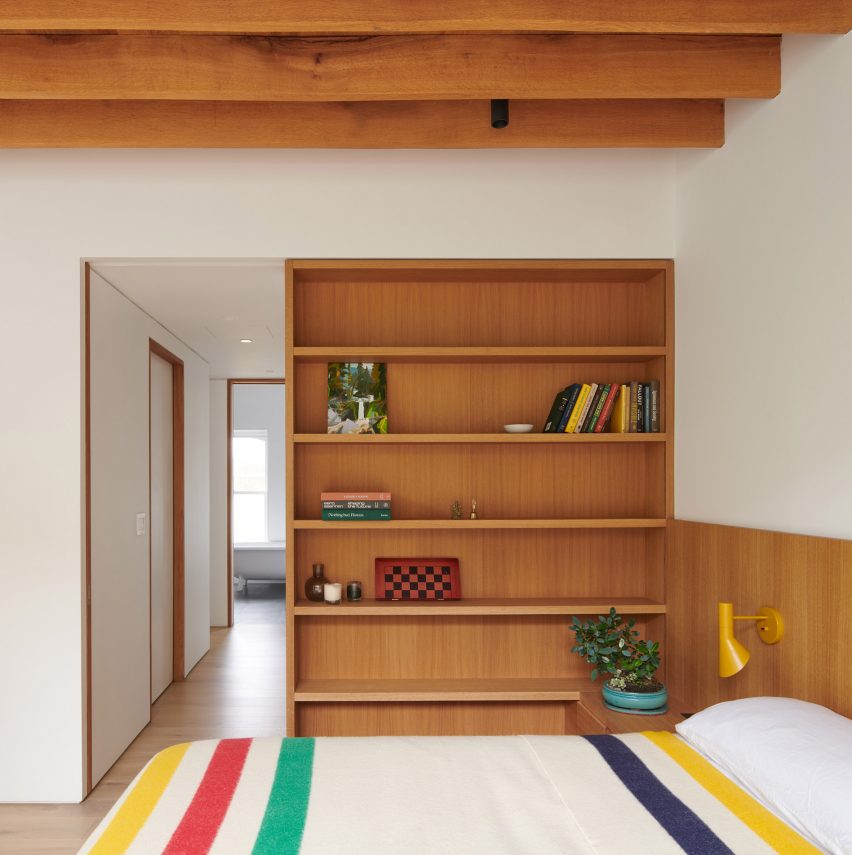
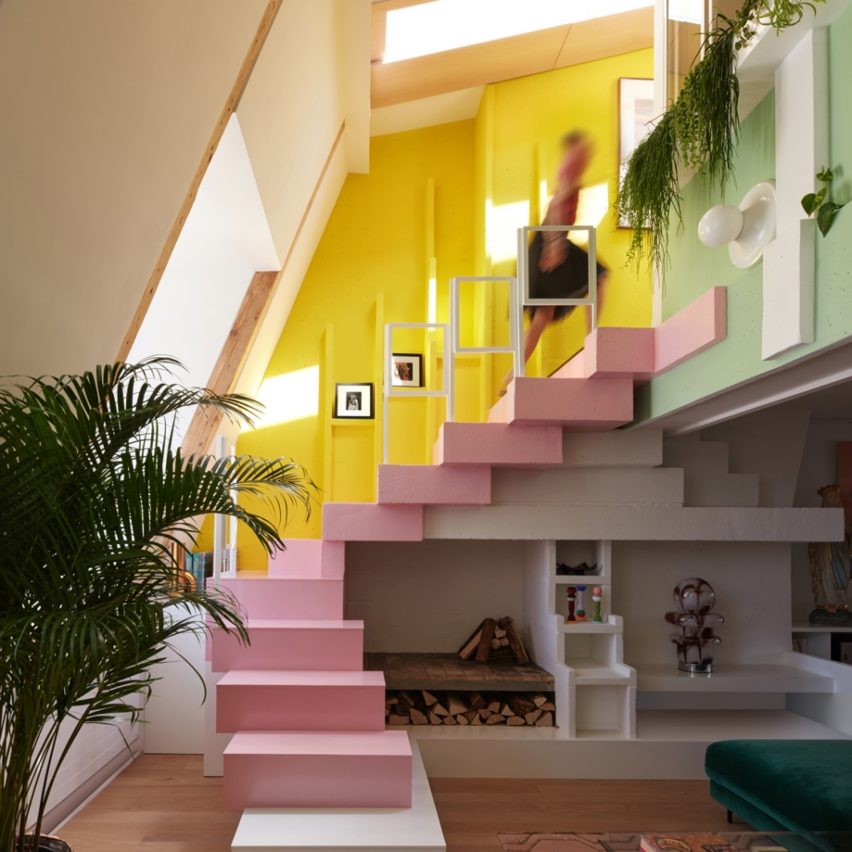
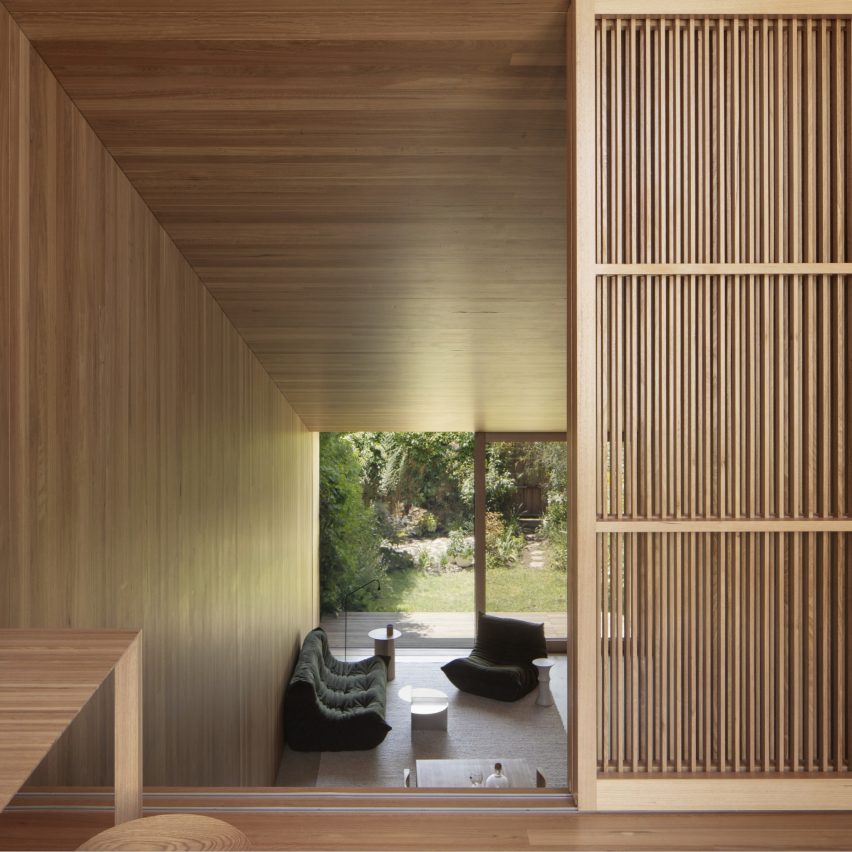
Above: Sun Dial Apartment by Manuelle Gautrand Architecture. Photo by Gaelle Le Boulicaut. Top: Shiny Gold by Nelly Ben Hayoun Studios. Photo by Vinciane Lebrun
The next stage of Dezeen Awards 2023 will see all longlisted projects assessed by our international jury of leading professionals including interior designers Eny Lee Parker, Nick Jones and Tola Ojuolape.
The judges will determine the projects that feature on the shortlists, which will be announced in October. A further round of judging by our master jury will determine the winners, which will be announced in November.
One of the nine winners of the interior project categories will then be crowned the overall interior project of the year.
Read on for the full interiors longlist:
Union Street House by Prior Barraclough. Photo by Ben Hosking
Dezeen Awards celebrates the world’s best architecture, interiors and design. Now in its sixth year, it has become the ultimate accolade for architects and designers across the globe. The annual awards are in partnership with Bentley Motors, as part of a wider collaboration that will see the brand work with Dezeen to support and inspire the next generation of design talent.