A kitchen remodel is one of the most expensive projects most homeowners take on, which makes material selection a big decision. To avoid your kitchen going out of style or losing resale value, it’s important to put thought behind major purchases.
Some kitchen cabinet colors come and go with trends, while others remain timeless. If you want to ensure you don’t regret your kitchen cabinet investment in five years, avoid choosing these outdated kitchen cabinet colors.
Gray
Gray was big in the early 2000s, with homeowners opting for gray walls, cabinets, and flooring. This color had its time in the spotlight, but most designers now view it as outdated. While it’s okay to choose a brown with gray undertones, avoid overly gray cabinet colors.
Bright White
White cabinets are not out of style, but bright white cabinets with white countertops are. Bright white cabinets can make a kitchen appear stark or blinding, especially in small spaces. They also show every finger smudge, blob of grease, and food splatter. If you want white, choose an off-white or cream color—just make sure the white you choose complements your countertop and backsplash.
Orange Stain
Orange oak cabinets, prominent in the 1990s, are now considered one of the most outdated options. Steer clear of any orange wood stain or orange paint. It’s difficult to make orange cabinets look modern, and they could hurt your home’s resale potential.
Trendy Paint Colors
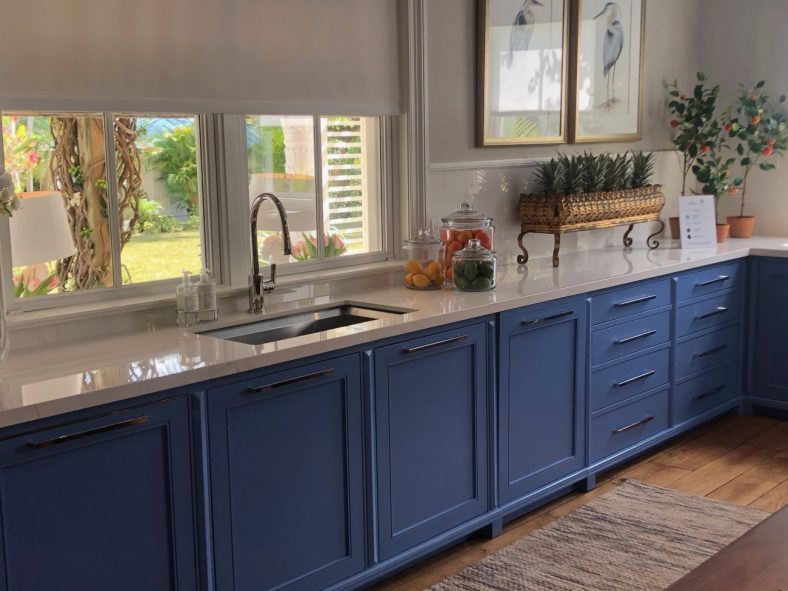
Every few years, new kitchen cabinet color trends emerge. In the past few years, dark green have been one of the most popular but are now dying down in favor of deep blue shades. You might feel like your kitchen is in style by jumping on a new color trend, but in five years, the trend may be obsolete.
Yellow
Yellow is bright and cheery, but unless you’re living in a retro mid-century modern, it’s not a good kitchen cabinet color. Save yellow for easy-to-swap accents, like wall art and cookware. Stick to something neutral on permanent finishes.
The Best Kitchen Cabinet Colors
The best kitchen cabinet colors are timeless. If you don’t want to worry about your cabinets going out of style, opt for natural wood tones and neutral paint colors. Some top paint colors include cream, taupe, and off-white. As far as cabinet style, shaker cabinets are a great option. They fit many home styles and are classic.
A French warship intercepted at least three Houthi ballistic missiles on Thursday.
Intense footage shows the moment a surface-to-air missile launched and hit one of the threats.
It marks the latest engagement between Western navies and the Houthis.
Thanks for signing up!
Access your favorite topics in a personalized feed while you’re on the go.
Newly released footage from a French frigate operating in the southern Red Sea shows the warship shooting down a Houthi ballistic missile on Thursday.
The frigate, which is deployed to the region as part of the European Union security mission Operation Aspides, destroyed three ballistic missiles during the incident, marking one of the latest engagements between Western navies and the Iran-backed Houthis.
In the video, shared to social media by the French military, sailors can be seen working on the bridge. A surface-to-air missile is then fired from a launcher. A short time later, it intercepts a target in the air.
EUNAVFOR ASPIDES 🇪🇺 Interception de 3 missiles balistiques en provenance du Yémen ciblant la position de la frégate 🇫🇷 et du porte-conteneurs qu’elle accompagnait. De Suez à Ormuz, notre engagement au profit de la liberté de navigation et la sûreté maritime se poursuit. https://t.co/bTfrFx24eepic.twitter.com/gODY0YifZn
— Armée française – Opérations militaires (@EtatMajorFR) March 21, 2024
France is one of several countries working alongside the US Navy to protect international shipping lanes from the Houthis, who have spent months relentlessly firing drones and missiles at vessels sailing off the coast of Yemen.
Gen. Michael Kurilla, commander of US Central Command, or CENTCOM, told lawmakers on Thursday that French forces destroyed two Houthi anti-ship ballistic missiles earlier in the day, likely referencing this incident, which at the time had yet to be confirmed by Paris.
The Houthis started firing anti-ship ballistic missiles at the end of 2023, marking the first time that such weapons have been used in combat. The rebels have since fired these missiles regularly, recently using them to sink their first vessel and stage their first fatal attack — both occurred within the past few weeks.
French sailors watch a missile launch.
French Navy photo
Beyond anti-ship ballistic missiles, the Houthis have also launched anti-ship cruise missiles, one-way attack drones, and unmanned surface vehicles, or USVs, which are essentially drone boats packed with explosives.
While the Houthis have not managed to hit US or coalition warships, engagements between the two sides are happening on a near-daily basis.
Alongside the French action on Thursday, for example, German and American forces each destroyed a Houthi drone boat, Kurilla said during testimony to the House Armed Services Committee.
A French warship intercepts a Houthi missile.
French Navy photo
US forces also routinely conduct preemptive strikes in Yemen, destroying Houthi missiles and drones before the rebels have a chance to launch them into the Red Sea or Gulf of Aden.
Meanwhile, the EU’s Operation Aspides — which has now been active for more than a month — said on Wednesday that a French helicopter shot down a Houthi drone that posed a threat to commercial ships.
Unlike humans, most animals don’t appear to savor their food by eating it slowly. Some dogs just fill their bellies as fast as possible, whether they’re very hungry or not. Their instinct is stronger than their appreciation for flavors and textures, even if there is no threat of losing their meal to another animal.
In most cases, there is nothing to worry about if your dog doesn’t chew their food; it simply means that you’ve got a guzzler on your hands. However, in some cases, it could lead to digestive problems or be an indication of a medical condition. Thankfully, there are ways to slow your dog’s eating down and improve their digestion.
Why Doesn’t My Dog Chew His Food?
Although some dogs do chew their food, many don’t. This behavior is instinctual and goes right back to when dogs lived in packs in the wild. Any food that was scavenged would need to be eaten fast before it was eaten by another dog, drew too much attention from other wild animals, or became the reason for a fight to break out. The faster a dog ate their portion of the food and moved on, the safer they were from losing out on a meal or getting hurt.
This behavior could begin early in puppies that were born in large litters, with puppies needing to fight for a nipple on their mother’s body to nurse if there were more puppies than nipples. As the puppies develop and start solids, they may continue to fight for a spot at the bowl with so many little mouths gulping down the food laid down for them.
With this in mind, your dog might be eating without chewing because of their environment. If there is a lot of noise around them, such as machinery, loud music, or screaming children, they may feel as though they are under threat and swallow their food down quickly. If you have several other dogs or pets, they may also try to gulp down their food quickly in fear of those pets getting to their food before they finish it.
A dog is built to eat food quickly as it was a way of survival in their past. If your dog has always been a fast eater and you regularly take them for their veterinary checkups, you probably don’t have anything to worry about.
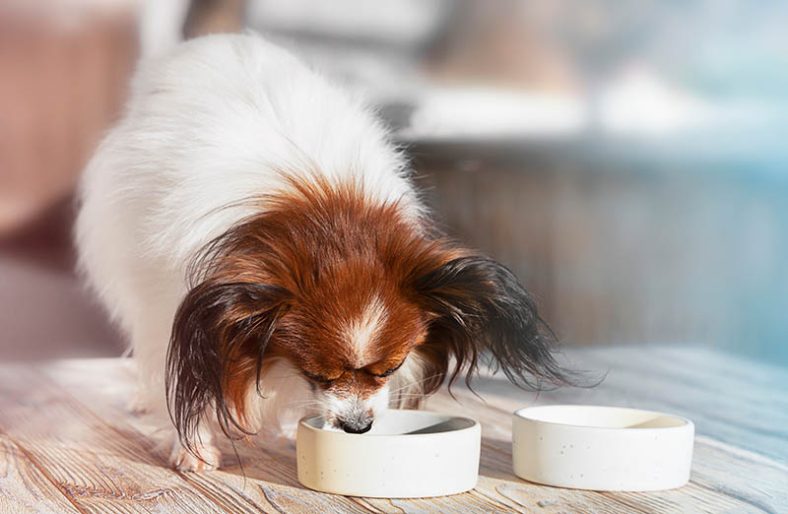
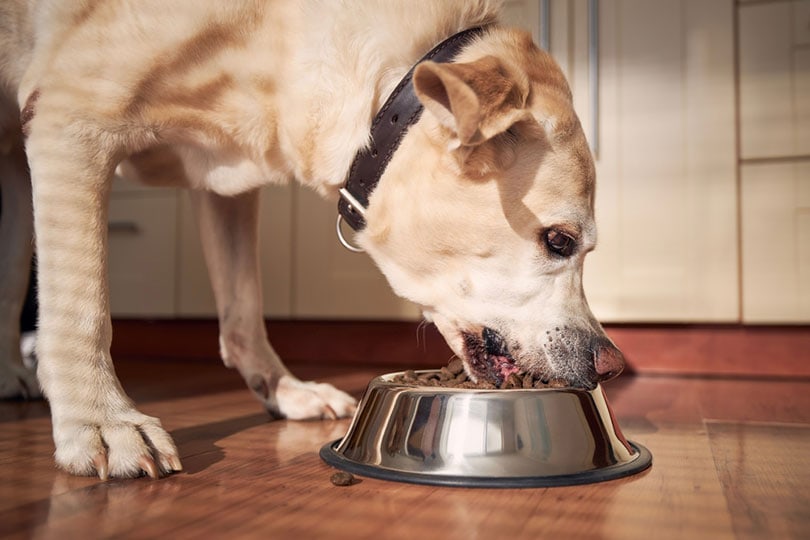
Image Credit: AndrasKiss, Shutterstock
When Should I Be Worried?
If your dog has always chewed their food but they have suddenly stopped, it might be an indication that something is wrong with them. However, not chewing their food will often be one of a few other signs.
Dental Disease
Dogs that have suddenly stopped chewing their food, whether soft or hard, and also have bad breath, tartar on their teeth, and other signs of dental disease might have started swallowing their food whole because their mouths are too painful to chew the food.
Injury
Another reason could be due to a cut in your dog’s mouth from chewing on something sharp, such as a stone or bone. Tooth fractures are also common from chewing such items. It’s important to take them to the vet for an oral examination to determine what the problem is and to get it treated to reduce the pain or discomfort that your dog is experiencing.
Cancer
Cancers in the mouth can also make it difficult for dogs to chew and swallow. This generally occurs in older animals and you might also notice signs of weight loss, vomiting or discomfort around the mouth.
Parasites
It’s not uncommon for dogs to get internal parasites, such as roundworms. These parasites live and feed in your dog’s intestines, eating away at the nutrients your dog gets from their food. As this happens, your dog loses out on those necessary nutrients and will gulp down their food in a desperate attempt to fill their stomachs. However, they won’t put on weight even if they are given more food than usual.
Poor Quality Diet
Just as dogs crave more and more food as the parasites steal the nutrients from their bodies, so is the case with diets that don’t have everything your dog needs. A nutrient-deficient diet won’t satisfy your dog and will cause them to always feel hungry, resulting in a dog that gulps down their food instead of chewing it.
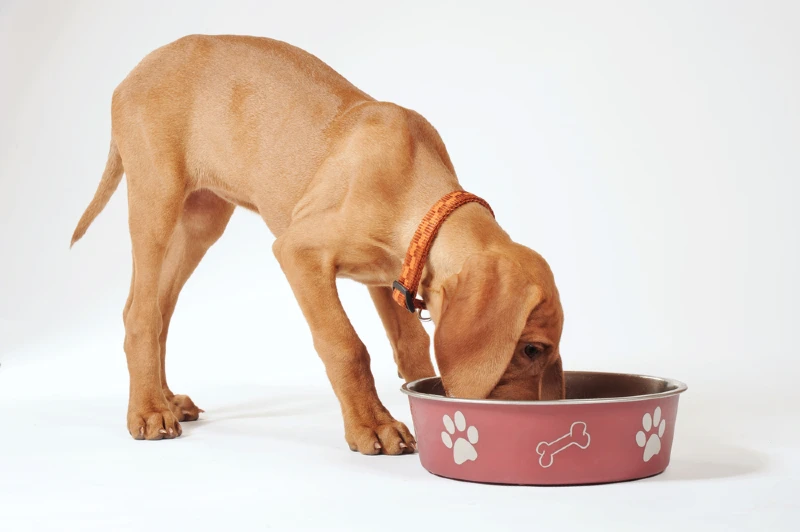
Image Credit: Tanya Dol, Shutterstock
The Problem with Gulping Down Whole Food
Some dogs can gulp down whole food and be fine. However, this way of eating can have a negative impact on some dogs and can cause them to have an upset stomach because the food isn’t able to digest well. This may result in your dog throwing up the food they just gulped down. However, for others, it has the potential to cause bloat, which can lead to gastric dilatation and volvulus, or GDV; a condition where the stomach twists and the dog needs life-saving surgery to survive.
Bloat is more common in larger breeds, and although the cause isn’t known, there is a higher chance of it occurring in dogs that ingest a lot of food and or water very quickly. There are other factors that can also increase the risk in dogs, such as their age, weight, etc.
Bloat occurs when a dog’s stomach stretches because of the large amount of food or gas that they ingested from eating or drinking too quickly. It causes pain in the dog’s stomach. If the stomach twists, it cuts off blood flow, which can cause damage to the stomach wall. Dogs with GDV go into shock because there is not enough blood reaching the heart. It can progress as far as damage to the spleen and other vital organs from being in shock. GDV quickly can be fatal if not recognized and treated.
Along with the abdominal pain, a dog with bloat may also dry heave, pace around the home, guard their stomach, pant, drool, have pale gums, and have a noticeably larger stomach and racing heartbeat. If treated quickly, dogs can recover within a few days.
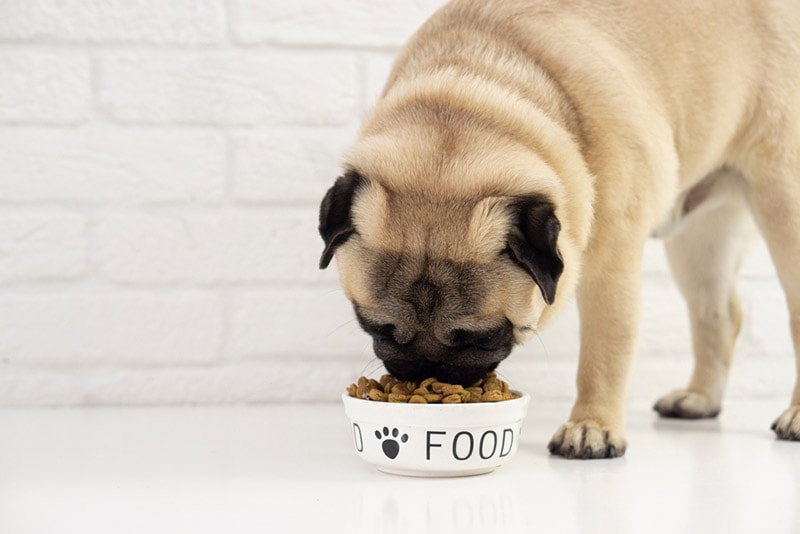
Image Credit: Jaromir Chalabala, Shutterstock
Ways to Encourage Chewing
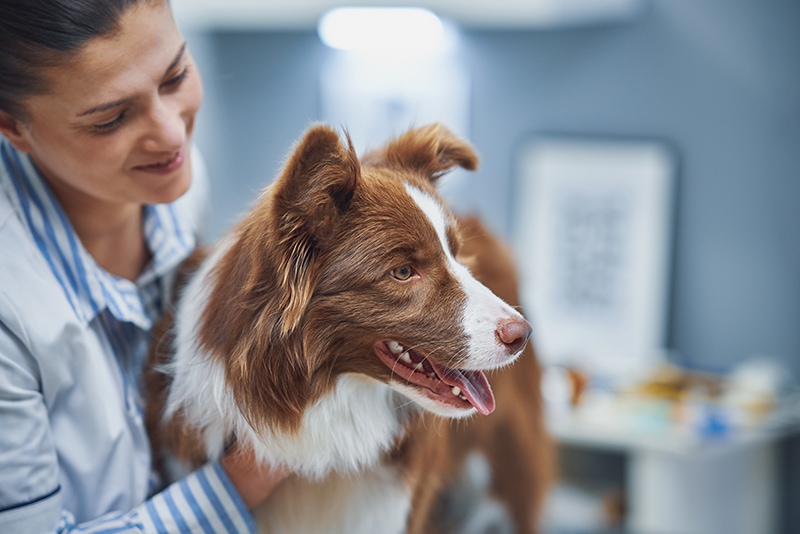
If your dog looks like they’re always hungry and in a hurry to get all their food down, or they’ve suddenly stopped chewing, the best thing you can do is take them to the vet for a physical and oral examination.
The vet will be able to treat your dog if they have parasites and recommend dog food with quality ingredients that are beneficial to your dog. If there is something preventing your dog from being able to chew their food, your vet will be able to pinpoint the problem and give them the correct care they need to ease their pain and discomfort.
If your dog is naturally a fast eater, be sure not to leave out large amounts of food as you want to prevent them from overeating. You could also feed them less food more frequently. Also, avoid vigorous exercise right after a meal. These steps will reduce your dog’s risk of developing bloat.
You can slow your dog’s eating down by placing balls and other objects that are too large to swallow in your dog’s bowl so that they have to try to get the kibble under or next to the objects, making it difficult to gobble up all their food in just a few licks. You can also purchase a slow-feeding bowl, snuffle mat or puzzle feeder that does the same thing. You can also place dog food in a dispensing toy so that as your dog plays with the toy, they can gobble up the kibble that falls out.
Some types of kibble are larger than others so buying a larger size biscuit may force your dog to chew more. Remember when changing your dog’s diet, it is best to do so gradually to prevent an upset stomach.
If your dog is eating their food quickly because they feel stressed out from loud noises or pets that are trying to steal their food, feed them in a separate room that is quieter and closed off to other pets.
Conclusion
Any changes in your dog’s eating habits should be investigated, but if they have been given a clean bill of health by your veterinarian, simply use techniques to slow your dog’s eating, feed smaller amounts more frequently and make sure they feel safe when eating. Eating slower is better for digestion and decreases their chances of developing bloat.
However, if your dog is gulping down food, always looks hungry, is underweight, seems painful around the mouth, has bad breath or drops food there may be a medical reason for them not being able to chew.
Musician Bruno Mars and design studio Yabu Pushelberg have teamed up to create the interiors of a cocktail lounge and live music venue at the Bellagio casino in Las Vegas.
Named The Pinky Ring, the 5,000-square-foot (465-square-metre) lounge is accessible directly from the casino floor, but designed as an entirely separate experience away from the bright lights, bustle and noise.
The stone bar at The Pinky Ring is surrounded by golden drapes that are reflected in the mirrored ceiling
The bar serves a curated collection of cocktails and hosts live entertainment by top musicians and DJs – though no phones are allowed inside.
A huge crystal chandelier hangs in the centre of the lounge and is visible from all corners
The entry sequence begins with a dimly lit mirrored passageway, where Mars’ collection of Grammy trophies is displayed.
“Inspired by contemporary museum design, the corridor was designed as a soothing and discreet exhibition space where guests can cleanse their visual palette from the outside world and begin to submerge into The Pinky Ring,” said the design team.
A VIP area is lined with faceted mirrored panels that create infinite reflections
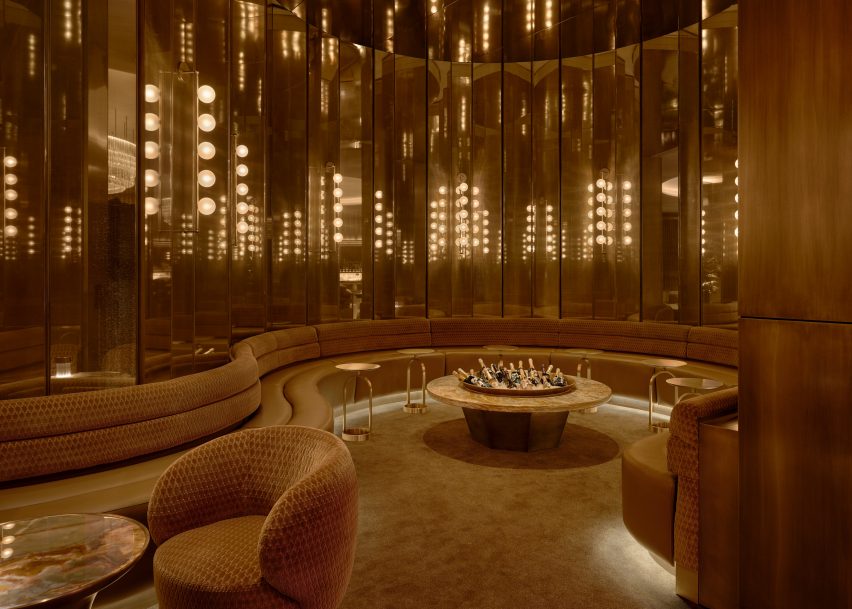
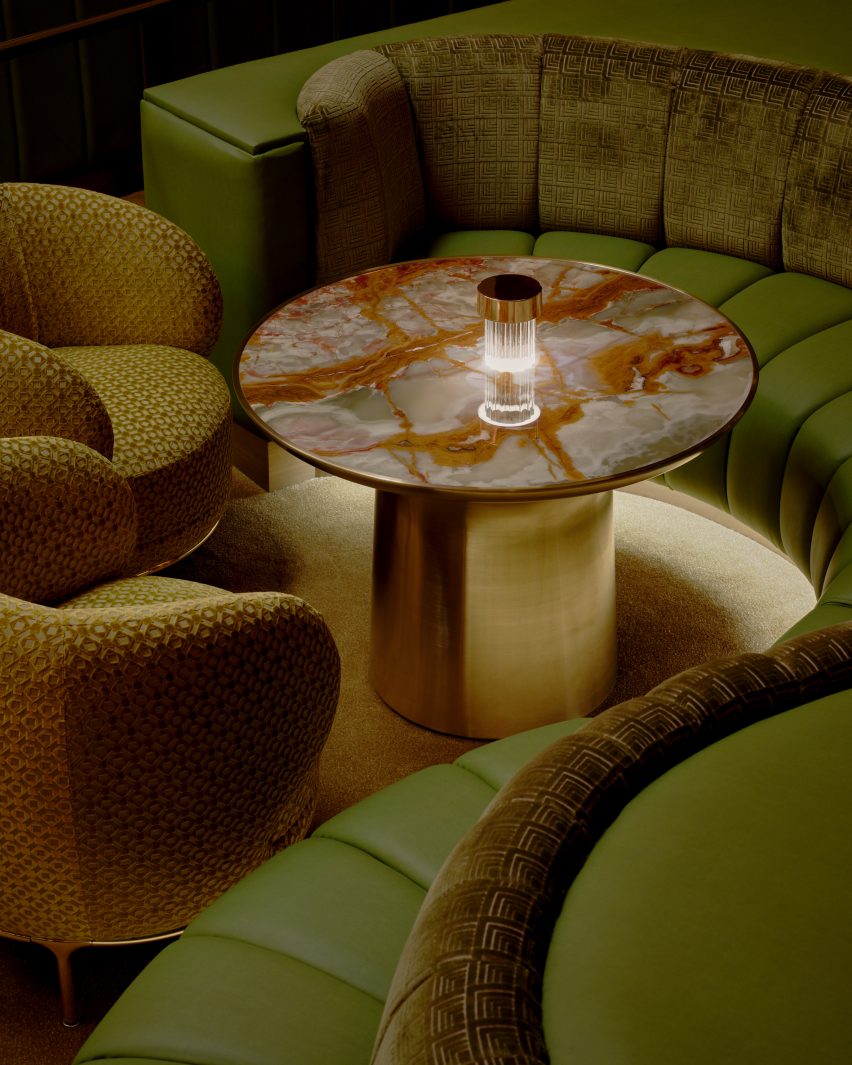
Guests arrive at the main bar and lounge in front of a sunken conversation pit, wrapped with a wavy banquette and furnished with soft armchairs gathered around a series of small tables.
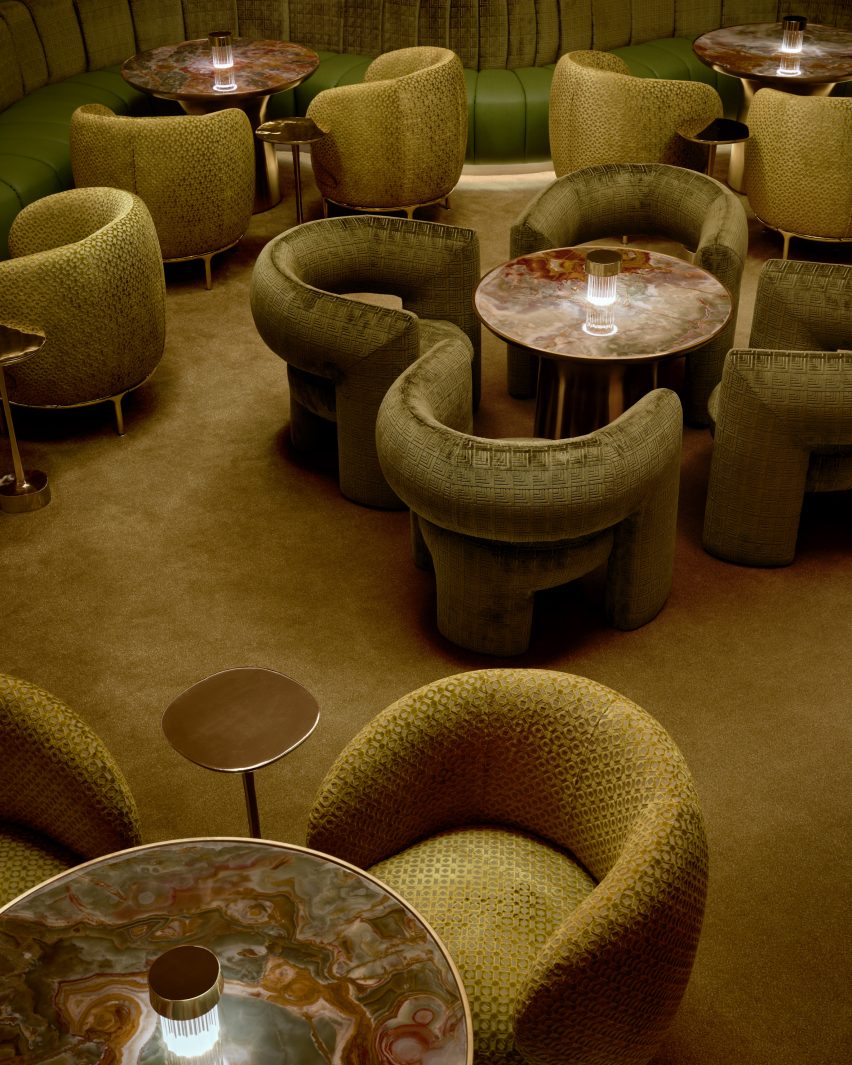
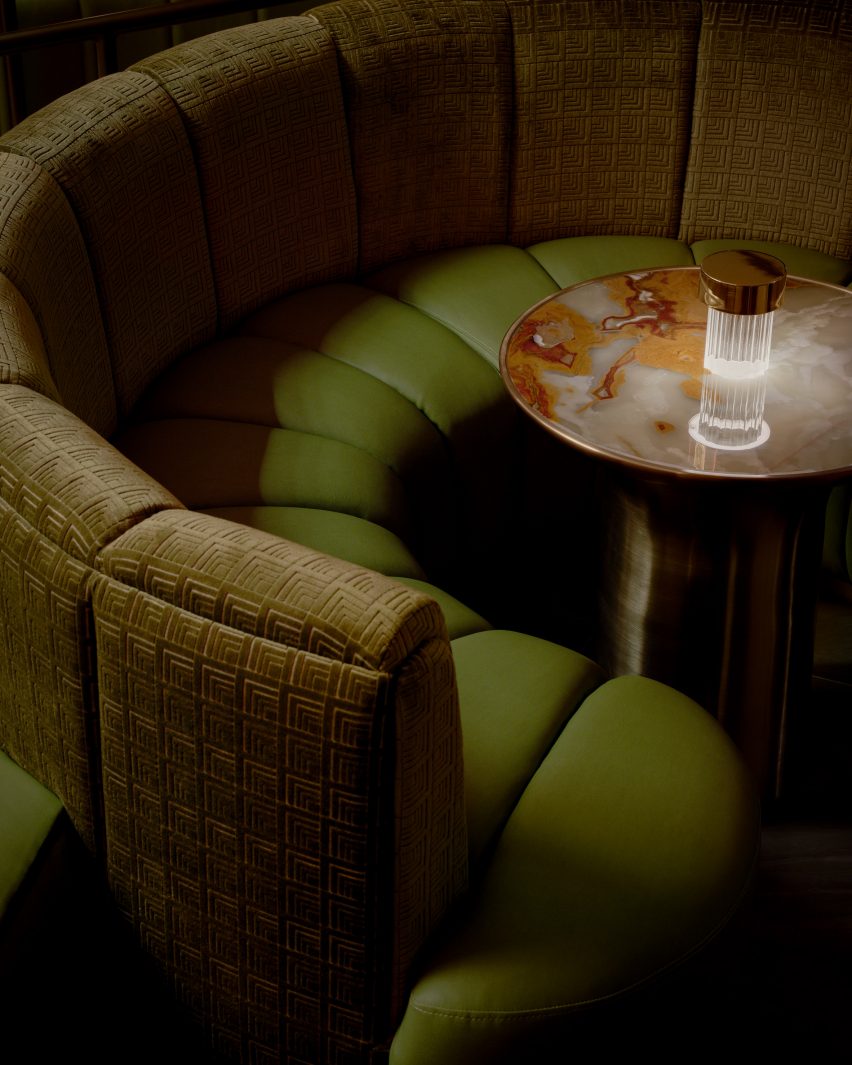
The carpet, the leather and the velvet chair upholstery are shades of green – colours also found in the richly veined stone tabletops.
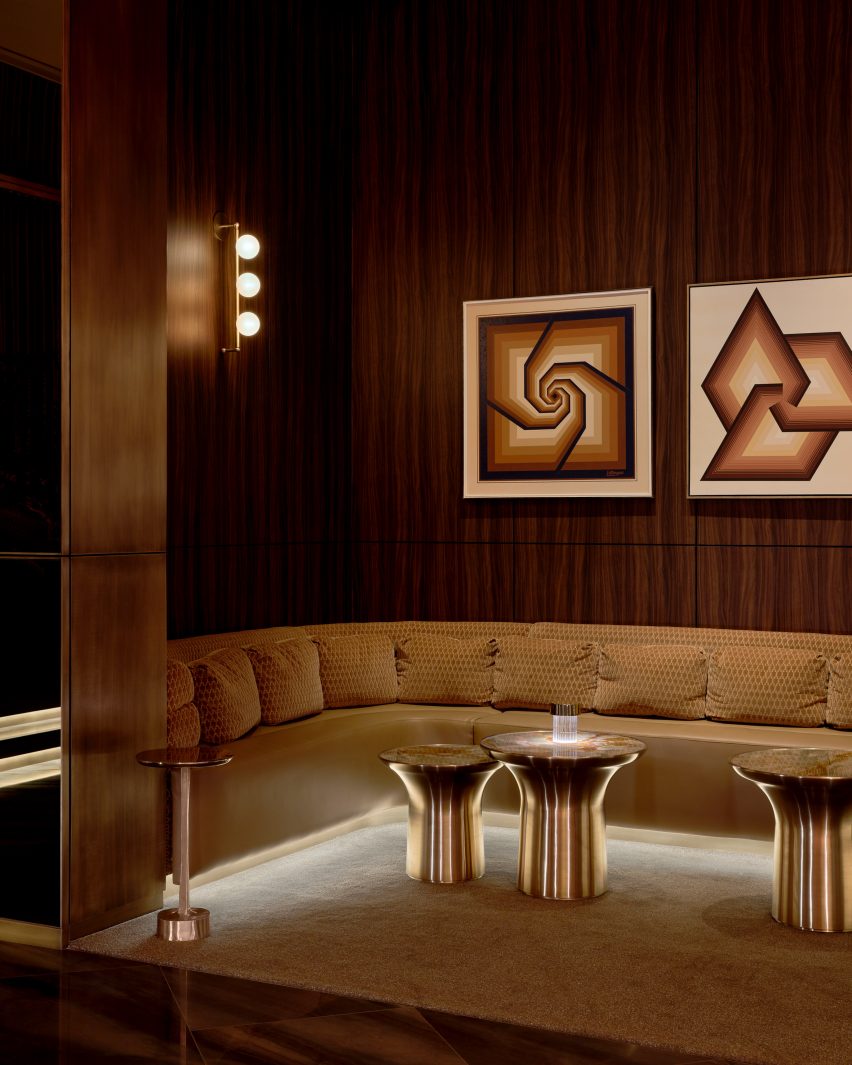
Other niches with additional seating feature dark wood-veneer panels
A giant halo-like chandelier with tiers of glowing crystal hangs from the ceiling above, providing a central focal point that can be seen from every corner.
At the rear of the space is a gently curved, dramatically patterned stone bar, topped with a row of metallic Flowerpot lamps by Verner Panton.
In the central conversation pit, various shades of green were chosen for the carpet, chairs and banquettes
The back bar is housed within an elongated pill-shaped, mirrored recess, which displays a wide range of liquor bottles and is ringed with stepped cove lights.
Golden drapes run floor to ceiling across the back wall and are reflected in more mirrors on the ceiling.
The green hues of the seating are echoed in the richly veined stone tabletops
Off the main lounge are various niches and VIP areas that offer additional seating, some lined with dark wood-veneer panels.
“See or be seen, each area is composed of its own suave and purpose that echoes into the next,” said the team.
One organically shaped space is lined with faceted, smokey mirrored panels that create infinite reflections, and features a banquette that wraps around a large table fitted with a giant ice bucket for chilling drinks.
An important factor in the design was the lighting, which comprises under-seat and ceiling coves, along with wall lights with five globe-shaped diffusers attached to vertical brass rods.
Patterned crushed velvet covers the curved banquette back, while the seat is wrapped in leather
“In the pursuit of perpetual allure, where lighting not only transforms spaces, but perceptions, The Pinky Ring unveils a strategic lighting innovation, schemed to make people look and feel their best,” the team said.
“Through a strategic interplay of low-level, contrast, and accent lighting, The Pinky Ring lighting design unveils the unseen.”
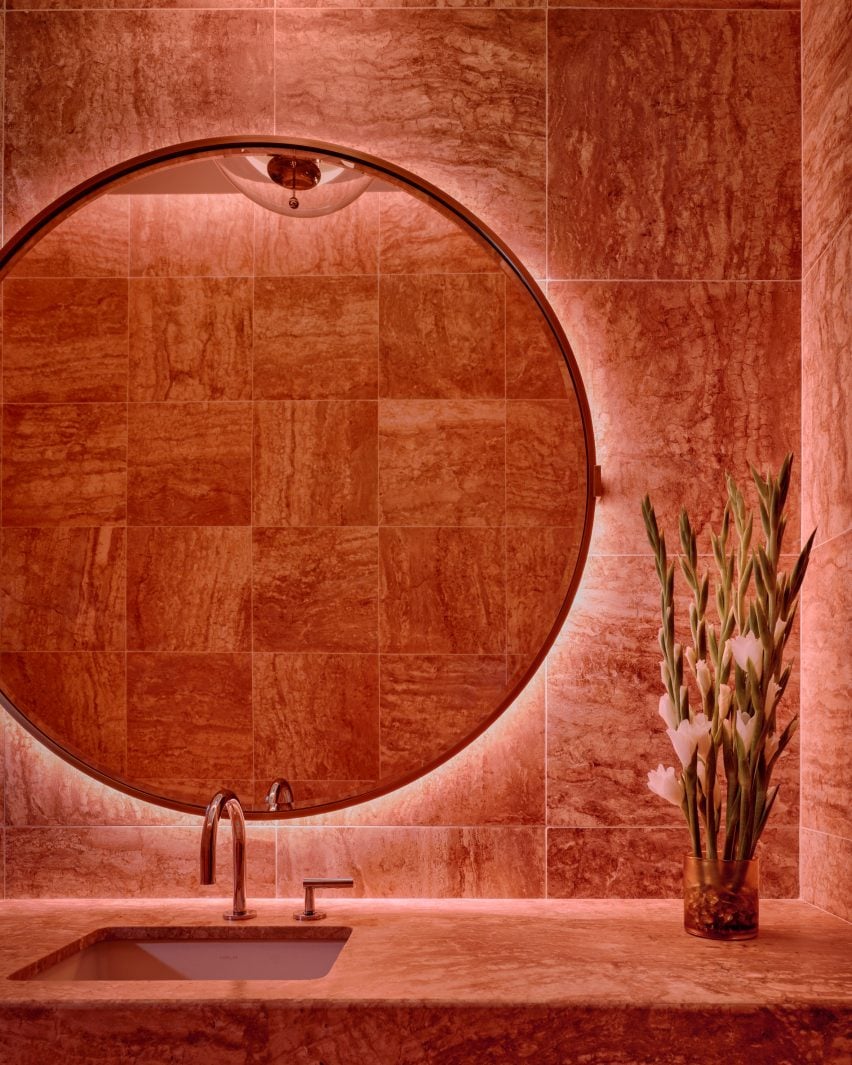
Pink-red stone tiles across the bathroom walls nod to the lounge’s name
Yabu Pushelberg was founded by George Yabu and Glenn Pushelberg in 1980, and the studio has designed some of the most recognisable hospitality interiors over the past four decades.
Shortlisted for Dezeen Awards 2021 design studio of the year and judges for the program in 2023, Yabu Pushelberg’s recent projects include the Moxy and AC Hotel in Downtown Los Angeles – of several they’ve completed for the Moxy brand – and The Londoner hotel on Leicester Square in the UK capital.
Whether you like to enjoy your favorite music, prefer listening to a podcast, or simply want to block out the hustle and bustle of everyday life through noise cancellation, it’s important to have a pair of quality headphones in your life.
We live in the age of technology where there are many options to explore, and sometimes the various technical terms can get confusing, but in this article we will discover the difference between headphone sensitivity and impedance and what you should be looking out for when purchasing your next set of headphones.
What is headphone impedance?
This can sound like a tough term to digest, but when broken down, it is really quite simple. Impedance is defined as electrical resistance, which means it’s basically how well your headphones can resist the electrical current passing through it. This is measured in ohms (Ω) and indicates how much strength your headphones will require to reach a comfortable listening volume. The higher amount of ohms, the more force and function your headphones can produce.
Certain gadgets such as smartphones may be unable to supply adequate power, meaning that even if you are at max volume, the sound quality may still be a bit weak, and you might even hear some strange distortions in the audio. This is why being aware of impedance when purchasing headphones is so important. It is considered that impedances of 20-40 ohms are a good choice for casual music listeners (such as the Phiaton BT 390 headphones) and 64 or higher for audiophiles. Anything above that will typically require a portable headphone amplifier.
What is headphone sensitivity?
The concept of sensitivity is similar to impedance, in that it measures the crispness of sound in your desired listening device, however it’s not particularly useful when determining whether or not to buy headphones. The problem is, many manufacturers aren’t always consistent with how it is measured. The sensitivity of a pair of headphones refers to how well it translates an electrical signal into an auditory signal, and it also determines how loud they will be at a certain volume level from the device. Decibels of Sound Pressure Level per Milliwatt, or dB SPL/mW, is the unit of measurement.
Since headphone sensitivity measures volume at a certain strength, it is also important to check it in decibels. For example, the sound sensitivity of a car passing you at 65mph around 25 feet away is 75dB, which is considered on the lower end of the scale but can still be “annoyingly loud to some people,” according to Iac Acoustics. Also revealed by Iac Acoustics is that 110dB is similar to live rock music, and is about the average human pain threshold, and music this loud should only be listened to for around 15 minutes. The safe range for sensitivity of a headphone is reported to be between 75 dB to 110 dB, however, individuals should use personal judgment as to not damage their eardrums.
So what’s the difference?
Most headphone and earphone specifications show actual impedance and sensitivity. Most headphones will have about the same range for sensitivity but it is worth knowing about the levels in measurement because if you are connecting to a smartphone, sensitive headphones will be able to play the music at a decent volume level. The higher the sensitivity, the louder the headphones are, but you’ll most likely be happy as long as you use your headphones at a safe volume.
As for impedance, being aware of this when searching for a new pair of headphones will come in handy as it will help us determine which audio sources will best suit the headphones for optimal performance. It would not be a travesty to purchase headphones with incompatible impedance, a headphone with an impedance that is either too high or too low for your desired music playing device may not provide the finest sound quality. Smartphones require lower impedance whereas professional music playing equipment will sound better with a higher impedance.
If you’ve started noticing you can smell your dog before you see them, it’s time to do your nose a favor and take care of the issue. You know you can give your dog a bath but what if you don’t have time? Are there any other options available?
In this article, we’ll tell you how to make your dog smell good without a bath in eight simple steps. Read on to learn how to help your stinky dog lose the odor without having to get them wet and be left with a mess!
Before You Begin
Your dog’s odor could be coming from one or more sources, which means there is a range of different steps you can take to help them smell better. Before you begin dealing with the stink, see if you can narrow down a particular part of your dog that seems extra smelly. For example, do they have bad breath or dirty ears?
Preparation
Depending on the source of your dog’s smell, you might need one or more of the following supplies:
Ear cleaner
Gauze or cotton balls
Dental care products
Brush
Waterless shampoo
Cornstarch or baking soda
Doggy cologne or perfume
Dog cleaning wipes
Laundry detergent (not for the dog)
Again, you likely won’t need every one of these items to help your dog smell better, but we wanted you to be aware of all the possible options just in case.
How to Make Your Dog Smell Good Without a Bath
1. Clean Their Ears
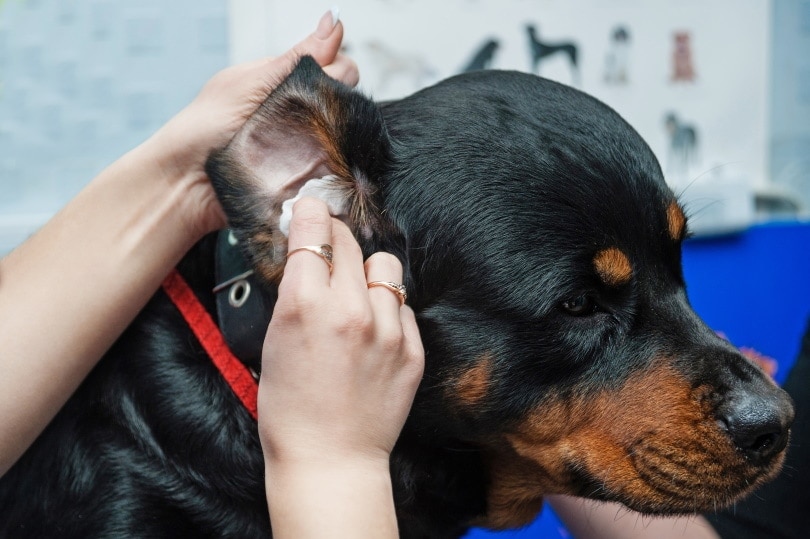
Your dog’s ears can be an overlooked source of an odor, easily remedied without a bath. Smelly ears can also indicate an ear infection, especially if the ears are also red, swollen, painful, or full of discharge. If you suspect an ear infection, see your veterinarian.
To clean your dog’s ears, you will need a doggy ear cleaner and cotton balls or gauze. Squeeze a little cleaner into the dog’s ear canal and massage to break up any deep-set dirt and odor. Step back and let your dog shake their head then use cotton balls or gauze to wipe out the ears.
Clean out all the folds of your dog’s ears thoroughly. Avoid sticking anything too far down the ear canal, such as a Q-tip. Repeat the process for the other ear, using fresh cotton balls or gauze.
Photo Credit: Yavdat, Shutterstock
2. Brush Your Dog Regularly
Brushing is another way to keep your dog clean and smelling fresh without a bath. Some dogs need to be brushed daily to keep their coats tangle-free. Short-coated dogs can also benefit from brushing 1–2 times a week, however.
A good brushing removes dirt and dead hair from your dog’s coat. It can also help spread their natural skin oils evenly, improving the look and feel of the coat.
3. Check Your Dog’s Teeth
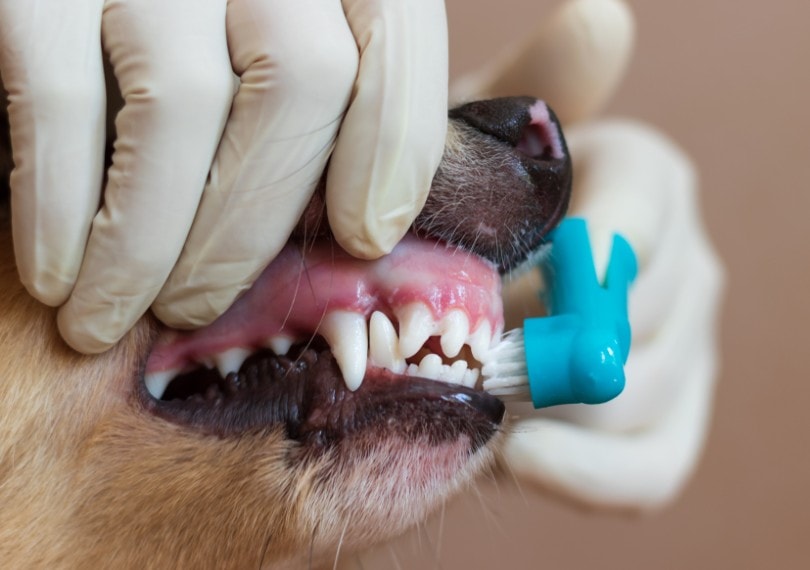
Not all bad breath comes from your dog’s teeth, but good dental care is still a vital part of a dog’s grooming routine. Brushing your dog’s teeth is the best way to keep them healthy. Choose a toothpaste designed for dogs and brush daily if possible.
Some other options for dental care include dental wipes, chews, and water additives. Despite your best efforts, most dogs will still need a professional dental cleaning eventually. If your dog’s mouth still smells despite regular dental care, you may need to have your vet investigate other possible sources of bad breath.
Photo Credit: DWhiteeye, Shutterstock
4. Use Baking Soda or Cornstarch
For a simple “dry bath” to help your dog smell better, try baking soda or cornstarch. Either product can be sprinkled on your dog and worked into the coat to help absorb odors or excess oil. To remove, simply brush away the powder and the doggy smell with it!
5. Wash Your Dog’s Bed
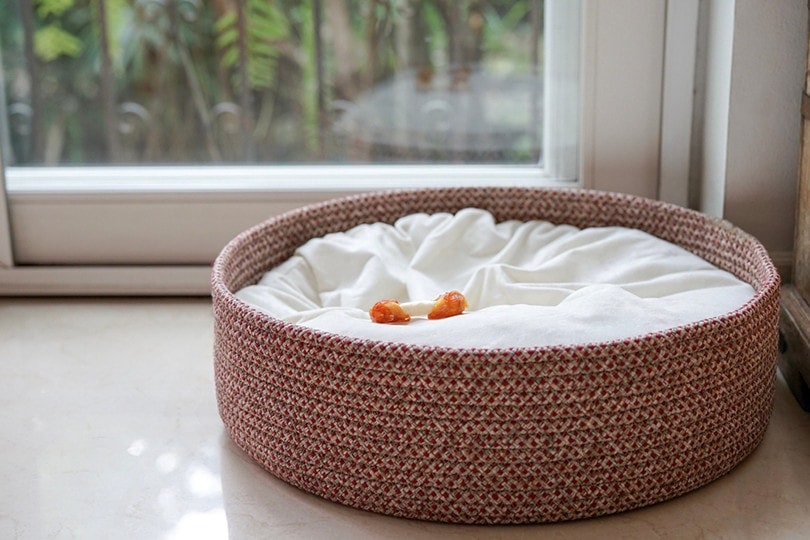
If it’s been a while since your dog’s bedding has seen the washing machine, the stink of the material could be rubbing off on your dog. Over time, hair, dander, dirt, and oils can build up on your dog’s bed, even if your pup stays generally clean. The odor can then cling to your dog when they wake up from a snooze.
Give your dog’s bedding a thorough wash, possibly with a laundry additive designed to eliminate dog odors. If you can, dry the bedding outside rather than in the dryer. Sunlight and fresh air add another layer of deodorizing power.
Photo By: Jareerat, Shutterstock
6. Use Waterless Shampoo or Wipes
To get your pup smelling fresh without a bath, try one of the many waterless shampoos or wipes on the market. These products are designed to quickly clean and deodorize your dog without needing to be rinsed afterward.
7. Spritz With Doggy Cologne or Perfume
For a quick hit of smell-good fragrance, try spritzing your pup with one of the many dog colognes or perfumes available. Some of these sprays offer a deodorizing component but most just mask the dog’s smell with a preferable scent. They usually aren’t very long-lasting but can serve to make your dog smell better quickly if you have unexpected guests.
Image Credit: trofalenaRV, Shutterstock
8. Evaluate Your Dog’s Diet
Sometimes, the source of your dog’s odor comes from within. Your dog’s food plays a key role in both their health and their scent. Gassy pups are no fun to live with, and poor-quality food or too many table scraps are often to blame.
Ask your veterinarian to recommend a quality, nutritionally-balanced dog diet. Don’t be distracted by trendy buzzwords like “grain-free” or “real meat sources”. Those are meant to attract your spending money and don’t necessarily indicate a healthier food or one that’s suitable for your dog’s particular needs.
What If My Dog Still Smells No Matter What I Do?
If your dog still stinks despite your best efforts, with and without bathing, it’s time for a trip to the veterinarian. Various skin conditions can cause your dog to smell and will resist all your attempts to battle the stench. Especially suspect a skin condition if you notice other symptoms such as scratching, hair loss, or a flaky coat.
Skin conditions can be frustrating to diagnose and treat. Patience and thoroughly following your vet’s treatment plan are essential. In some cases, your vet may suggest a referral to a veterinary dermatologist for more specialized and advanced care.
Image By: Kamil Macniak. Shutterstock
Conclusion
You can’t always avoid giving your dog a full bath, especially if they routinely play in the mud or suffer from allergies. However, frequent bathing can disrupt your dog’s natural skin and coat oils, drying them out. Try these eight steps to help your dog smell better without a bath and save the complete spa treatment for when your pup really needs it.
Featured Image Credit: Christin Lola, Shutterstock
Outdated kitchen design rules, which once seemed unbreakable, now feel suffocating and restrictive. Gone are the days when we had to follow kitchen rules that dictated the appearance and color of the kitchen. Rules that ensure uniformity in finishes, standard layouts, and specific colors are giving way to a more personalized approach. Modern kitchen designs celebrate individuality by incorporating eclectic materials, asymmetrical arrangements, and bolder color palettes.
Functional spaces such as kitchens value versatility and adaptability over strict adherence to tradition. Knowing outdated kitchen design rules can help you break free and create a space that encourages creativity and experimentation.
We all want a kitchen design that is distinct to our home and style, but everyone is susceptible to style trends that can influence our decisions. Many of our kitchen design ideas are out of date, so it is time to take a fresh approach. Breaking these outdated rules allows for more creativity and personalization in kitchen design, reflecting your individual style and preferences.
The kitchen work triangle is a kitchen design concept that originated in the 1940s. This concept stated that the three primary work areas, the sink, stove, and refrigerator, should be designed in a triangular configuration and kept close together to maximize space efficiency.
While the kitchen work triangle remains an important concept, it is out of date for a variety of reasons. First and foremost, the modern kitchen serves as more than just a workspace. It is a busy hub of the home and accommodates many non-cooking activities. Second, this design can hamper creativity and flexibility in kitchen design. Finally, as kitchen appliances evolve and new cooking innovations are introduced, this approach has become less useful.
The necessity of kitchen islands sparks a lively debate among kitchen design professionals. Almost no one disputes the usefulness of kitchen islands; they provide an excellent space for food preparation and eating, as well as a place to hide unsightly appliances such as dishwashers and microwaves.
However, many designers want to create kitchens that are more adaptable to modern spaces and aesthetic preferences. Kitchen islands work well in large kitchen layouts, but they are less useful in small kitchens or those with plenty of countertop space. Some homeowners are opting for either small or movable kitchen islands, kitchen tables, or countertop peninsulas to occupy what used to be the space of a stationary kitchen island.
Standard counter height is 36 inches, which is a combination of the height of countertops and cabinets. While there is a case for using standard counter height, such as for resale or design consistency, some people prefer to deviate from this common kitchen design rule for aesthetic or ergonomic reasons.
If you are significantly shorter or taller than average, you may want to install lower or higher countertops. This will make food preparation more comfortable, potentially saving you from future physical problems. A unique countertop height may also work better for your space if your kitchen serves multiple generations, including children or grandparents. Customizing your countertop height recognizes that there is no one-size-fits-all when it comes to designing a workable kitchen.
Using a consistent metal type in the kitchen for elements such as hardware, lighting, and plumbing fixtures was once thought to be the key to visual harmony. Designers are abandoning this approach in favor of combining metals to create a more layered and eclectic kitchen design. Mixing metal colors such as brass, nickel, gold, and chrome can add character and depth to some kitchen designs, breaking up the monotony. It is a technique for highlighting specific visual elements while allowing others to provide background interest.
The key to mixing metals in the kitchen requires a thoughtful and deliberate approach. Use complementary pairings that work well together, like brass and nickel or matte black with chrome. Consider the proportions and distribution of the metals throughout the space to ensure that you are highlighting the features that you want to elevate in the room.
Kitchen experts are constantly praising the benefits of cabinet storage for making your kitchen look more cohesive and organized. Cabinets are unquestionably important in the kitchen, but they can also make the space feel cramped and closed off.
Instead of using upper cabinets, many designers and homeowners are choosing to replace certain cabinet sections with open shelving. Some people dislike open cabinets because they tend to collect dust and grime, but this does not have to be an all-or-nothing design element. A few open shelves in place of closed cabinets can make a kitchen feel more spacious and welcoming. This can provide you with a prime location to showcase a collection of beautiful dishes or glassware that would otherwise sit in the dark.
Other people are going without any cabinets or shelving on top altogether. This works well in large kitchens that have adequate lower storage, eliminating the need for upper storage. Eclectic kitchens are best suited for this approach, as are those with large windows or other architectural features that make upper storage difficult to accommodate.
Avoid Bold Kitchen Colors
Historically, kitchens have been designed with light and neutral colors, giving them a more classic and timeless appearance. The logic of this approach is undeniable, but it should not be applied universally because everyone’s taste is not the same. Avoiding bold colors limits creative expression and opportunities for personalization. It also fails to recognize how colors can help create a specific mood and atmosphere while also serving as an integral part of your home’s overall design.
There is a growing interest in using vibrant colors throughout the home, including the kitchen. The kitchen’s walls, ceiling, cabinets, and trim are all excellent surfaces to experiment with bold colors. Using bright colors can help you express your personality and create a more inviting atmosphere for cooking, dining, and entertaining.
Galley kitchens have had their detractors for many years. Galley kitchens became common in the mid-20th century and were characterized by their long, narrow layout, with countertops, cabinets, and appliances arranged along two facing walls. While these were once relegated to the history of outdated kitchen ideas, galley kitchens are once again becoming popular in certain types of houses.
Galley kitchens are ideal for certain home layouts due to their efficient use of space. Galley kitchens work well in small homes with limited space. These kitchens provide an intimate and cozy cooking experience that is suitable for small households. These kitchen layouts are small enough to allow the user to customize the look and design of the kitchen without having to invest as much as larger kitchen footprints.
There is a general design rule that you must never block windows, and this is an easy one to understand. After all, maximizing natural light is vital in interior spaces. This is a rule that you can break at times, but it is worth proceeding with caution. Some homeowners are extending open shelving over windows. This works well as a way to maximize your upper storage without sacrificing too much natural light. Opt for slim and organized shelves to create a design that is effective and natural.
Many homeowners and designers prefer light and bright colors in kitchen design to amplify natural light and create a cheerful and welcoming atmosphere. While this design approach is effective for many people, it is not suitable for all. This approach fails to recognize that some homes work better with dark and moody colors that complement the overall color palette of the home.
Dark colors enhance the depth, drama, and sophistication of interior spaces. They add an unexpected look to kitchens, making them both surprising and unique. Contrary to popular belief, dark colors do not make rooms appear smaller; instead, they can enhance the perceived proportions of a room. Dark colors also make an excellent backdrop for highlighting specific design elements or bright hardware, which can help make your kitchen feel more personalized. Dark shades of blue and green are especially popular today, but other colors, such as brown and black, are becoming more common.
Using matching surfaces such as countertops, cabinets, hardware, and colors was once thought to be a safe way to create a cohesive and harmonious kitchen space. This approach works well in small or modern-style kitchens but can be modified in large and more eclectic kitchen designs.
Layering different colors and materials can help give your kitchen a more dynamic appearance. Different elements are being adapted by designers for specific uses, such as introducing a variety of light fixtures to facilitate work in various kitchen spaces or employing different countertop materials throughout the kitchen for specific purposes.
Former President Donald Trump’s lawyers on Tuesday issued a blistering declaration to the Supreme Court about Trump’s controversial assertion of sweeping immunity to criminal prosecution.
In particular, Trump’s legal team claimed that if the high court were to find that former presidents do not hold “absolute immunity for criminal prosecution for official acts” then future presidents could be effectively blackmailed.
“A denial of criminal immunity would incapacitate every future President with de facto blackmail and extortion while in office, and condemn him to years of post-office trauma at the hands of political opponents,” Trump’s team wrote.
Trump and his lawyers have repeatedly pushed that their claimed immunity shield protects the former president from criminal charges related to his conduct on and before the January 6, 2021, Capitol riot. Justices previously agreed to hear Trump’s case, pushing back special counsel Jack Smith’s prosecution of the former president.
Trump’s team has claimed immunity so sweeping that it has stunned some observers.
One notable example is when D. John Sauer, one of Trump’s lawyers, refused to deny that a president could hypothetically avoid criminal prosecution for ordering Navy SEALs to assassinate a political rival. Sauer argued that the president would have to be impeached for ordering the killing first, but left the door open if Congress were to decline to bring charges against the president.
Numerous legal experts have rejected the immunity argument, pointing out that accepting such a claim would increase the power of the presidency to almost imperial standards.
Sauer, who is also listed on the Supreme Court brief, and Trump’s team have argued that the former president can’t face criminal charges related to January 6 because the US Senate did not convict him of inciting the riot during an impeachment trial.
It is worth pointing out that some Republican senators refused to convict Trump because they felt that Congress does not have the power to impeach presidents who have left office. Senate Minority Leader Mitch McConnell said at the time that the chamber’s failure to convict Trump did not mean the former president was getting off scot-free.
“President Trump is still liable for everything he did while he was in office as an ordinary citizen,” McConnell said on the Senate floor. “He didn’t get away with anything yet.”
Elsewhere in the Supreme Court brief, Trump’s lawyers point to examples of recent presidents whose political rivals or critics suggested they could face criminal charges. The former president’s team points to President Bill Clinton’s controversial pardon of Marc Rich, President George W. Bush’s claim that Iraq held “weapons of mass destruction,” and President Barack Obama’s drone policy that led to the death of American citizens.
Interestingly, Trump’s team also points to conservative commentators who have argued that President Joe Biden should face charges for his immigration policy. Left unmentioned is that Trump himself has suggested that he would have Biden indicted.
The Supreme Court will hear oral arguments in the case on April 25.
Call them age spots, liver spots, black spots or sun spots. No matter what name they go by, these patches are often signs of skin damage. Here’s what you need to know about dark spots and what’s going on with your skin when hyperpigmentation occurs, why it happens and what skin care solutions to consider.
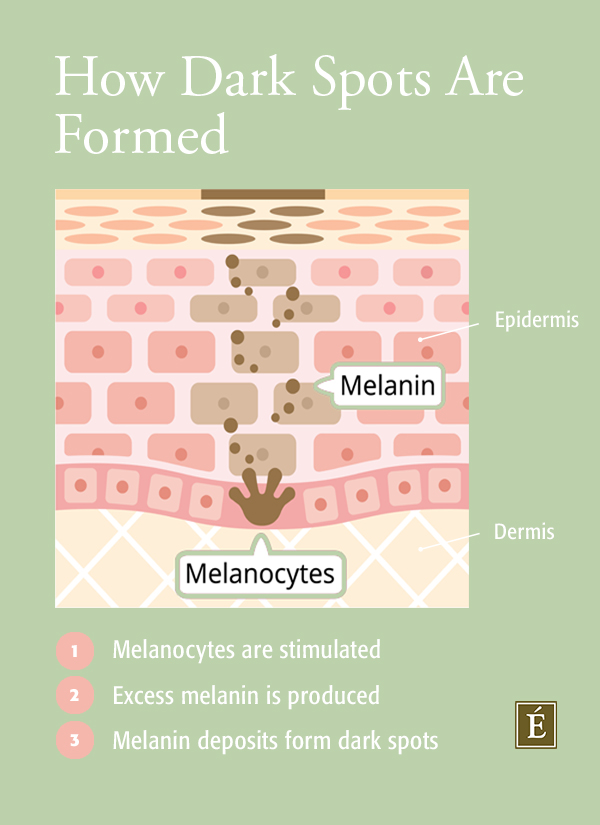
Whether your skin tone is dark or light, your skin contains a pigment called melanin. Produced by cells called melanocytes, melanin acts as a form of protection for the skin. However, when hyperpigmentation occurs, your skin produces excess melanin which forms deposits, creating spots and patches darker in color than the surrounding skin. Although hyperpigmentation affects people of all skin colors, it tends to affect darker skin types more frequently. Here are three reasons why you could be suffering from dark spots:
Sun Exposure
The number one cause of dark spots is sun damage. When stimulated by harmful UV rays, melanocytes react by releasing melanin which acts as a natural sunscreen. Melanin is useful because it absorbs the energy from UV rays and redistributes it. However, the sun can trigger the production of too much melanin, causing dark spots and patches of skin.
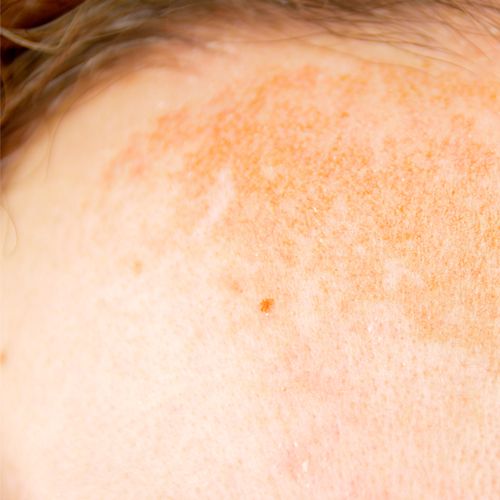
The sun is not just the root problem for sun spots, it also causes the dark marks that we call age spots or liver spots. This type of hyperpigmentation is also caused by sun damage, accumulated over many years of exposure.“As you age,” according to Harvard Health Publishing, “years of being in the sun start to add up.” Most common in adults over the age of 55, these tan, brown or black spots tend to speckle the areas most exposed to the sun: face, hands, back, feet and shoulders. Aging can also intensify the appearance of hyperpigmentation for two reasons. First, as we age, melanocytes decrease in number but increase in size and pigment production. Second, older skin tends to look thinner, paler and more translucent, emphasizing the appearance of dark spots.
Hormones
When hormone levels zigzag up and down, one of the most common side effects is a change in pigmentation called melasma. Frequently seen during pregnancy, hormonal therapies or even changes in birth control, a rise in hormones stimulates the production of melanin. Pregnant women often develop dark patches on the nose, cheeks, jawline, forehead or chin, creating a pattern called “mask of pregnancy” or “chloasma.” This type of hyperpigmentation typically lasts until pregnancy ends or hormonal levels return to balance.
Exposure to the sun and heat can worsen the appearance of this hormonally-triggered hyperpigmentation. If you suffer from melasma and hope to unwind in a sauna or a session of hot yoga, you may want to rethink your chillaxing plans. A high-temperature environment can affect your hyperpigmentation and dark spots, helping dark patches enlarge and spread.
Inflammation
Dark spots can sometimes develop after inflammation or an injury to the skin, especially for those suffering from acne, eczema, allergic reactions or other skin conditions. Termed post-inflammatory hyperpigmentation, this type of discoloration is the skin’s natural response to inflammation. After a wound occurs, the skin becomes inflamed and, as it heals, the skin naturally produces excess melanin which darkens the skin.
Hyperpigmentation due to inflammation is especially common after breakouts. As the irritated skin heals from acne, a dark spot is left behind, ranging in color from pink to red, purple, brown or black. The worse the inflammation, the larger and darker the spot can be. Also, there’s a reason why the experts warn you to avoid picking your acne. Popping those pimples can increase the likelihood of developing pimple inflammation or a dark spot.
How To Prevent Dark Spots (Hyperpigmentation)
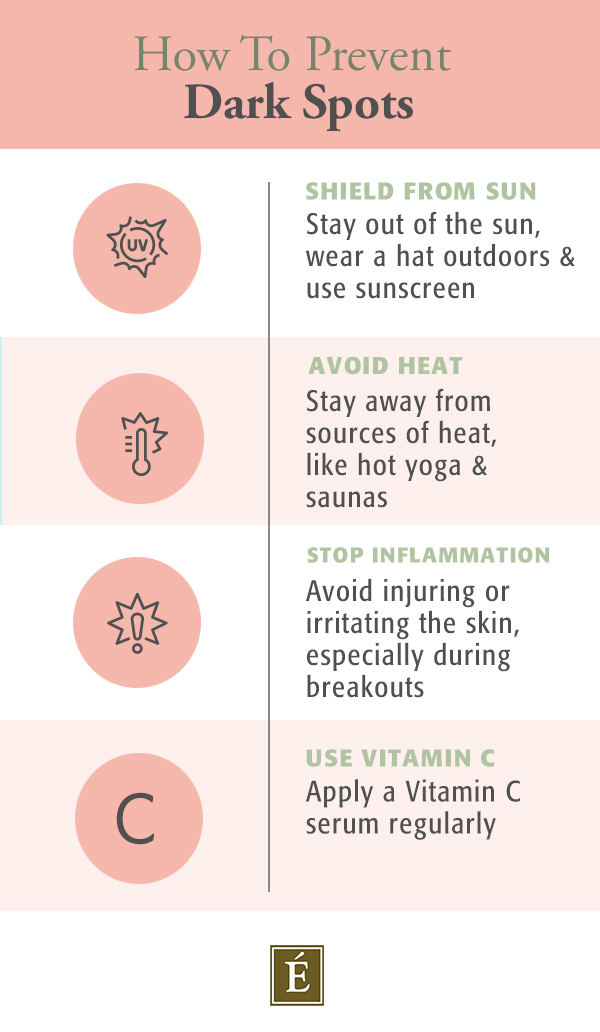
Protecting your skin from further damage is just as important as reducing existing hyperpigmentation. These are our top tips for preventing further dark spots from appearing on the skin:
Shield Yourself From The Sun
Brian Goodwin, International Educator at Eminence Organic Skin Care, says that time in the sun plays a “significant role” in the development of hyperpigmentation. It’s easy to underestimate its true impact. “Since we typically see the results of a day in the sun after we’ve retreated indoors, you may not realize that your consistent sun care habits (or lack thereof) are responsible for the formation of hyperpigmentation,” he says.
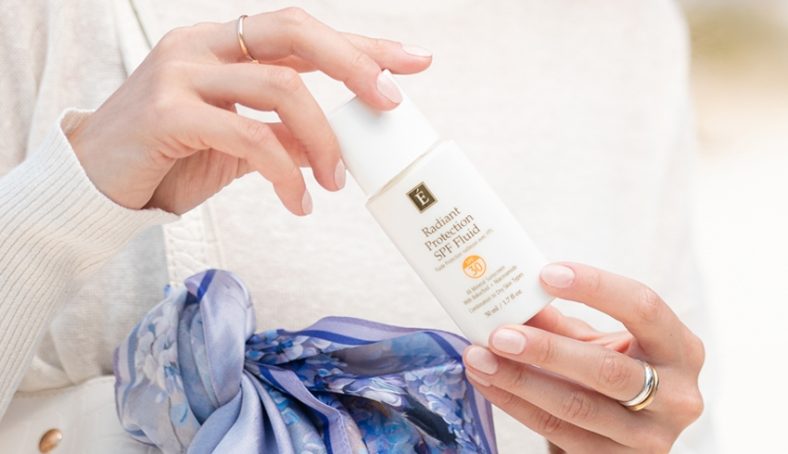
Since sun damage is one of the top causes of dark spots — including age spots — preventing exposure to UV rays is essential to preventing hyperpigmentation. This means staying out of the sun, wearing a hat outdoors and slathering on sunscreen. By avoiding or blocking UV rays that stimulate the production of melanin, dodging the sun is one of the best ways to prevent dark spots.
Avoid Heat
UV rays are not the only triggers for melanin production. Sources of heatcan also stimulate melanocytes to produce more pigment. Avoid activity with major heat exposure and keep the skin cool to reduce this potential problem for dark spots.
Stop Inflammation
Because inflammation is another major reason for hyperpigmentation, you’ll want to stop any harmful habits that injure or inflame the skin. Pimple picking is a no-no, as are any other activities that aggravate your complexion.
Use Vitamin C Regularly
Experts advise that a topical antioxidant like a Vitamin C serum helps with the look of dark spots when applied on a regular basis. Because Vitamin C interferes with melanin production (and provides so many other benefits for the skin!), keeping a bottle of this antioxidant-rich skin care product on hand is another essential step for preventing hyperpigmentation.
With this guide on the whys and hows of hyperpigmentation, we’re confident that you can even your skin tone and treat any pesky spots. Do you suffer from dark spots? Visit your nearest Eminence Organics Spa Partner to get a personalized skin care consultation.