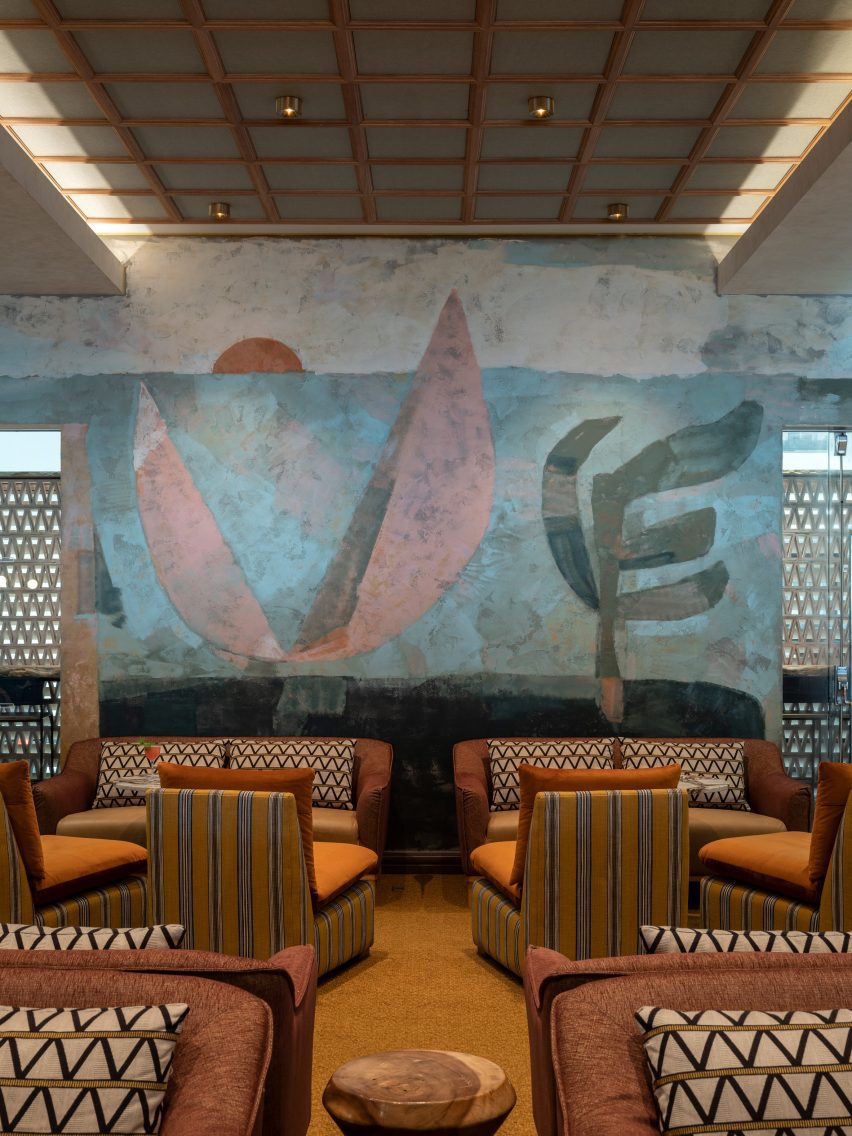
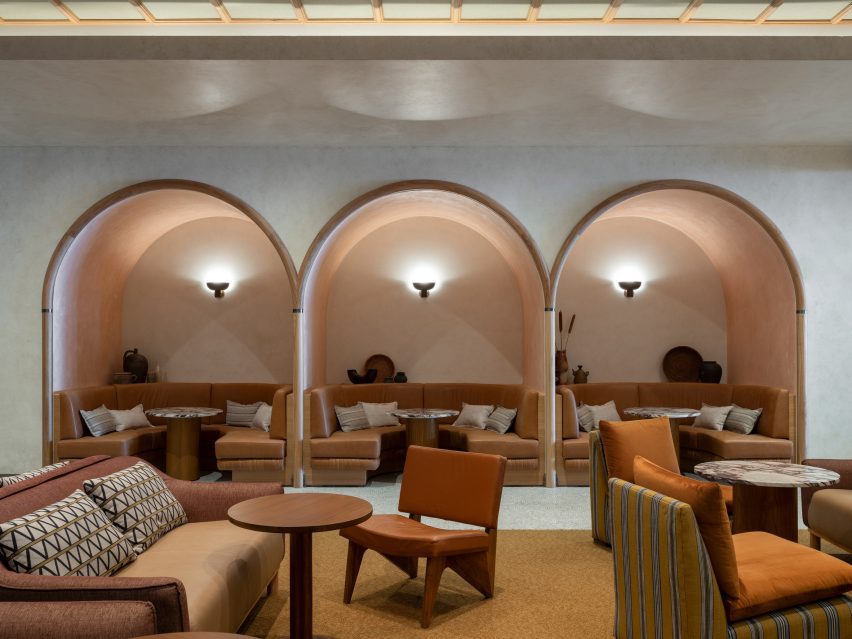
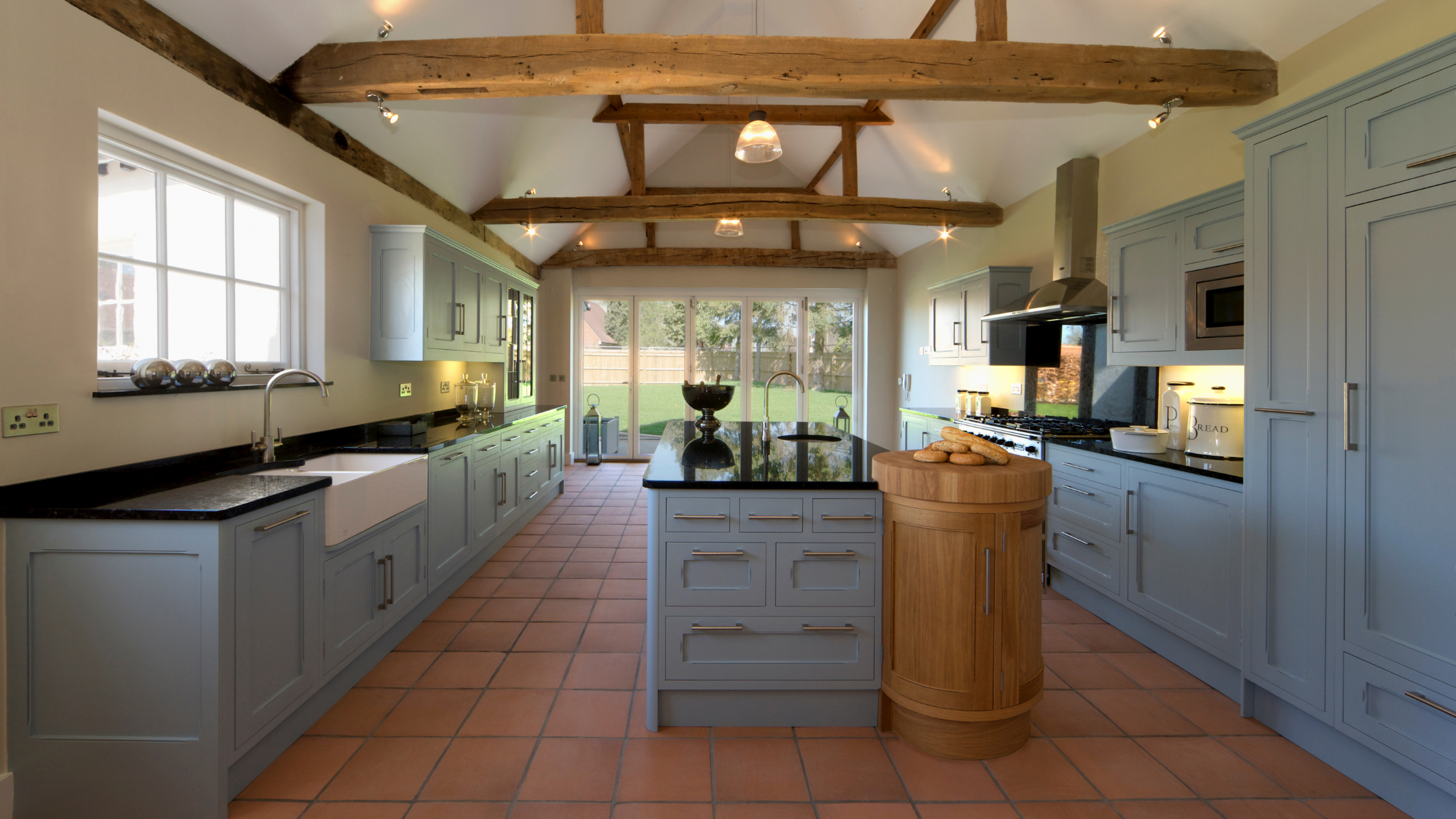
New York City…the Big Apple. It’s ironic for a city that boasts go big or go home that residents of this sprawling city find themselves fighting for space; and their kitchen is no exception. And especially in the melting-pot inspired region which influences eclectic and pronounced design choices, how do you create a New York City-inspired space, one that blends functionality and aesthetics?
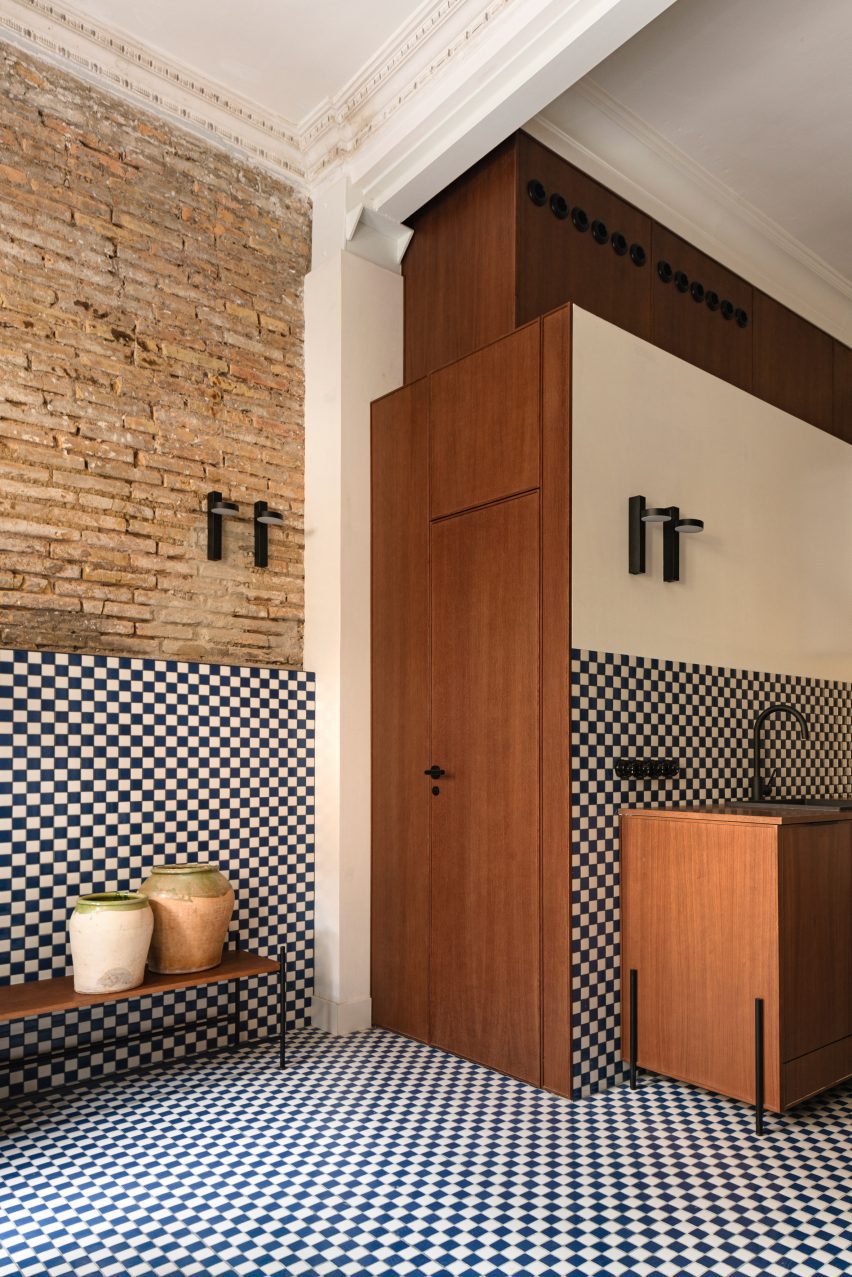
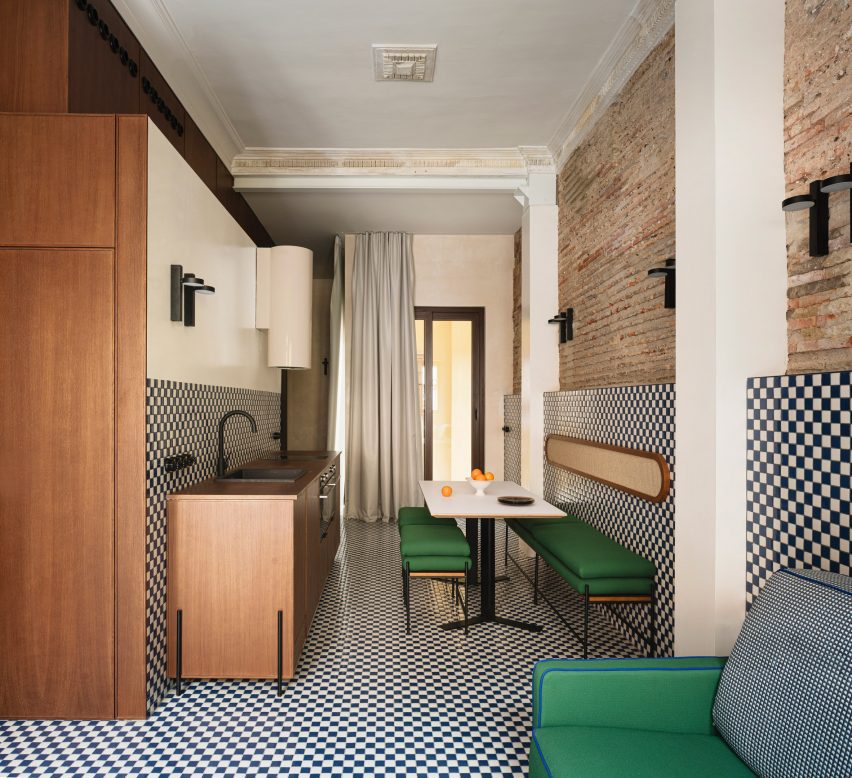
Spanish interiors studio Viruta Lab has renovated a compact house in El Cabanyal, Valencia‘s traditional fishing neighbourhood, using geometric blue-and-white tiling for an understated nautical aesthetic.
Built in 1946, the humble two-storey building once belonged to the grandparents of the current owner but had been boarded up for many years.
Viruta Lab has renovated a former fisherman’s house in Valencia
Viruta Lab was brought on board to transform the small 85-square-metre home into a modern holiday residence while respecting its great sentimental value to the family.
“Emotion was a very important starting point,” the studio told Dezeen.
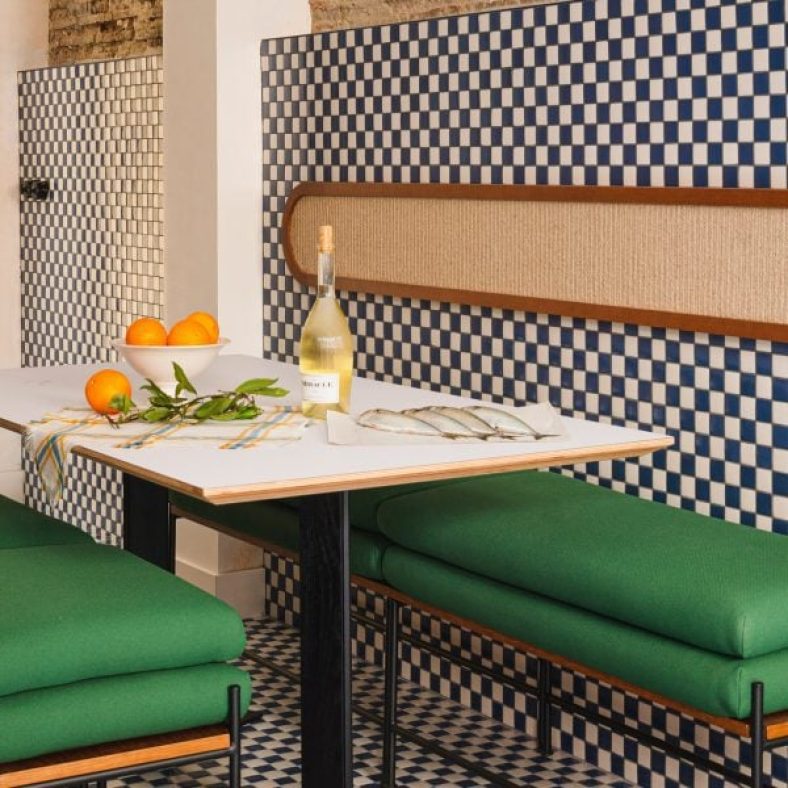
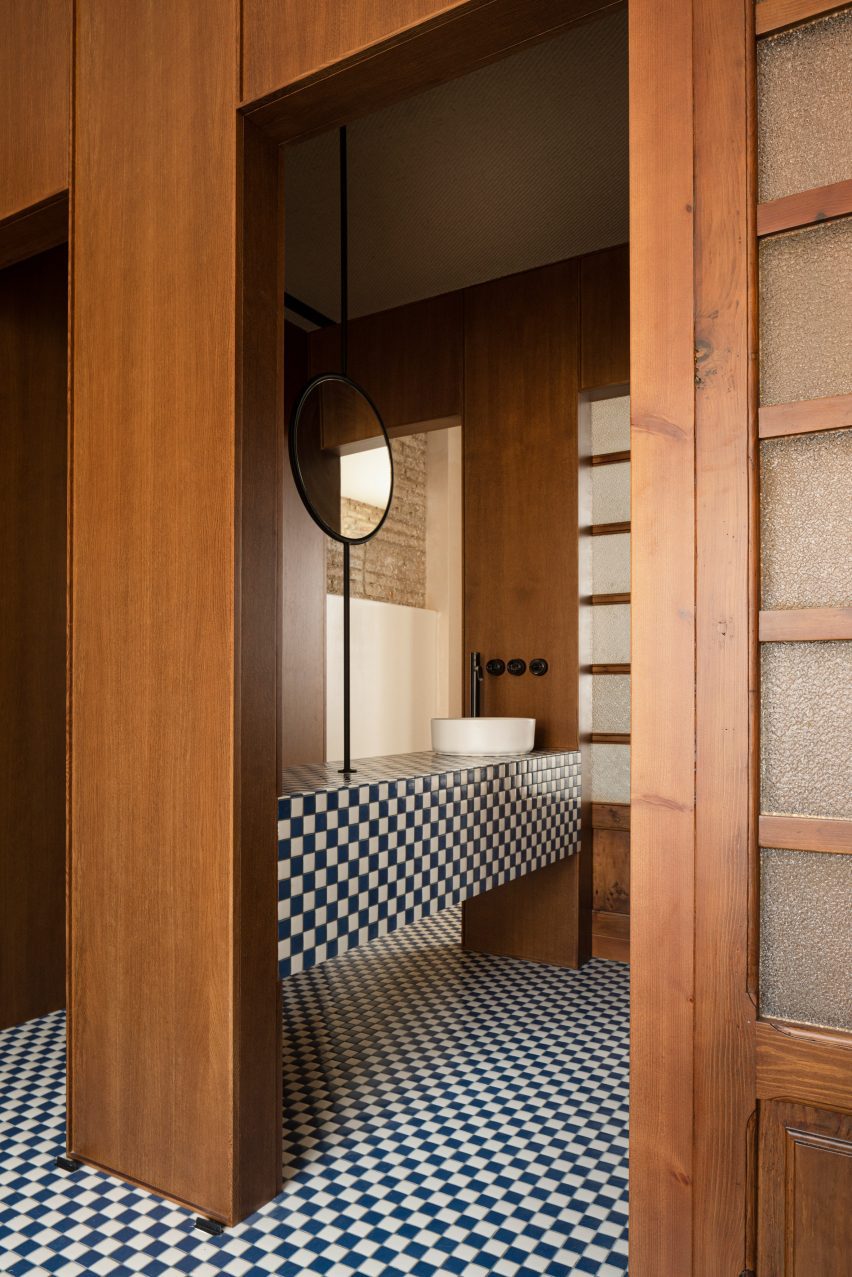
The interior is dominated by chequerboard tiles
“The house is a family legacy and the image they have of it is very deep, so it was necessary for any intervention to be as respectful as possible and with a language that they understood and took as their own,” Viruta Lab continued.
“We understood that the architecture already had a value, that we only had to beautify it, preserve it.”
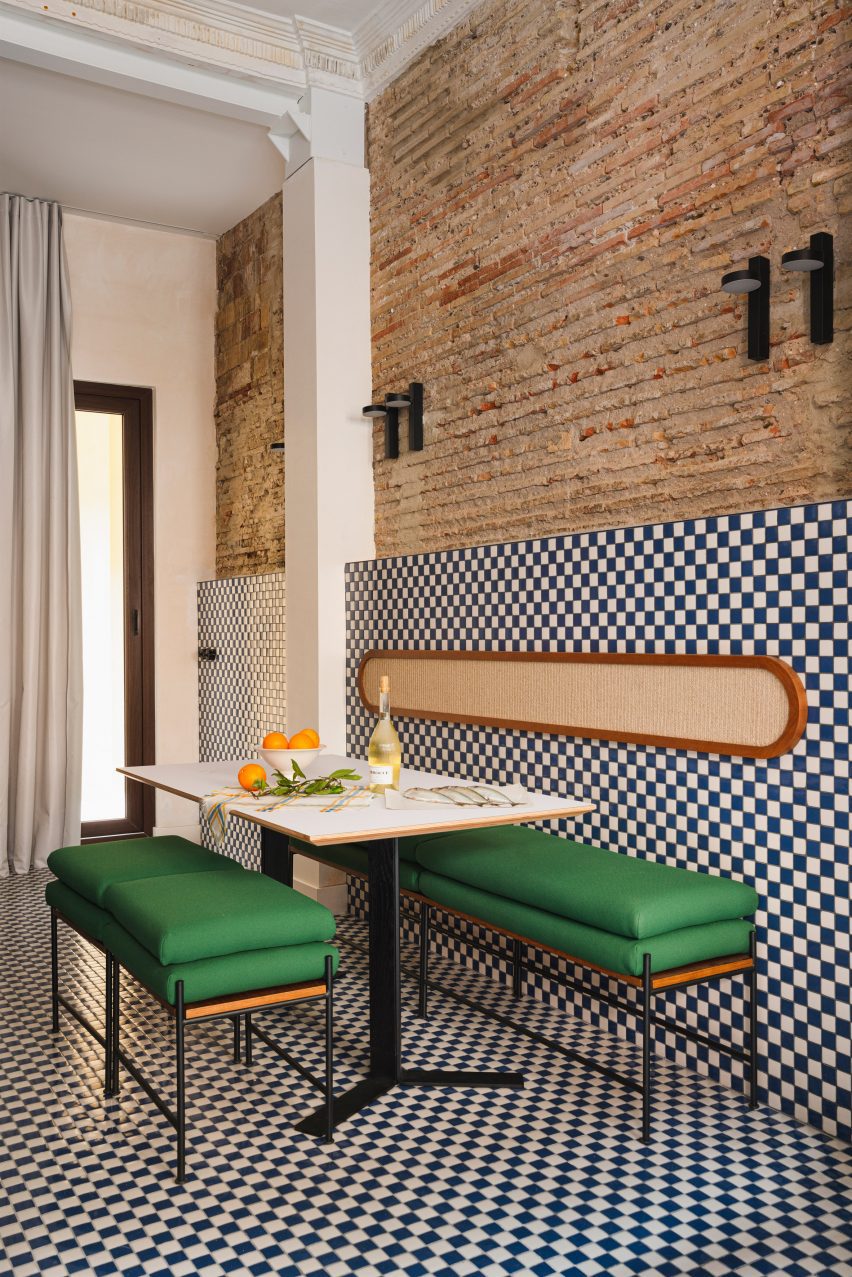
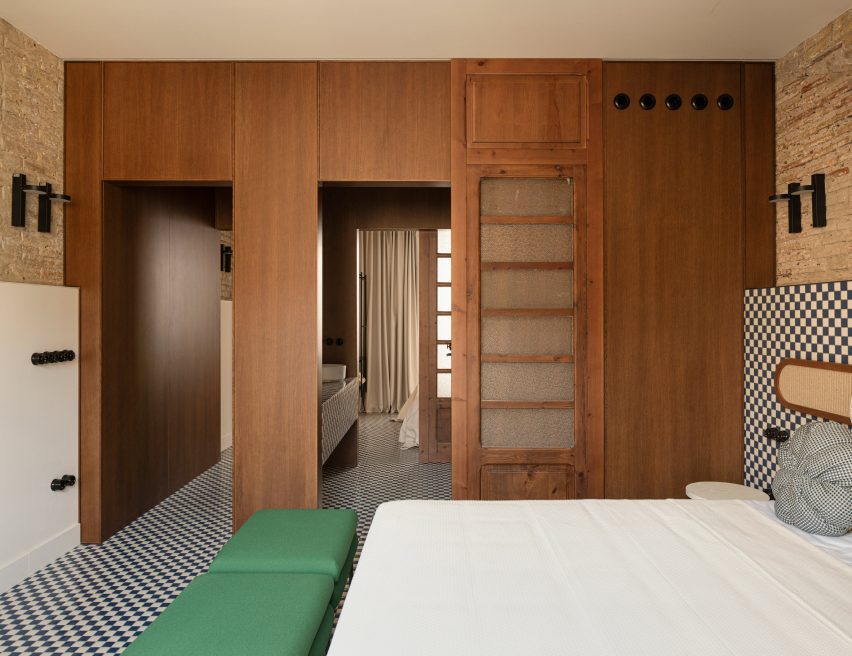
Green upholstery provides a contrast with the blue-and-white colour scheme
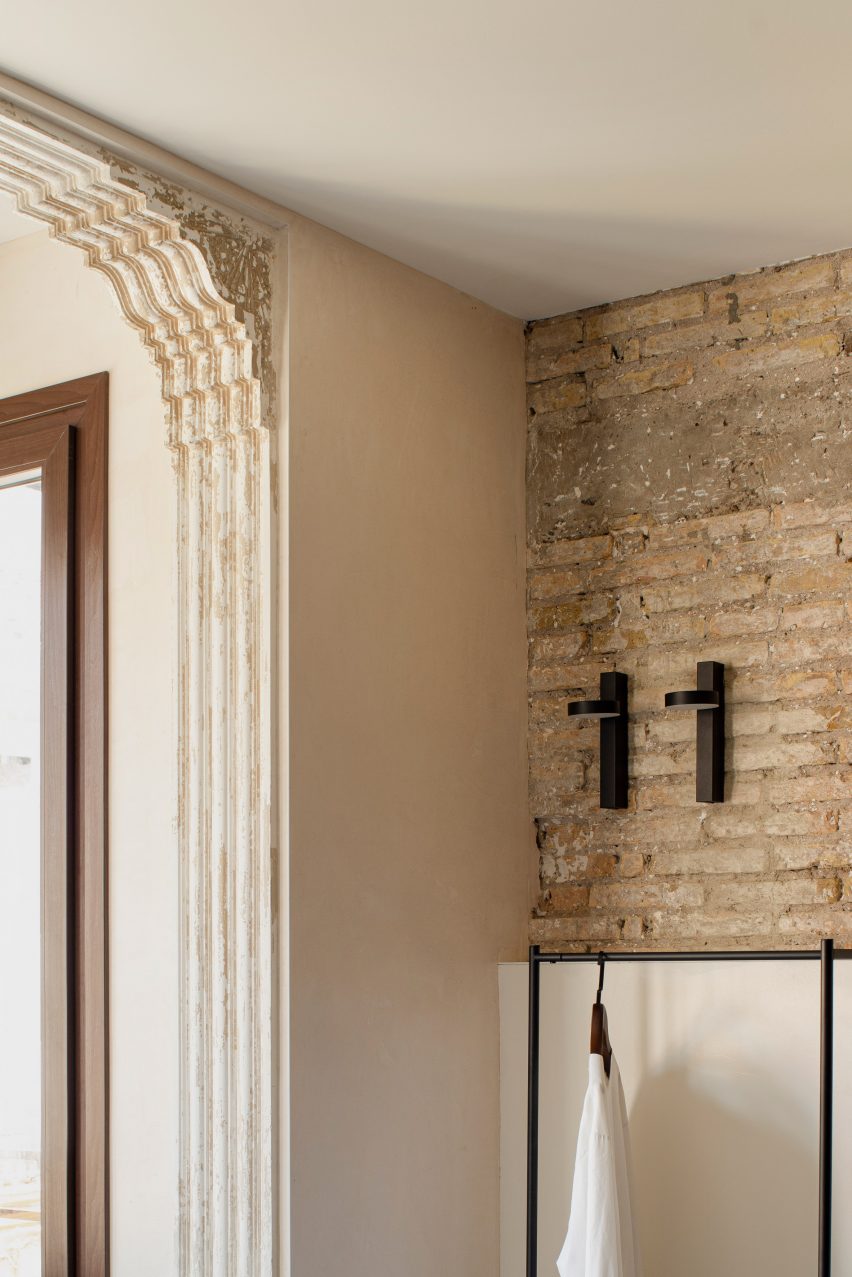
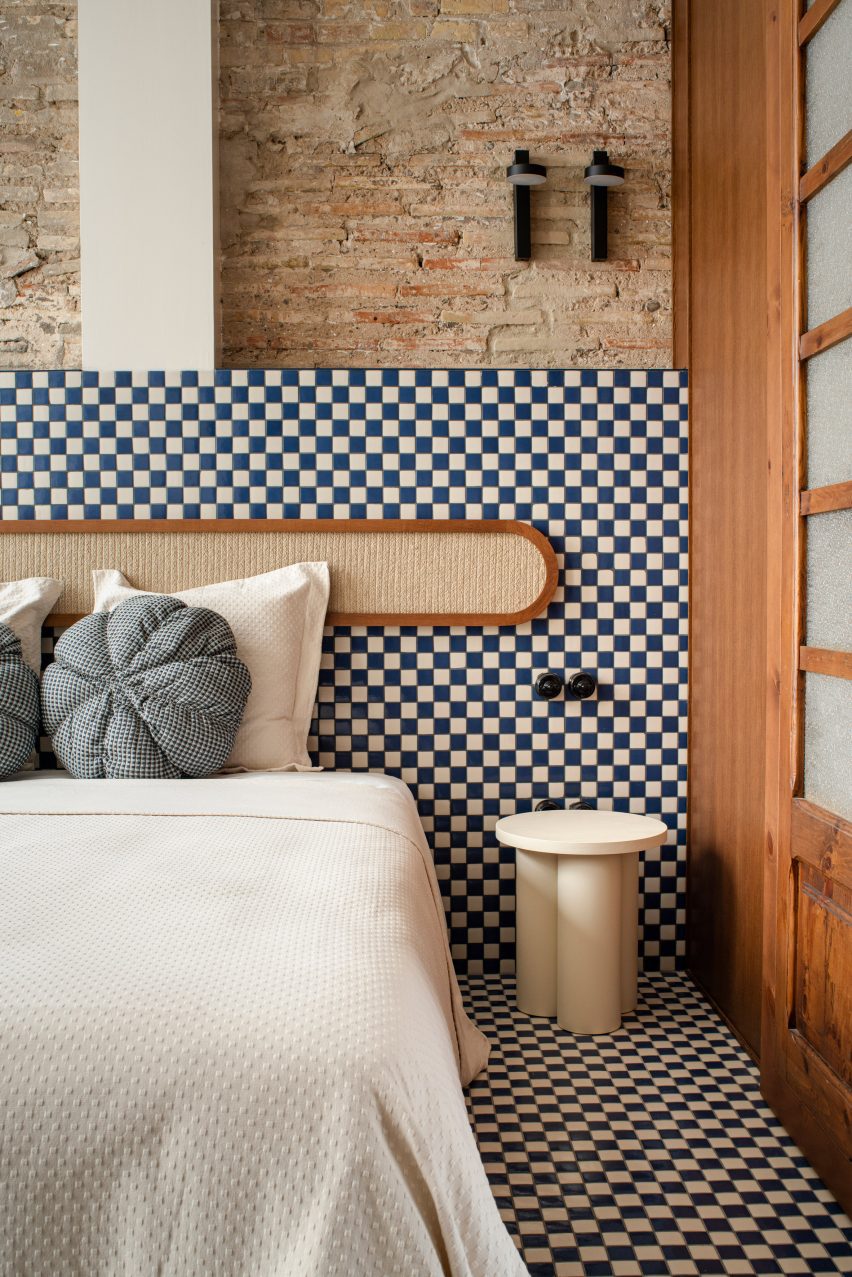
Viruta Lab uncovered the building’s original brick walls from under layers of peeling paint and carefully repaired the pre-existing mouldings “to give height and nostalgic value to the interior design”.
Liberal chequerboard tiling provides a contrast to these traditional design details, featured throughout all the rooms from the kitchen to the sleeping quarters.
Viruta Lab restored the home’s original mouldings
In a suitably nautical palette of navy and off-white, the tiles reference the great variety of tiled facades found in the El Cabanyal neighbourhood.
“The dominant colours on the facades of the Cabanyal are white, blue and green, which are associated with a lifestyle linked to the resources offered by the sea,” the studio said.
“It was clear that we had to respect the local traditions, the architecture and the essence of the house and give it a maritime aesthetic, reinterpreting the Mediterranean style to adapt it to the tradition of the neighbourhood using its own materials.”
Green shows up throughout the interior in the form of simple upholstered furniture – including a sofa, pouffe, benches and stools – all custom-designed by Viruta Lab for this compact space.
European oak was used to form joinery details
The interior woodwork in European oak was stained to resemble Canaletto walnut, matching the tones of the two remaining original interior doors that were painstakingly restored and repurposed as sliding doors.
“We wanted the woodwork to provide a quality counterpoint to the cold tones of the blues and greens, with an imprint and weight,” the studio said.
The remaining interior doors were restored and repurposed as sliding doors
Another key local material – esparto grass fibre – is less noticeable than the tiles but pops up throughout the house to add textural interest.
Traditionally used to make ropes, baskets, mats and espadrille sandals, the flexible natural material was repurposed to form headboards and backrests, and even clad the suspended ceilings in the bathrooms.
Esparto grass was used to from headboards and backrests
“This material has been used because of its roots in the traditions and life in the Mediterranean area, especially in the Valencian community,” the studio said.
“For Viruta Lab, the legacy comes from its use by men of the countryside and the sea, by the original residents of the Cabanyal, those men who used to wear espadrilles.”
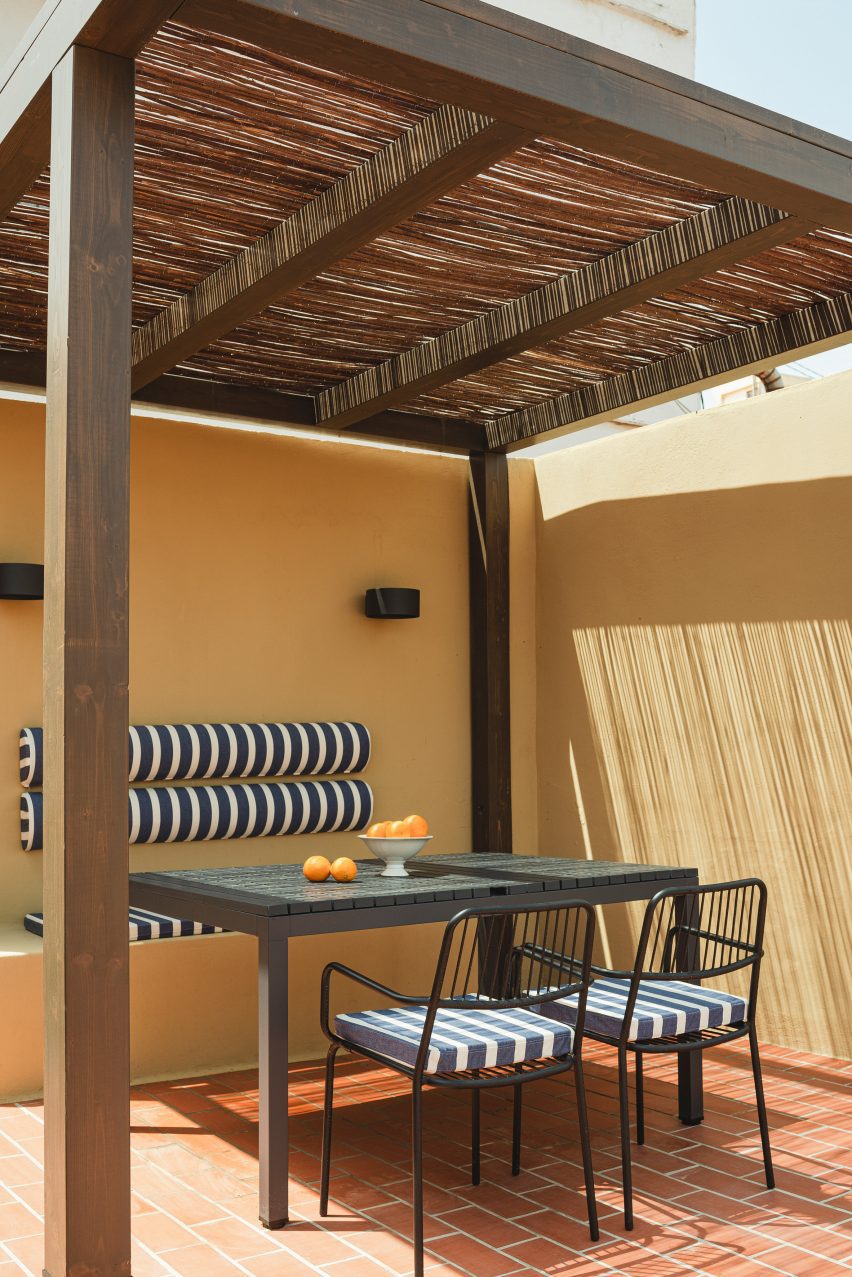
The house has a shaded outdoor dining area on the roof
As well as a clay-tiled roof terrace with a shaded outdoor dining area, the house also features a sensitively restored inner courtyard, complete with a stone water trough where the owner’s grandfather once dried his fishing nets at the end of a day’s work.
Room types are organized by bold colours at this hotel in Louisville, Kentucky, which was designed by US hospitality group Bunkhouse and Philadelphia-based design studio Rohe Creative.
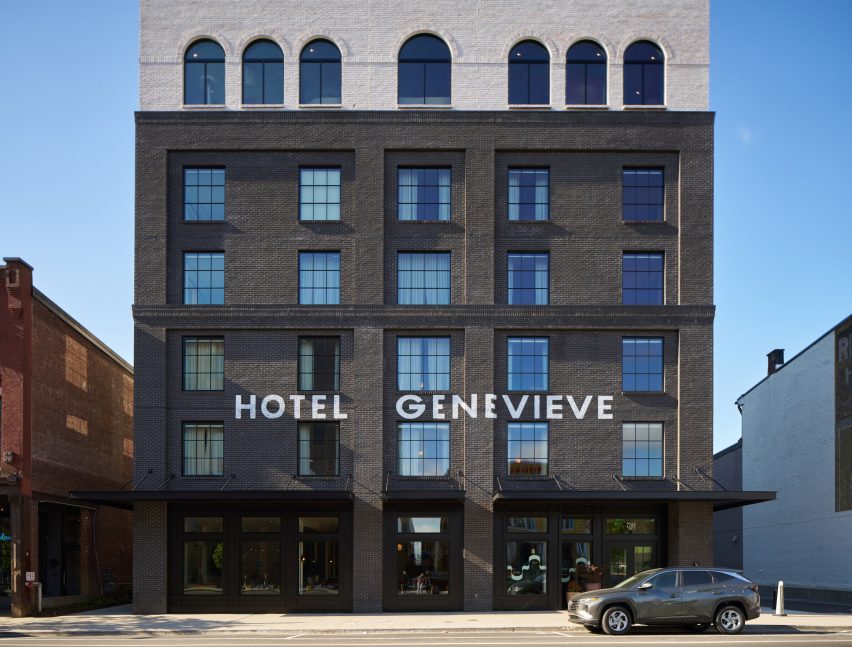
Located in Louisville’s East Market district, also known as NuLu (New Louisville), Hotel Genevieve occupies a new six-storey, black-brick building that’s within walking distance of some of the city’s biggest tourist attractions.
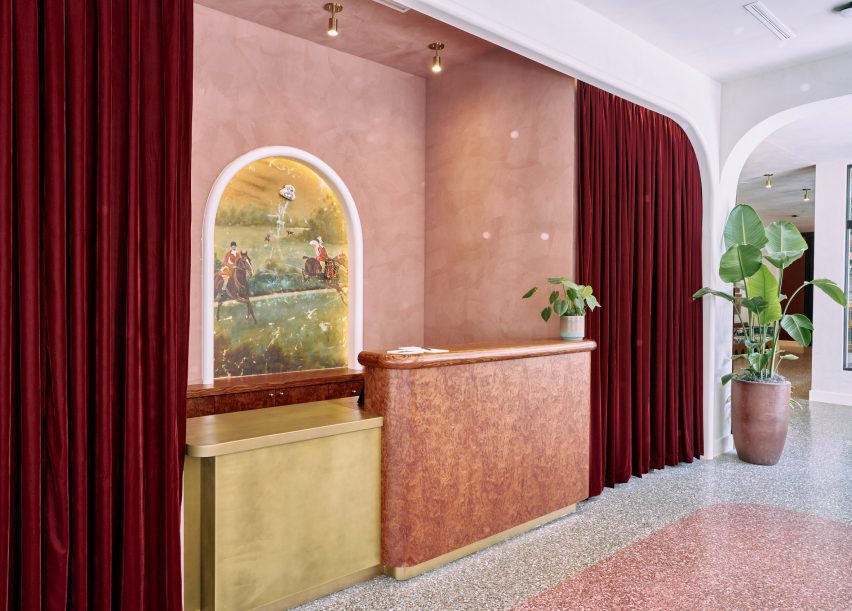
In the hotel’s lobby, pink terrazzo flooring matches the plasterwork behind the reception desk
The hotel takes its name from a regional type of limestone, Saint Genevieve, which is a key ingredient in local bourbon production and also prevalent in Texas, where operator Bunkhouse is based.
The company collaborated with Rohe Creative on the interiors, which are intended to reference Louisville’s history.
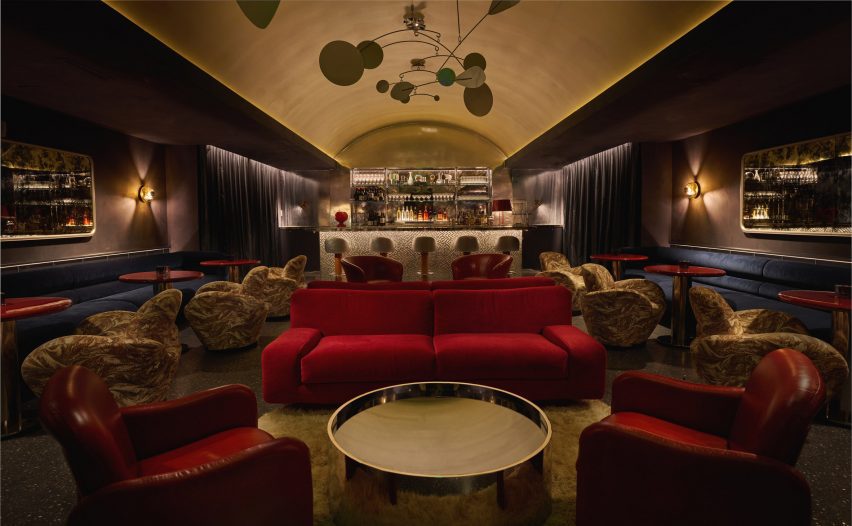
Communal spaces for guests include a speakeasy-style bar with a golden vaulted ceiling
In the lobby, pink tones of terrazzo flooring are echoed in the plasterwork behind the reception desk, surrounding an equestrian-themed mural.
Artworks are displayed on white walls and in front of red velvet curtains to form a gallery around the lobby seating areas and corridors.
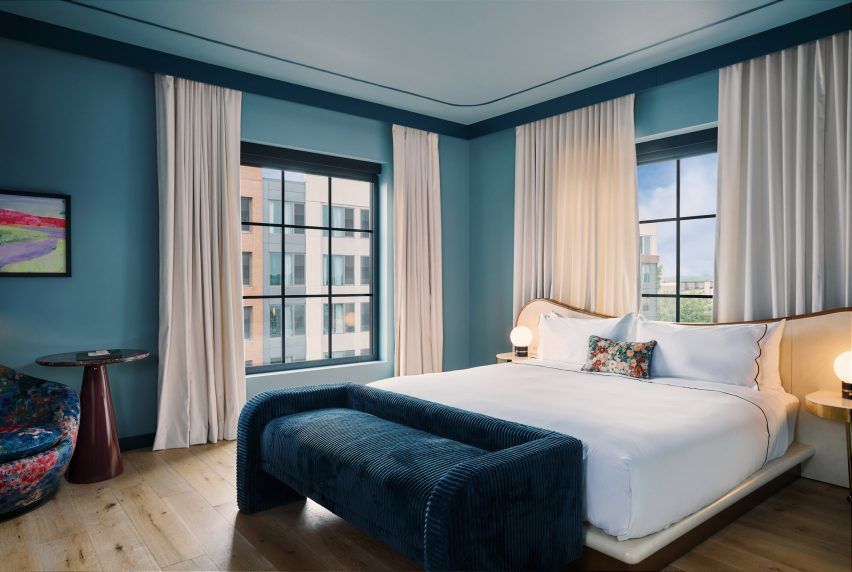
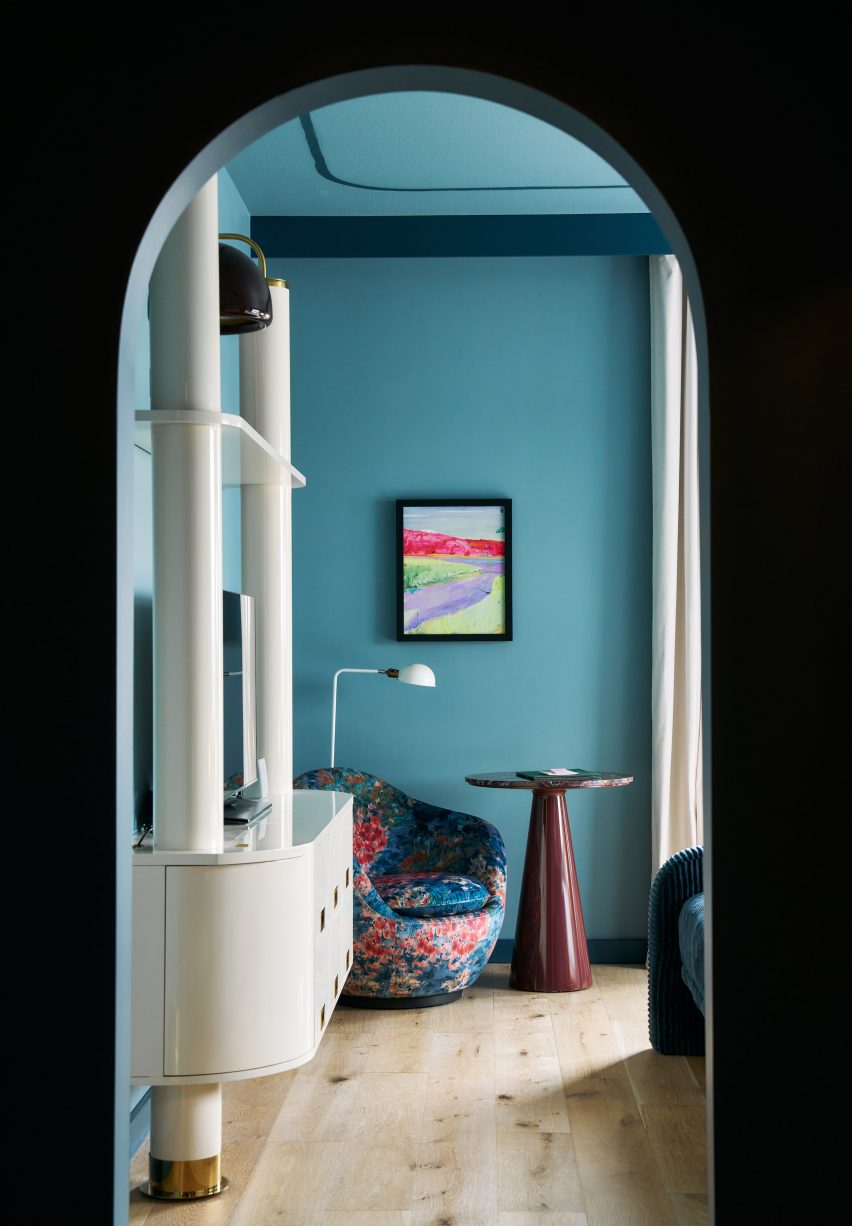
The rooms are coloured by type and the smaller spaces feature a blue palette
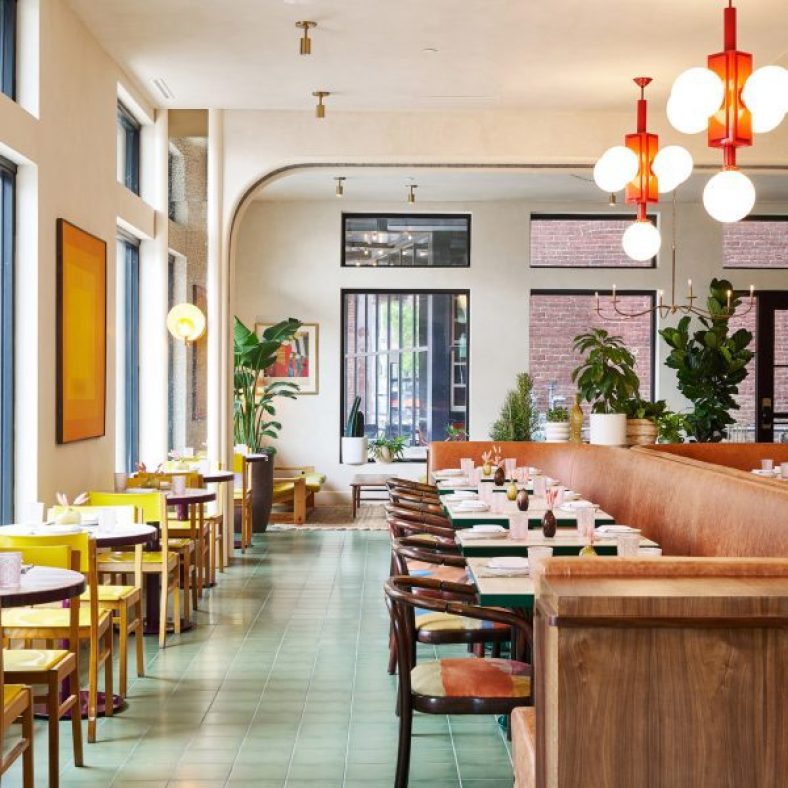
The adjacent all-day restaurant, Rosettes, serves food made with local ingredients and is influenced by al fresco Parisian cafes and chef Ashleigh Shanti’s Southern background. This bright, brasserie-like space combines green-tiled floors with colourful dining chairs and retro light fixtures.
“Richly decorated, each design accent tells a story, from bold usages of colour to a playful mix of vintage and modern furniture, and a vivacious art program featuring local talent,” said the hotel team.
The chosen colour in each room extends across the wall and ceiling, as well as into the bathrooms
A mini market on the ground floor, which is “part convenience store, part pop art installation”, sells locally sourced provisions, handmade artisanal goods, and coffee and snacks to go.
There’s also a dark and moody speakeasy-style bar with lounge seats and a golden vaulted ceiling.
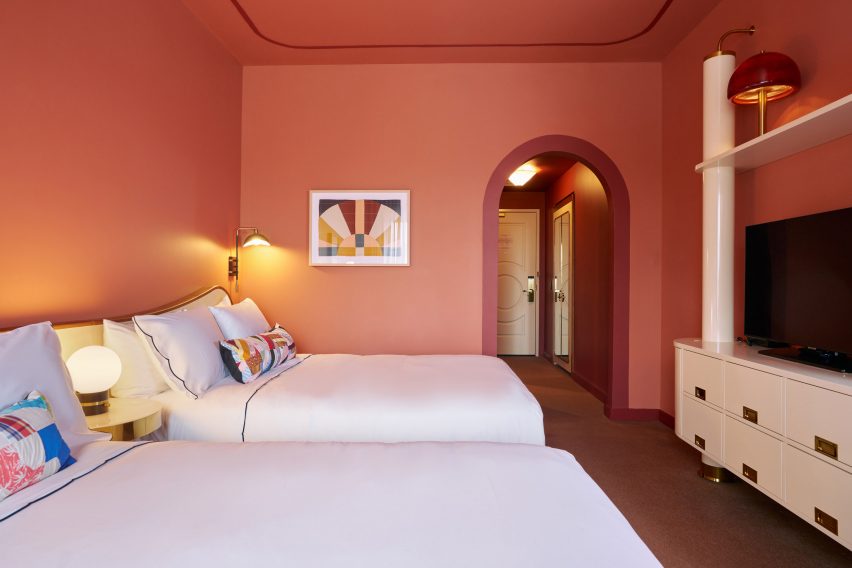
Double Queen rooms are decorated in a terracotta hue
“Luxurious and feminine architectural details bring life to the space and reference the city’s namesake, King Louis XVI, heavily featuring Louisville’s vibrant local flora and fauna, with goldenrod [plants] shining throughout the suites and ground-floor restaurant,” said the hotel team.
The hotel’s 122 guest rooms are each painted a distinct colour that correlates with their size or type. These hues cover the walls and ceilings, and also extend into the bathrooms via floor and shower tiles.
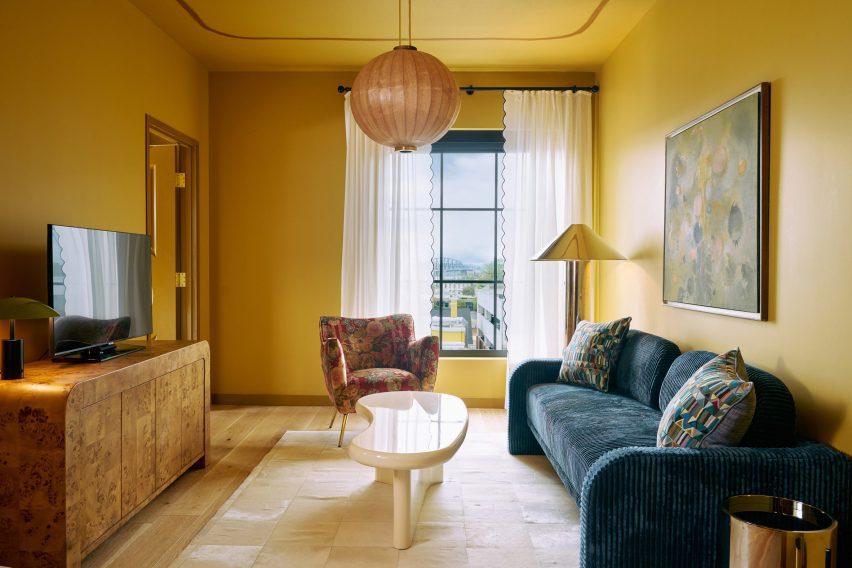
Four Suite Genevieve rooms have a separate living room and are coloured yellow
Smaller rooms, including the King Louie and Petite King categories, feature a blue palette, while the slightly larger Double Queens are decorated in a terracotta hue.
Four Grand King rooms accommodate a seating area and are also painted blue, while an additional four Suite Genevieve rooms have a separate living room and are coloured yellow.
All of the rooms boast custom features and fittings by ROHE, as well as paintings and prints by Kentucky-born artist John Paul Kesling.
The rooftop venue, Bar Genevieve, serves cocktails and French-Mediterranean food from an indoor space that opens to the outdoors.
Bar Genevieve on the top floor features teal accents and can be hired for private events
The bar area is accented with deep teal colours across the counter, stool seats, arched window frames and floor-to-ceiling velvet curtains that can be used to divide up the room.
Hotel Genevieve has also partnered with local organisations Black Soil Kentucky, Louisville Orchestra, and the Olmsted Parks Conservancy for programming across its varied communal spaces.
The hotel occupies a new black-brick building in Louisville’s East Market district
Kentucky draws visitors for its bourbon production and horse racing heritage, and demand for high-end accommodation in the state appears to be on the rise: a new five-star hotel called The Manchester also recently opened in Lexington.
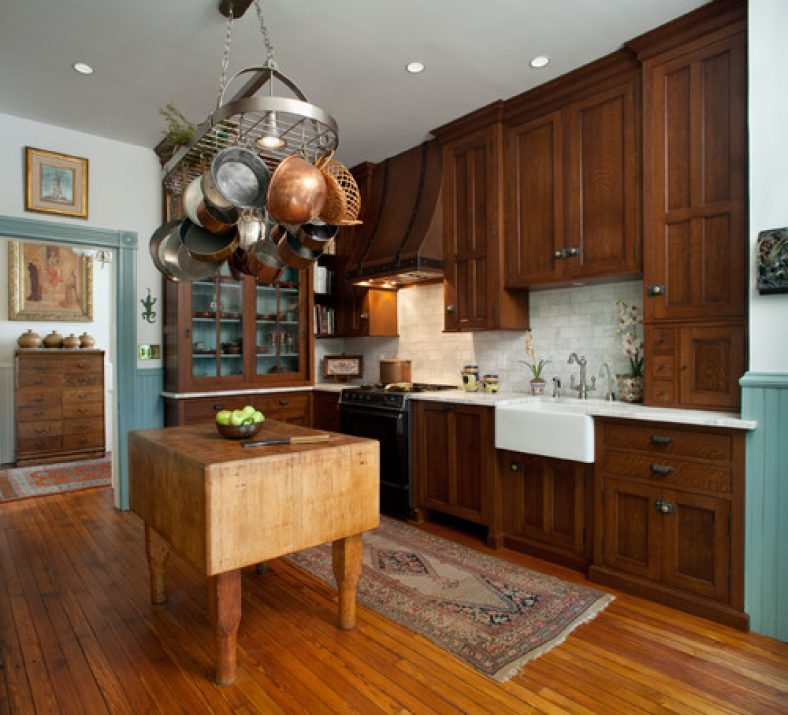
Are you interested in cabinetry that is both beautiful and durable? Oak cabinets are a definite possibility. Over the past decade, the relentless pace of kitchen design trends have made it seem like oak is a non-option, but plenty of kitchen design and build teams will tell you otherwise.
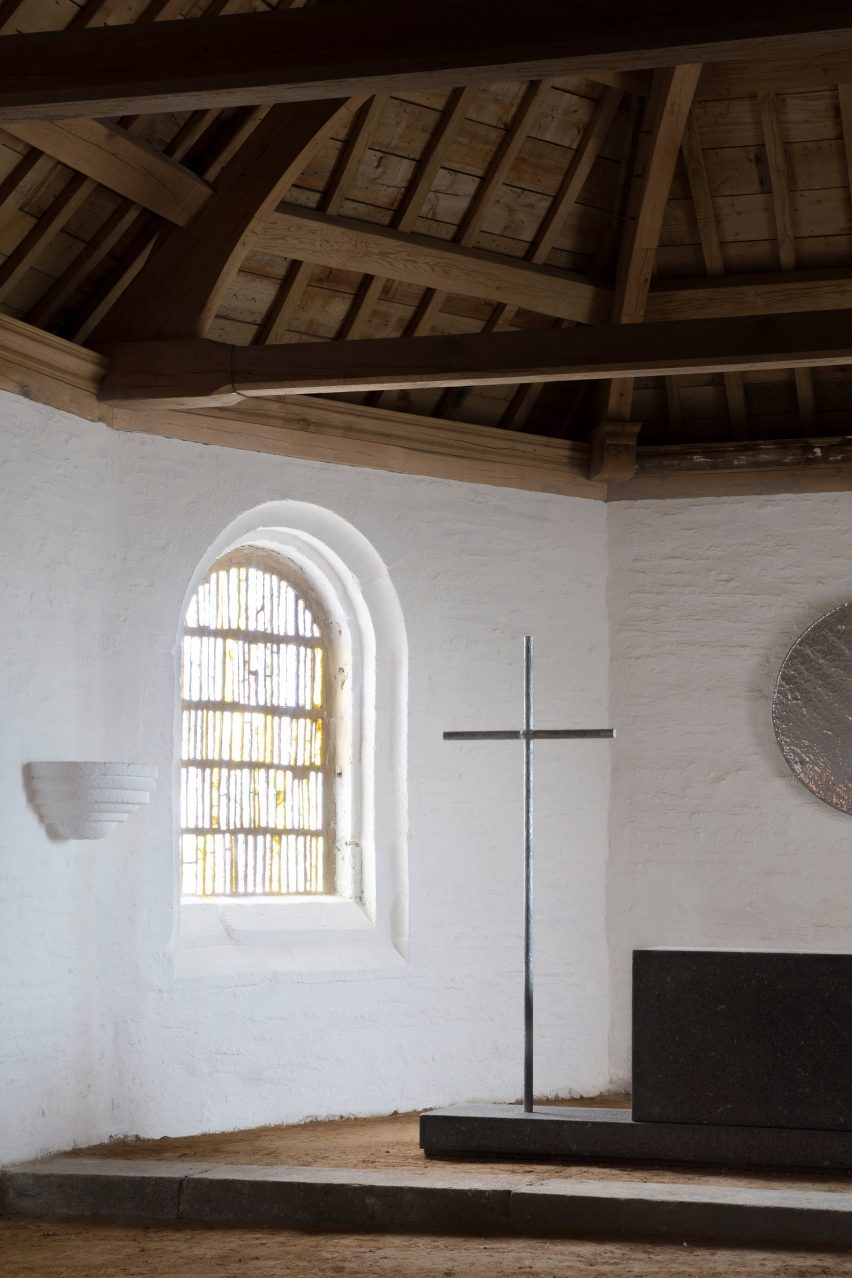
Following the wildfires that ravaged Brittany‘s Arrée mountains last summer, Ronan Bouroullec has reimagined the interior of the region’s historic Chapelle Saint-Michel de Brasparts as part of a full restoration.
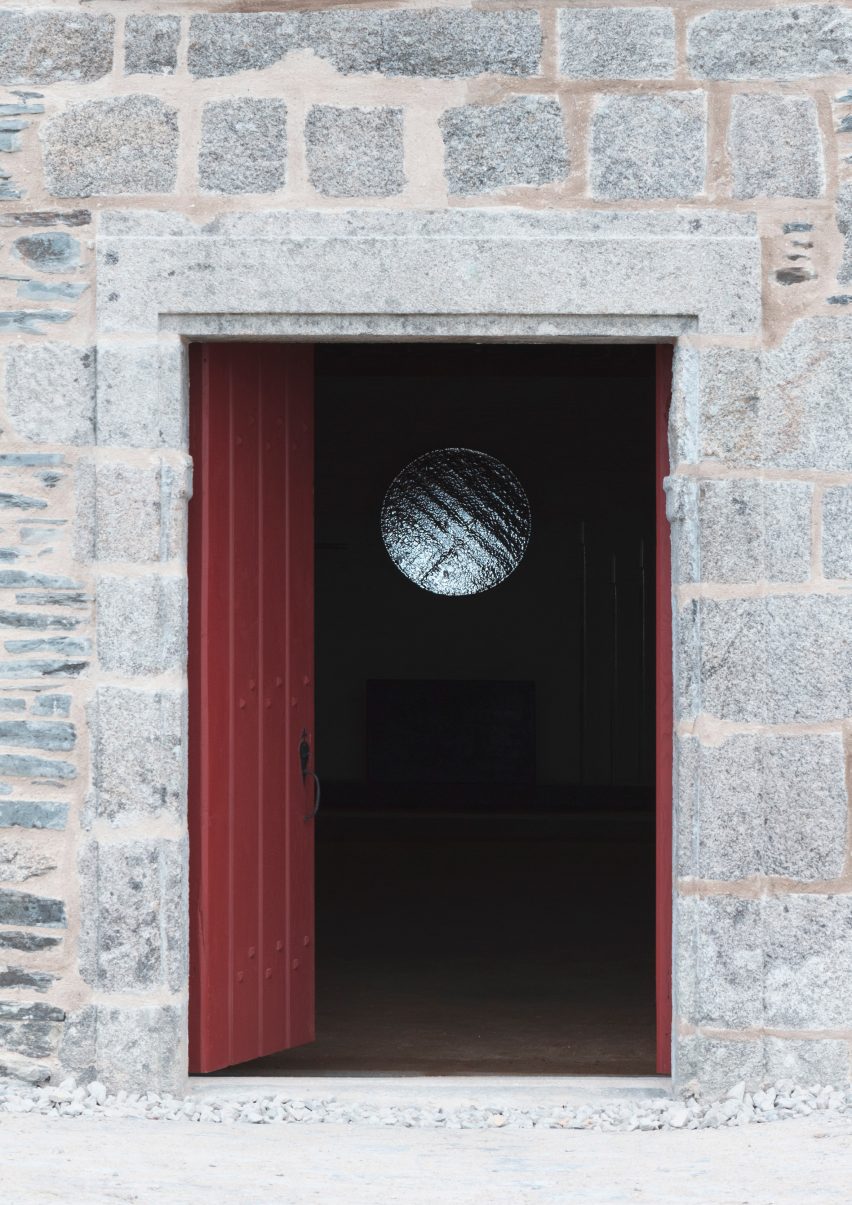
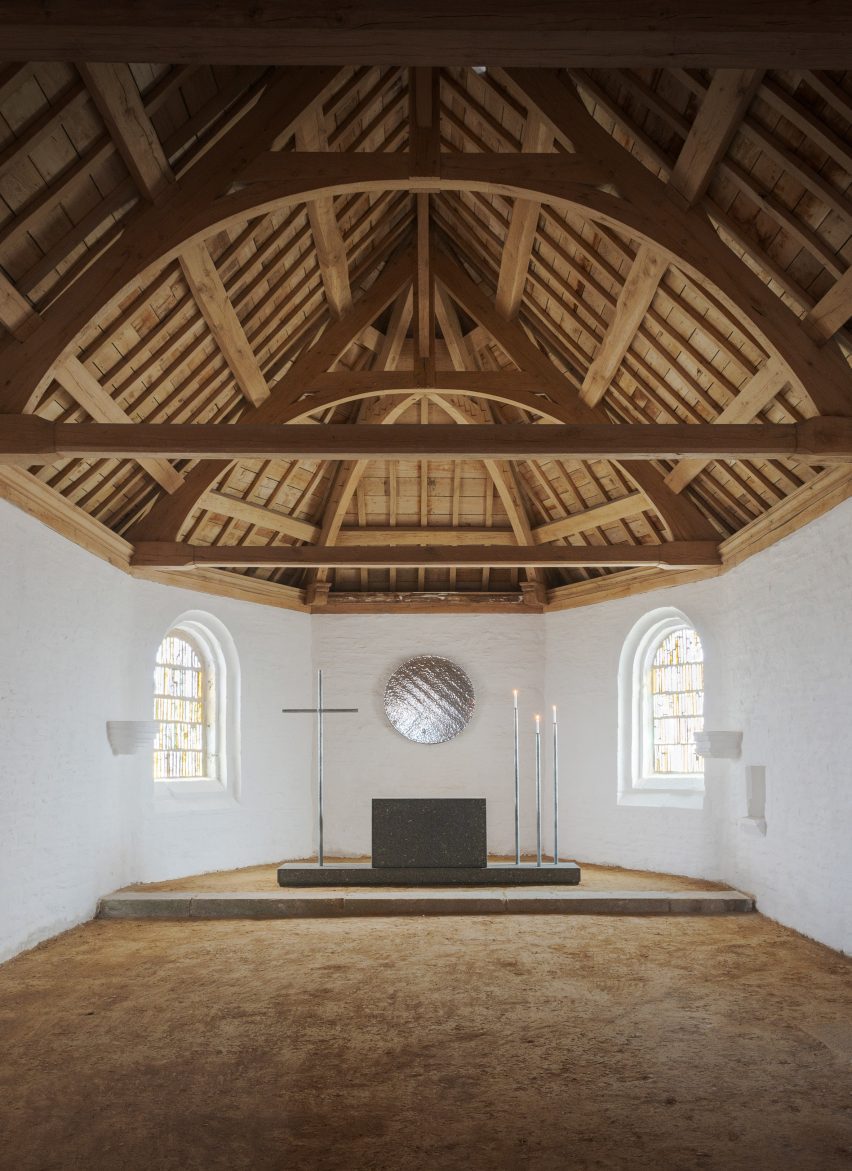
Originally built at the end of the 17th century, the chapel is a modest building without lighting or electricity, perched on top of a prominent hill that rises above the surrounding moorland.
Chappelle Saint-Michel de Brasparts has undergone a full restoration
Breton businessman François Pinault, founder of luxury group Kering, financed the chapel’s restoration after it was damaged during the wildfires, patching up its metre-thick stone walls, rammed-earth floors and the exposed oak frame supporting the slate roof.
Bouroullec, who was born and raised in Brittany, remembers the chapel from his childhood and was compelled to design a new altar and several furnishings for the building as part of the refurbishment.
Working in collaboration with local artisans, he used a trinity of roughly-hewn materials – granite, steel and glass – that would stand the test of time while reflecting the building’s rugged rural location.
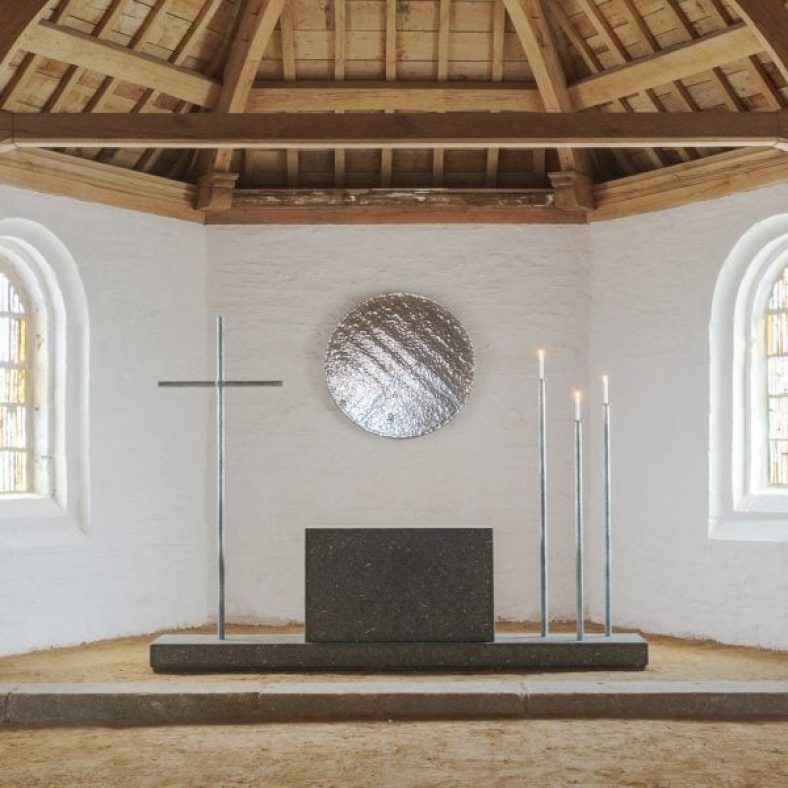
Ronan Bouroullec designed a new altar for the chapel
“Heavy enough not to be moved, sturdy enough not to be damaged, rough enough not to require cleaning, the elements that Ronan Bouroullec has placed in the chapel must succeed, despite or because of these characteristics, in creating a sensory experience,” wrote Martin Bethenod, former CEO of Pinault’s Bourse de Commerce museum, in an introductory text for the project.
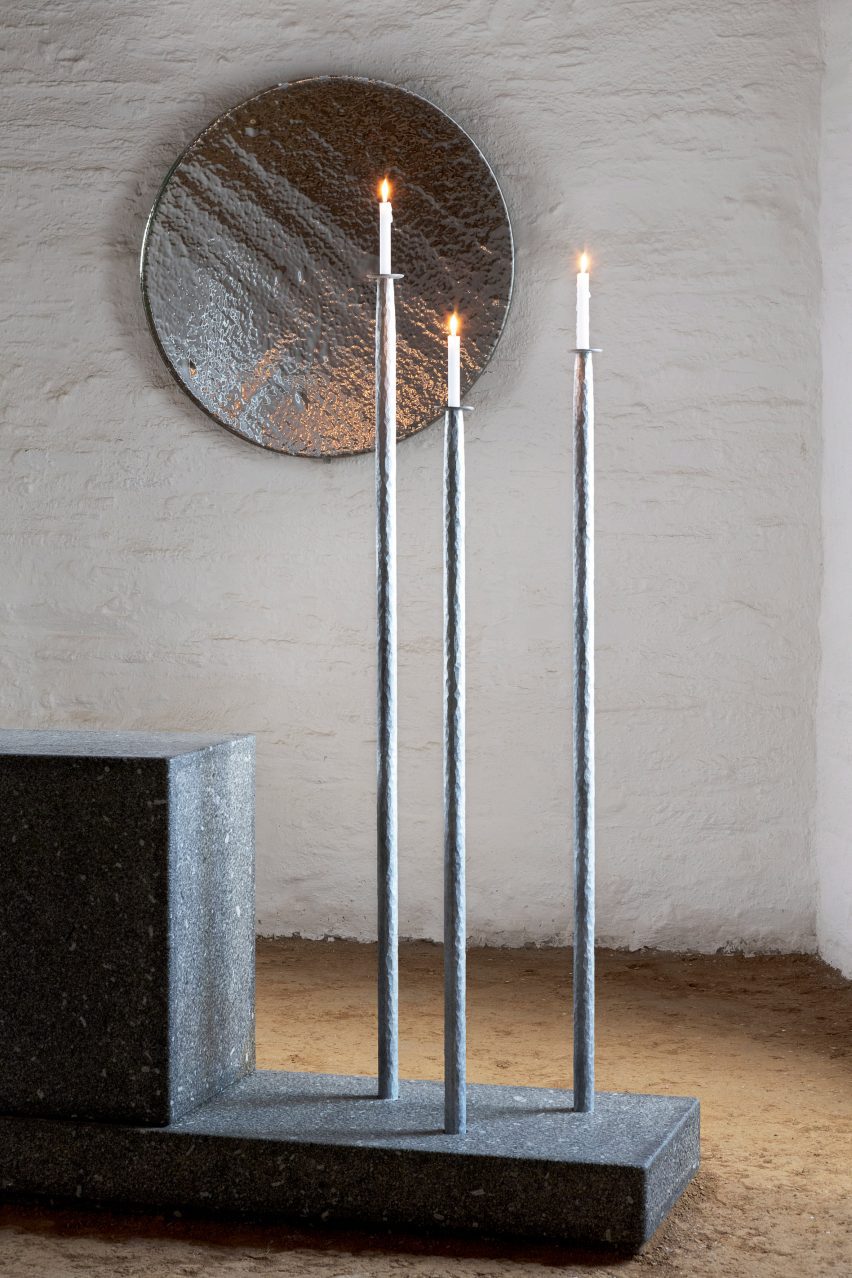
“The bush-hammered granite, blurred glass, hammered steel, the choice of a galvanized finish to soften the contrast of the cross and candlesticks with the whiteness of the lime-rendered walls – each intervention combines sensations of roughness and softness, of force and tremor.”
The granite altar is topped with a simple hammered-steel cross
Nuit celtique de Huelgoat granite – quarried less than 15 kilometres away from the chapel – was cut into three pieces before being worked by local stone mason Christophe Chini to create an altarpiece, its horizontal base and a console table for candles and offerings.
Bethenod compares the dark stone, studded with shards of white, to “the starry night sky over the chapel, virtually devoid of light pollution”.
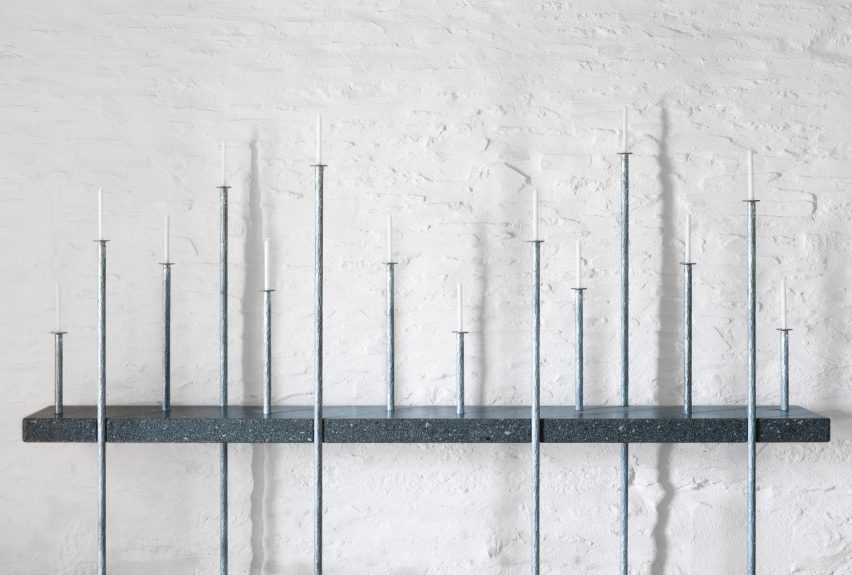
The metal elements – a simple cross and a group of three tall candle holders, all in hammered steel – were the result of another collaboration, this time between Bouroullec and Roscoff-based metalworker Mathieu Cabioch.
Some of the candles stand directly on the altar while the rest are integrated into the Brutalist console table, which consists of a long slab of granite, seemingly supported by several of the steel candle holders.
A mirrored glass disc is mounted centrally behind the altar
The final element in Bouroullec’s material trinity is glass, in the form of a large mirrored disc that hangs centrally behind the altar.
Made by glassmakers from the Venice area, with whom Bouroullec has worked for several years, the piece was designed to create a dialogue with the two stained-glass windows in the apse, which are the chapel’s only surviving decorative element.
“More than a mirror, more than an object, it is a light source without physical substance, as if a round hole had been made in the wall to reveal daylight, unpredictable and constantly changing,” said Bethenod.
Steel candleholders are also integrated into a wall-mounted console
The magic of television has bamboozled us once again… The Dunphy clan from Modern Family, the hit sitcom airing on ABC in 2009, spent much of their time in one another’s Los Angeles, CA homes. Or so we think! Most prominent is Phil and Claire’s massive kitchen in their warm, inviting home. And if you’re like me, you definitely thought they were filming inside a real home. The rooms transition seamlessly, as if it were a real home, and the kitchen offers all the charm of a truly lived in space. Let’s take a look at some of our favorite elements of Phil and Claire’s Los Angeles kitchen!
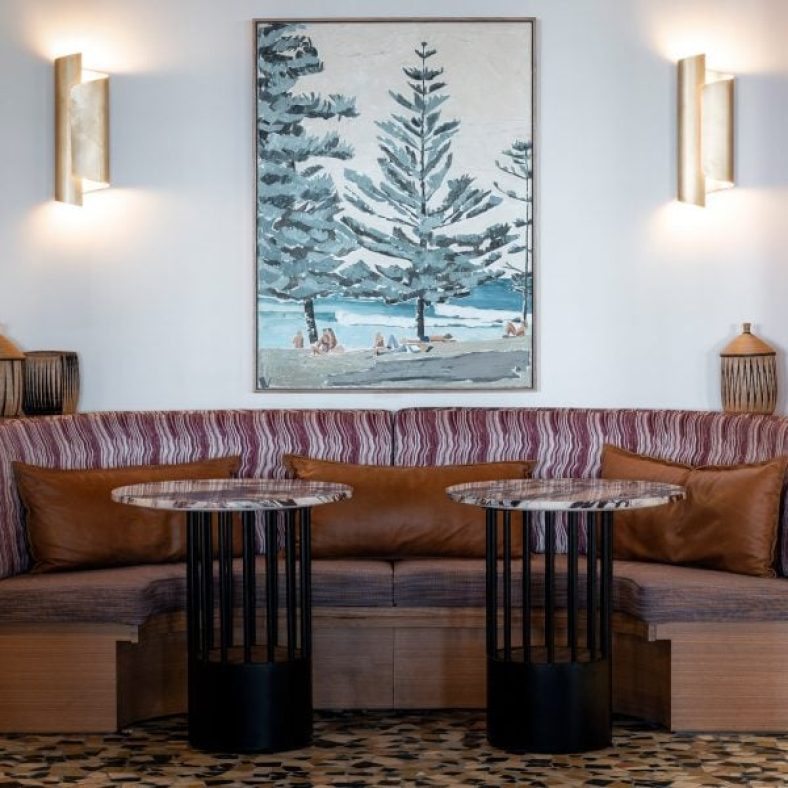
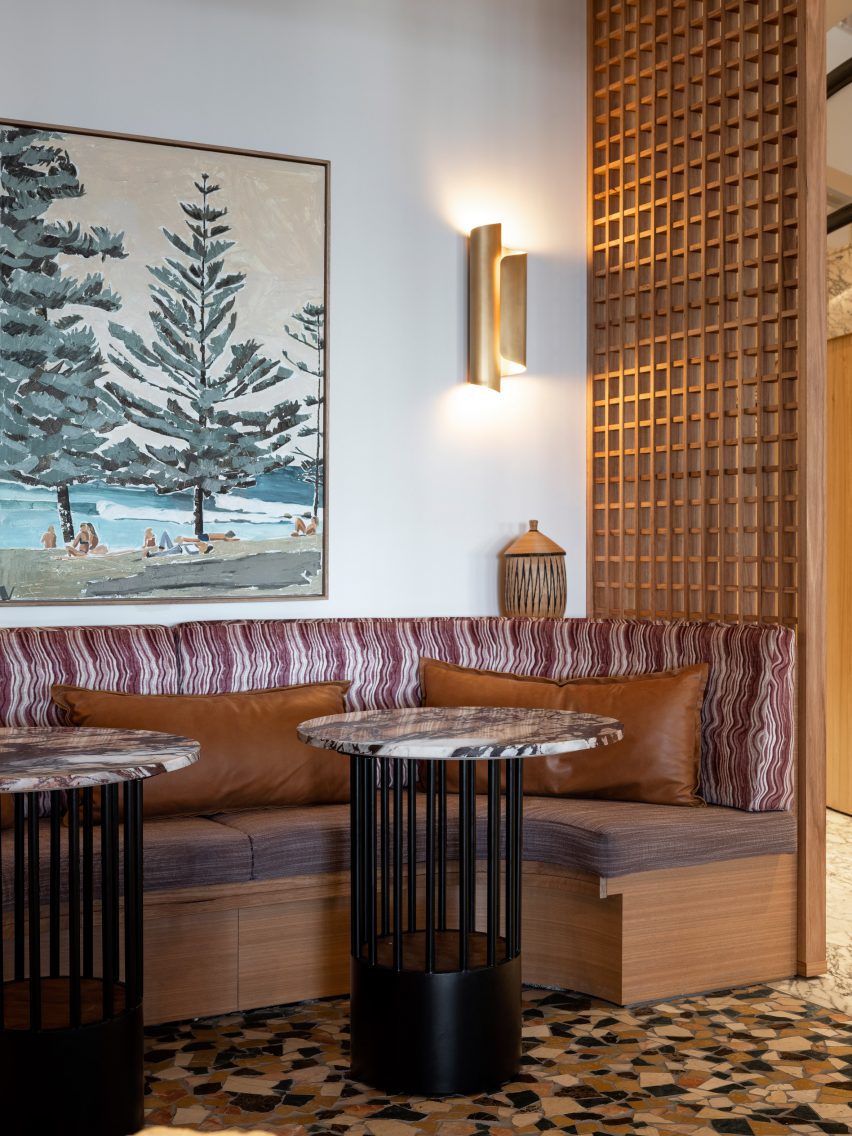
Spicy shades of turmeric, cinnamon and ginger feature alongside mosaic tiles and hand-painted murals in the public spaces of this hotel in Sydney, following a makeover from local studio Luchetti Krelle.
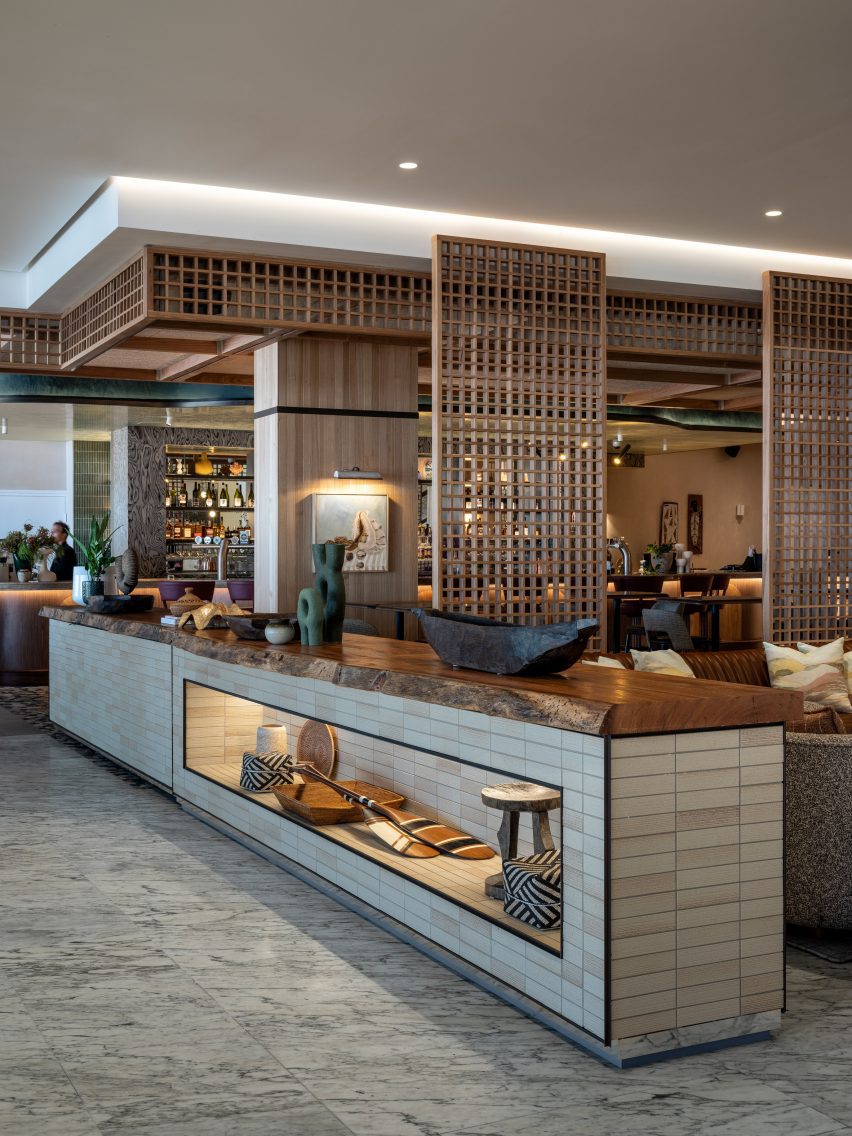
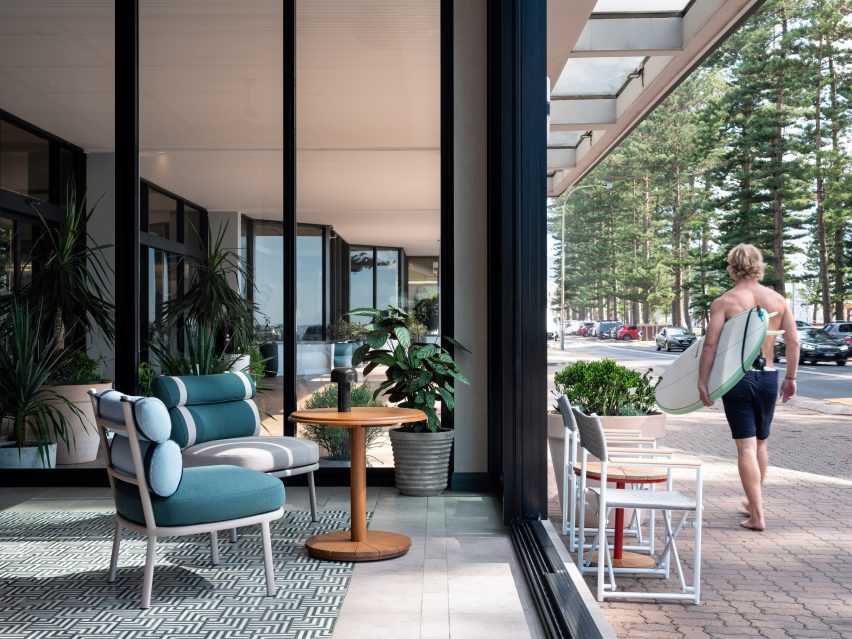
The renovation encompassed Manly Pacific‘s lobby as well as its 55 North bar and a few neighbouring lounge areas, all located on the hotel’s ground floor, which opens directly onto Manly Beach.
Luchetti Krelle has overhauled the lobby of Sydney’s Manly Pacific hotel
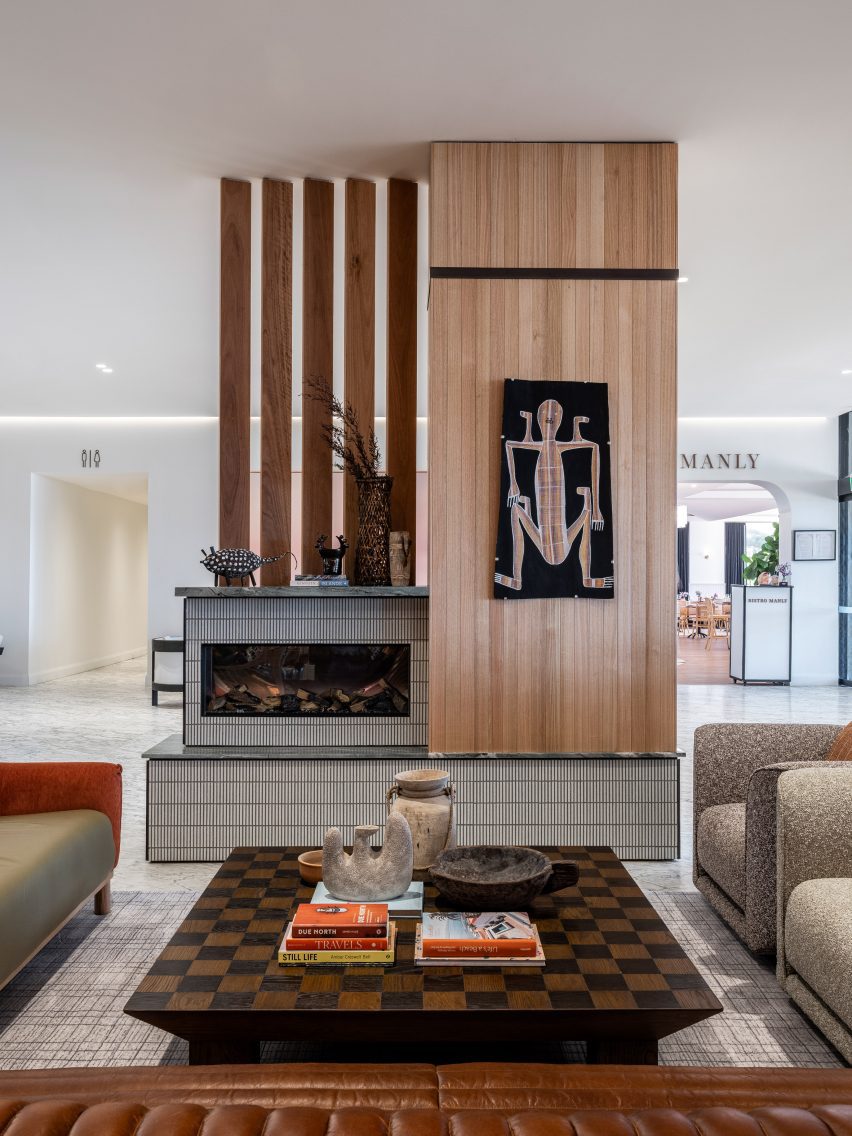
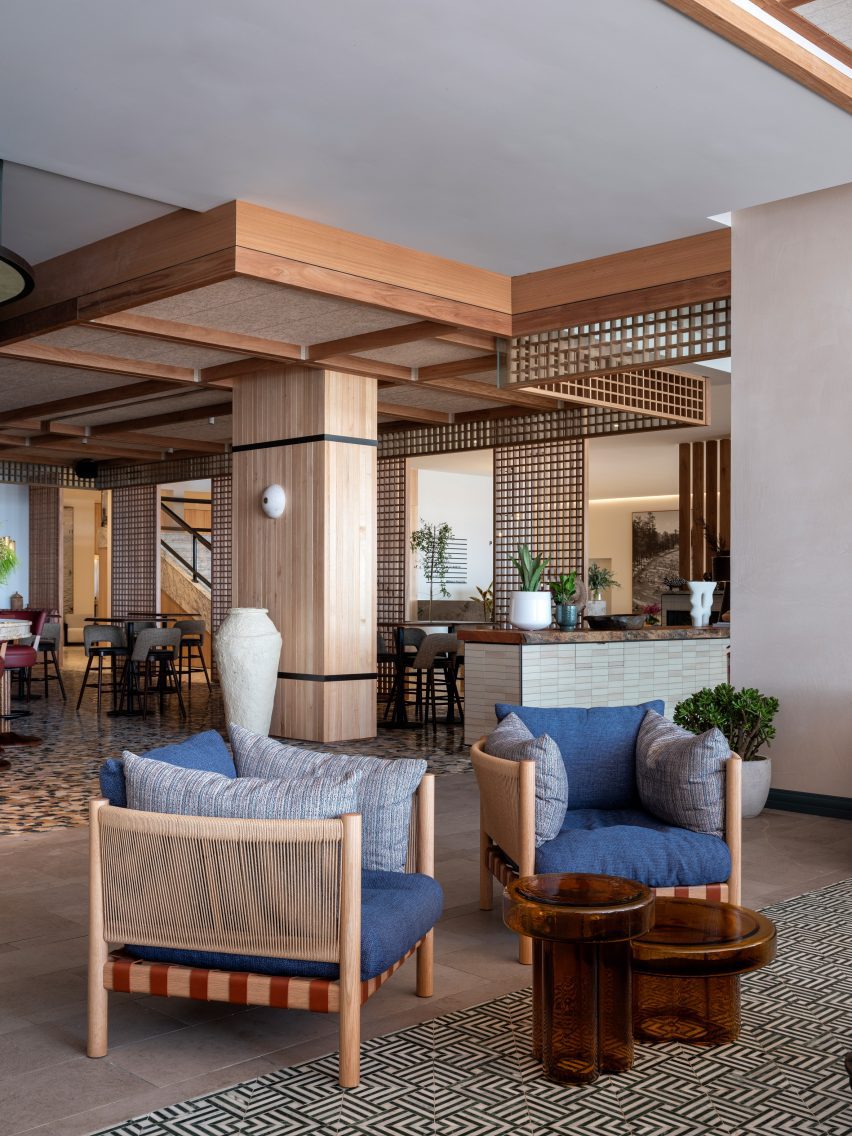
In the reception area, Luchetti Krelle created an intimate lounge setting to bring a sense of warmth and welcome into the otherwise vast white space while creating a link to the more richly decorated drinking spaces beyond.
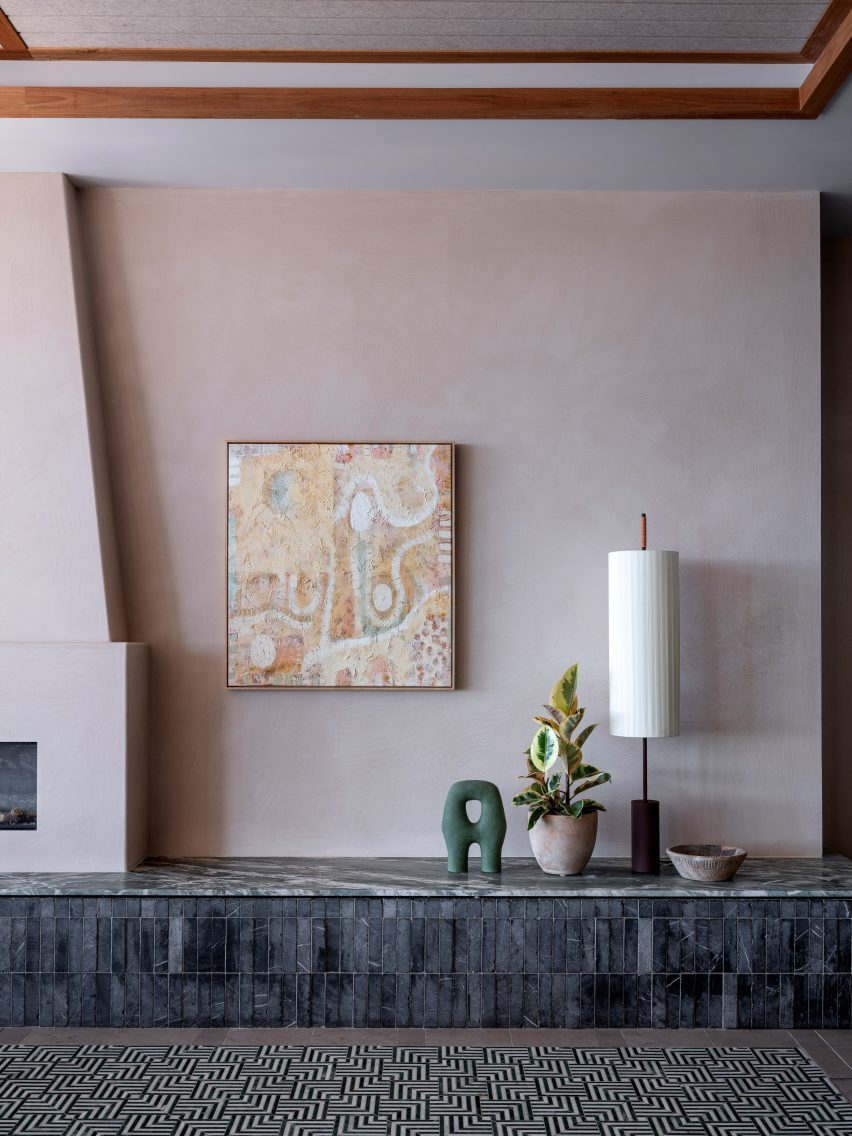
Tactile sofas and clubby armchairs are clustered around a chequerboard table looking onto a fireplace that mixes tile and timber in a mid-century-influenced design.
Latticed screens create a loose separation between Manly Pacific’s reception and the adjoining bar area, which introduces a richer palette of colours and materials to forge a sense of laid-back luxury.
The studio also renovated the adjoining bar
“A loose luxury defines our approach to the reappointment of the bar and neighbouring lounge areas,” Luchetti Krelle said.
“Layered textures, spiced tonal triggers and punchy patterns were selected to energise the drinking spaces with a graceful attitude that prioritised home comfort.”
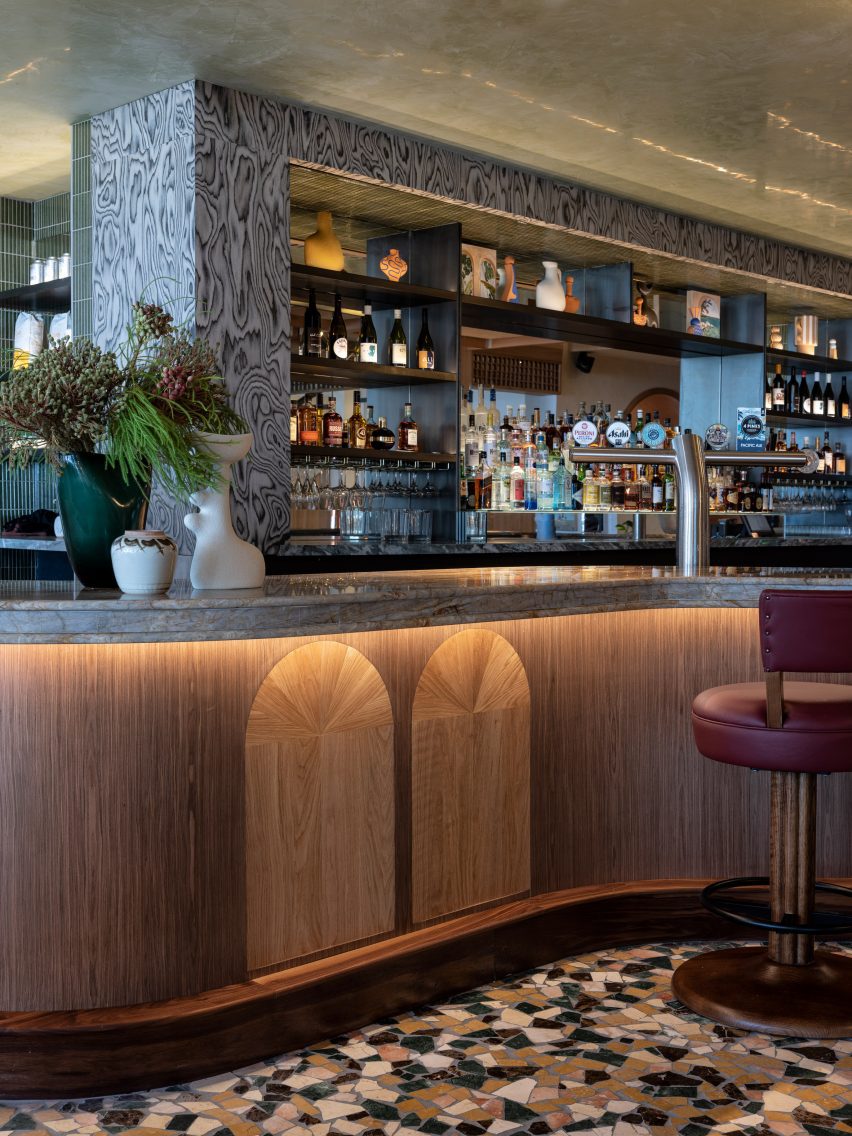
55 North is centred on an impressive island bar that curves outwards into the room to create a sense of welcome.
Crazy paving in autumnal hues defines the bar area
The bar’s outlines are mirrored by the lines of the bulkhead ceiling above, creating a shape reminiscent of a clamshell that draws the eye across the room and brings a cosy intimacy to the bar area.
“Hospitality design is about making people feel welcome, relaxed and confident so less noticeable elements drove our process,” the studio said.
“We lowered the bar’s original height so smaller guests didn’t feel intimidated by its stature, adding custom leather swivel stools with curved returns to encourage lengthier sittings.”
Lattice screens help to loosely divide the space
The client had originally requested a new bar closer to the lobby. But Luchetti Krelle chose instead to improve the existing design to conserve waste and save valuable build time.
“As with all hospitality projects, there is an added pressure to complete the build and installation within deadline, given commercial pressures to open for business,” the studio said.
“So we saved time finding creative solutions to transform existing elements, avoiding demolition and the waste of materials.”
A series of lounge spaces lead off the bar
Opening off the main bar area is a series of lounges.
Through the careful use of curves, arches and latticed screens, Luchetti Krelle designed these spaces to flow from one to another with a clear sense of continuity, while each area maintains its own distinct character and sense of purpose.
“We created adjoining rooms to encourage hotel guests to treat the space like an extension of their home during the day,” the studio said.
On the beach side, a sunroom takes its cues from the vista with striped and patterned upholstery in a palette of cooling blues that tether the space to the seascape beyond.
To the rear of the bar, a former gaming room has become an expansive cocktail lounge, where arches frame three intimate booths and the eye is led across the room by an underwater scene, painted onto Venetian plaster by local mural studio Steady Hand Studio.
Cool blue tones connect the sunroom to Manly Pacific’s beachside setting
Tiles are the protagonist material of this project, defining each area.
“Intricate autumnal crazy paving lures eyes through latticed screens that lightly separate the lobby and bar,” said Luchetti Krelle.
“Waves of fanned pearl-hued marble mosaics accentuate the rear lounge’s sophistication. Within the front sun lounge, tessellated Indian green and Carrara marble mosaic arrangements mimic the effect of a rug.”
The sunroom opens straight onto Manly Beach
Timber, too, plays a large part in the design, used across walls, ceilings, arches and booths – particularly in the bar.
“It was important to use varied timber species, including Blackbutt and walnut, to add textural depth and warm shades,” the studio said.
A variety of plaster finishes introduce another level of texture while helping to convey a sense of history and permanence, according to Luchetti Krelle.
A hand-painted mural dominates the cocktail lounge in the rear
These include the teal plaster applied to the bulkhead surround of the main bar, which features a glossy underside to bring a sense of lightness to the structure.
And in the ocean-side lounge, the pale sand shade of the fireplace wall cools the space during summer, reflecting the sunlight.
Seating booths are enveloped in cosy arches
The Manly Pacific is among a number of hospitality projects that Luchetti Krelle has completed in Sydney over the last two years.
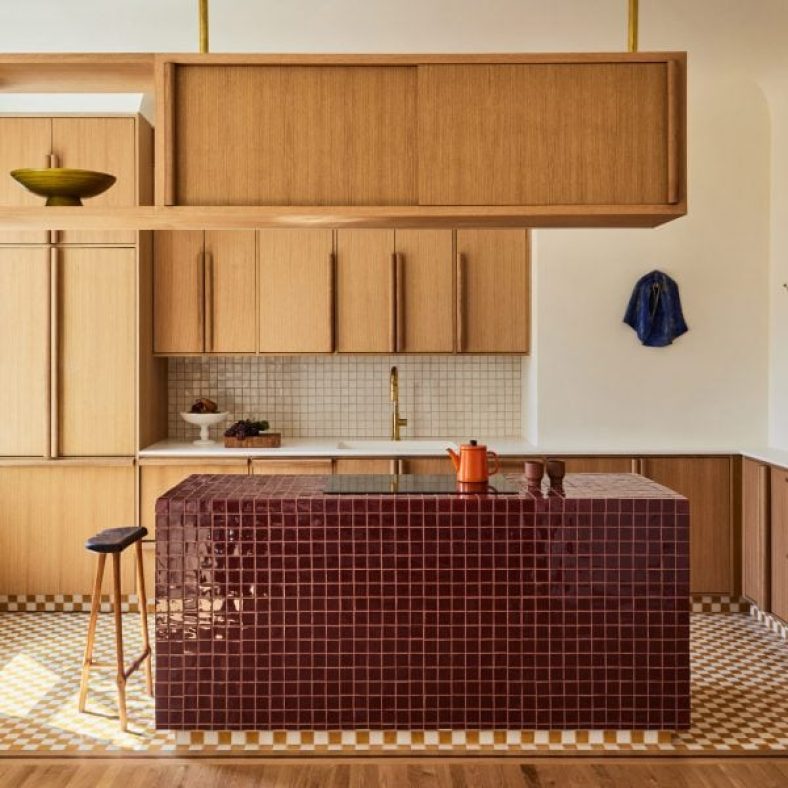
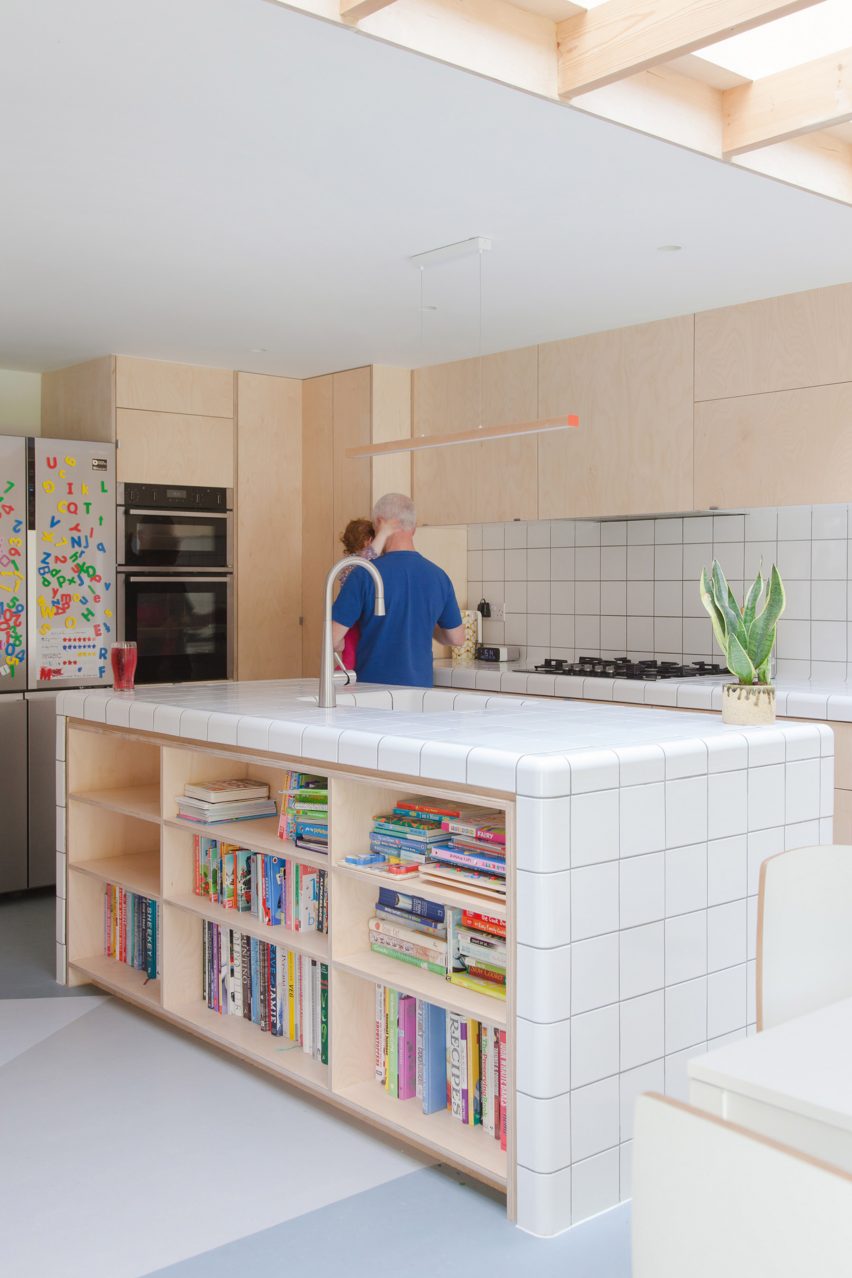
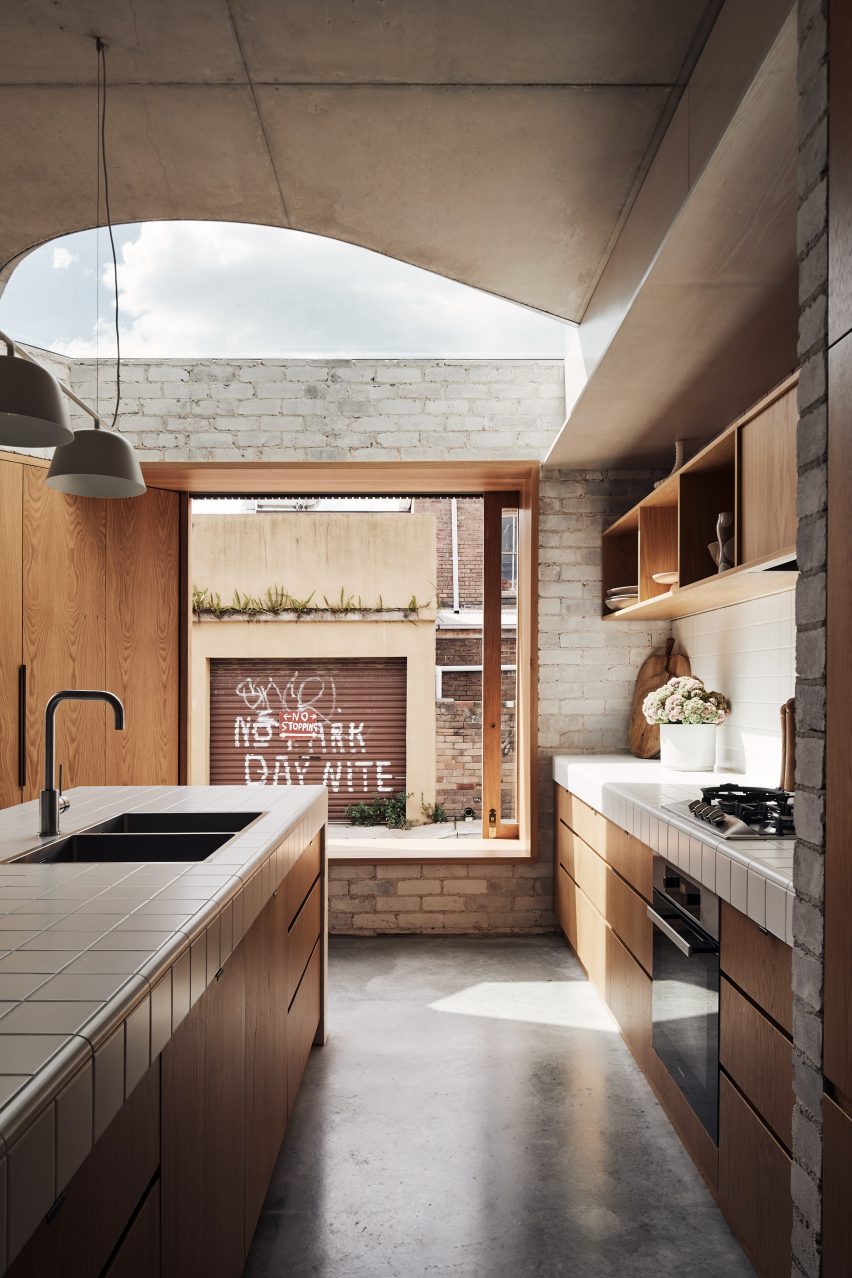
A kitchen with a statement oxblood-colour island and another with curved child-friendly counters feature in our latest lookbook, which spotlights eight worktops that are covered in tiles.
Tiled worktops can be a functional yet attractive addition to a kitchen, able to withstand hot pots and food stains while also creating an opportunity for decoration.
The examples in this lookbook range from tiled worktops designed as focal points to more utilitarian counters that blend in with surrounding walls, illustrating the potential of tiles in a kitchen and proving they are not limited to just splashbacks and flooring.
London studio Nimtim Architects opted for bright white tiles to cover the worktops of this kitchen and teamed them with plywood cupboards, shelves and drawers for a deliberately simple look.
Some tiles have curved edges, helping to create seamless transitions between the counters and splashback while also eradicating sharp corners so the space is safer for the client’s children.
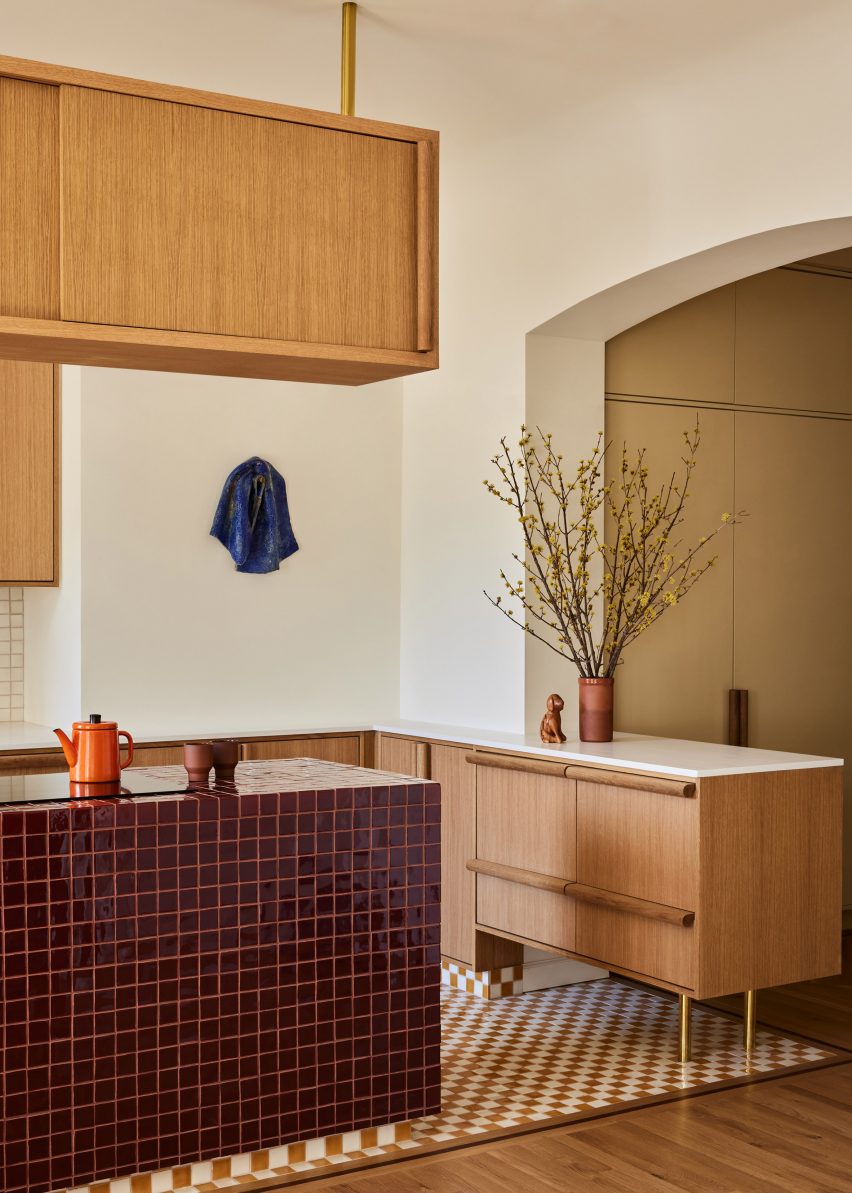
The focal point of this kitchen in an East Village apartment is an island covered in oxblood-coloured tiles, which stand out against a backdrop of white-oak cabinetry with oversized handles.
This rich, jewel-toned finish was complemented by chequerboard mosaic tiling across the floor and shiny brass legs for the end kitchen counters.
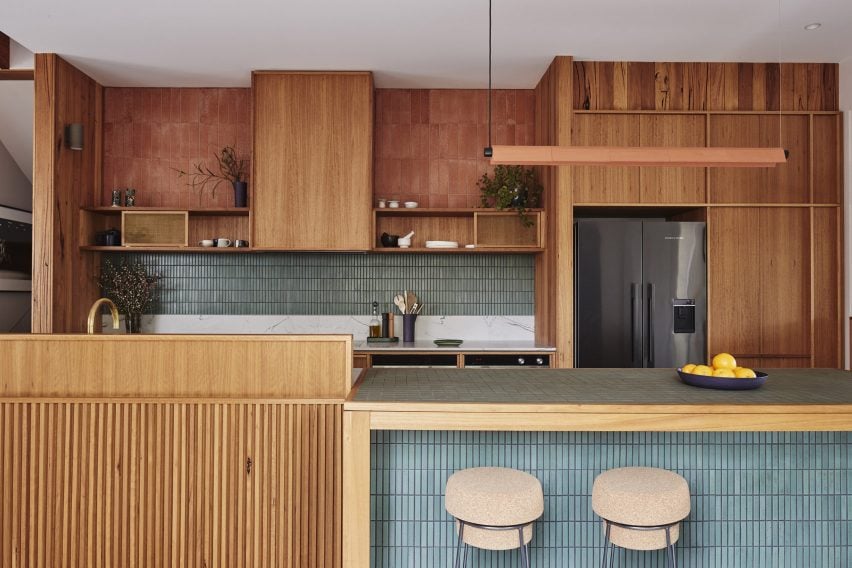
Duck-egg blue tiles adorn the surfaces of this galley kitchen, which studio Brave New Eco created in West Bend House in Melbourne.
This includes an island running through its centre, where square tiles are used on the worktop and the sides are lined with elongated versions. They are teamed with wooden joinery and slender bar stools.
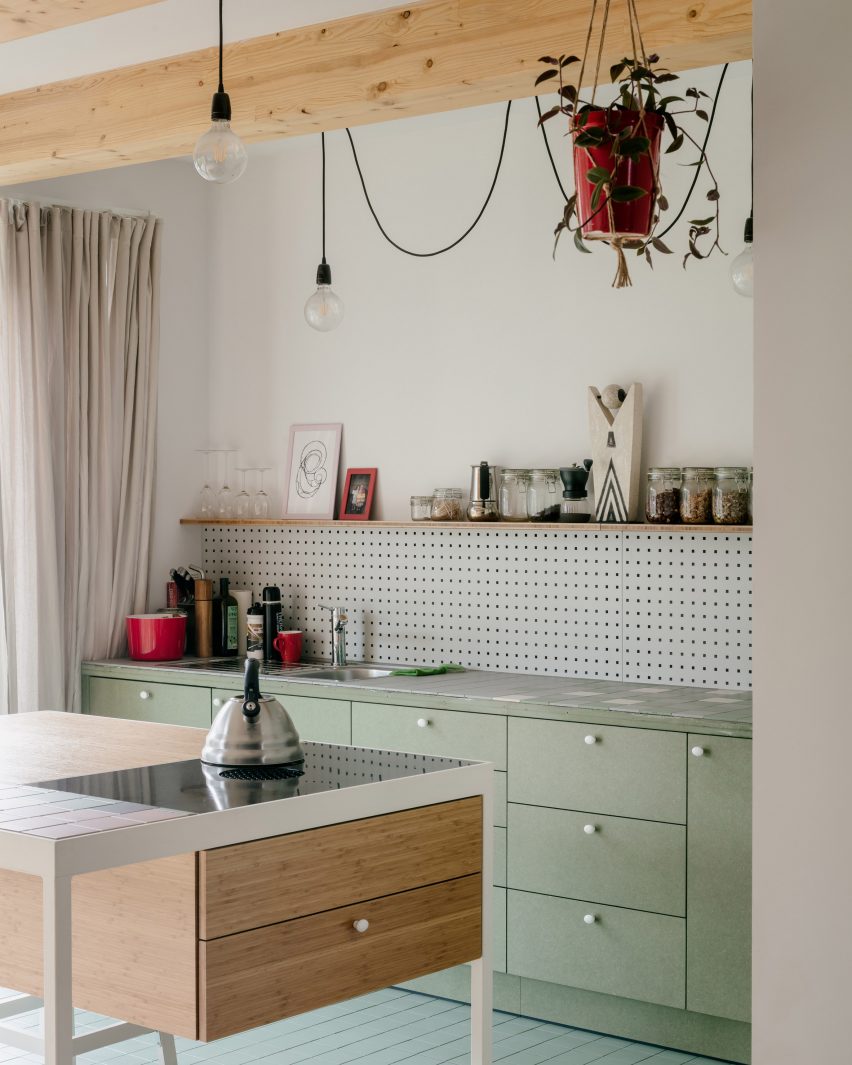
Officeu Architects combined a mix of pastel-hued square tiles to decorate the worktops in this kitchen, which features in the De Sijs co-housing project in Leuven.
The dusky colours of the surfaces are complemented by a mix of fern-green and wooden cabinets and help draw attention to playful furnishings and fixtures, including hanging lights and bright red pots.
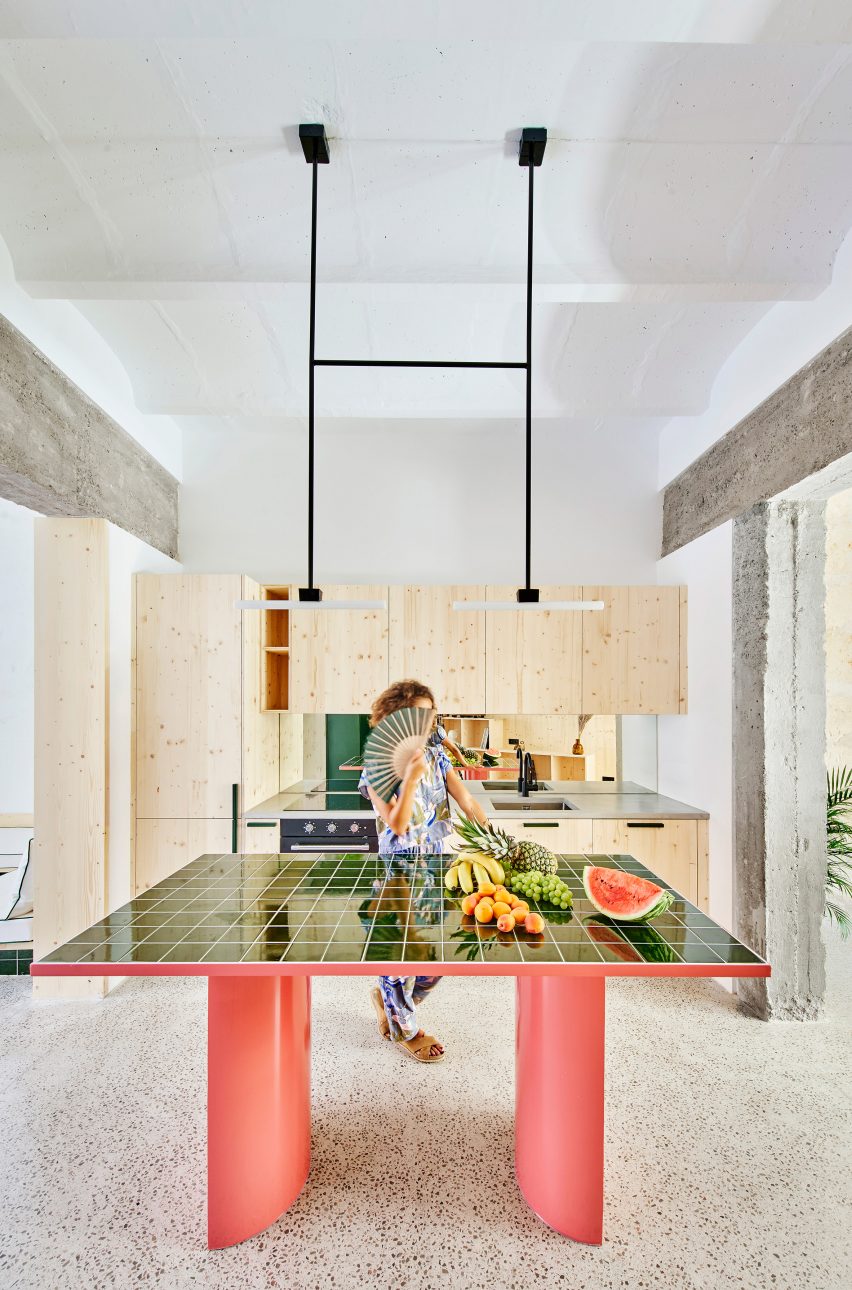
Green tiles are used to create focal points throughout this lofty apartment, which architect Mariana de Delás has hidden in a former motorcycle workshop in Palma de Mallorca.
This includes the kitchen, where the tiles crown a statement island supported by chunky pink legs. This watermelon-like colour combination pops against a concrete floor and wooden cabinets.
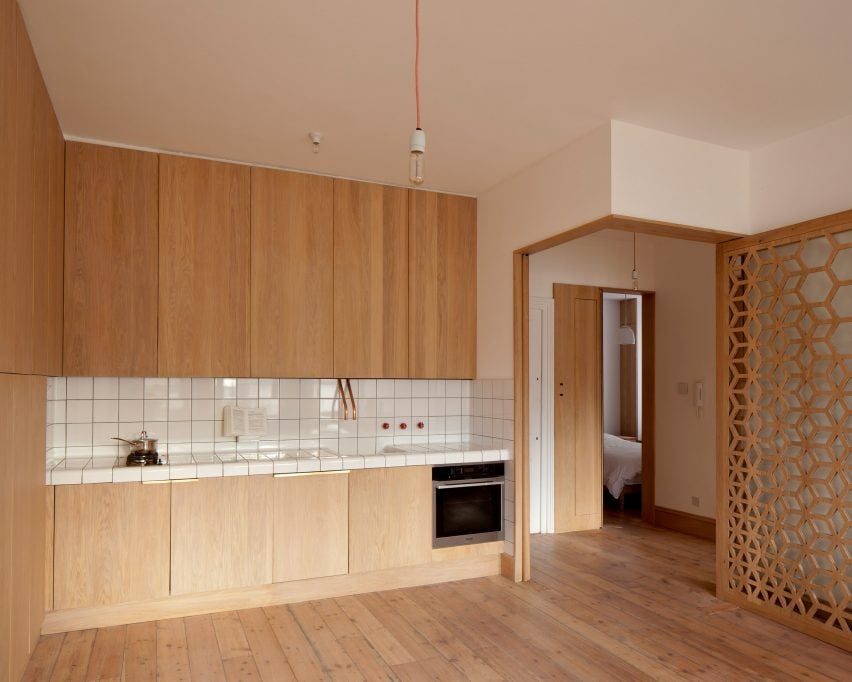
This pared-back kitchen features inside Screen House, a north London flat that was modernised and reconfigured by Studio Ben Allen.
To align with a strict budget, the kitchen features utilitarian fixtures and combines simple wooden joinery with white-tiled surfaces. The end tiles are curved to form a smooth edge to the counter.
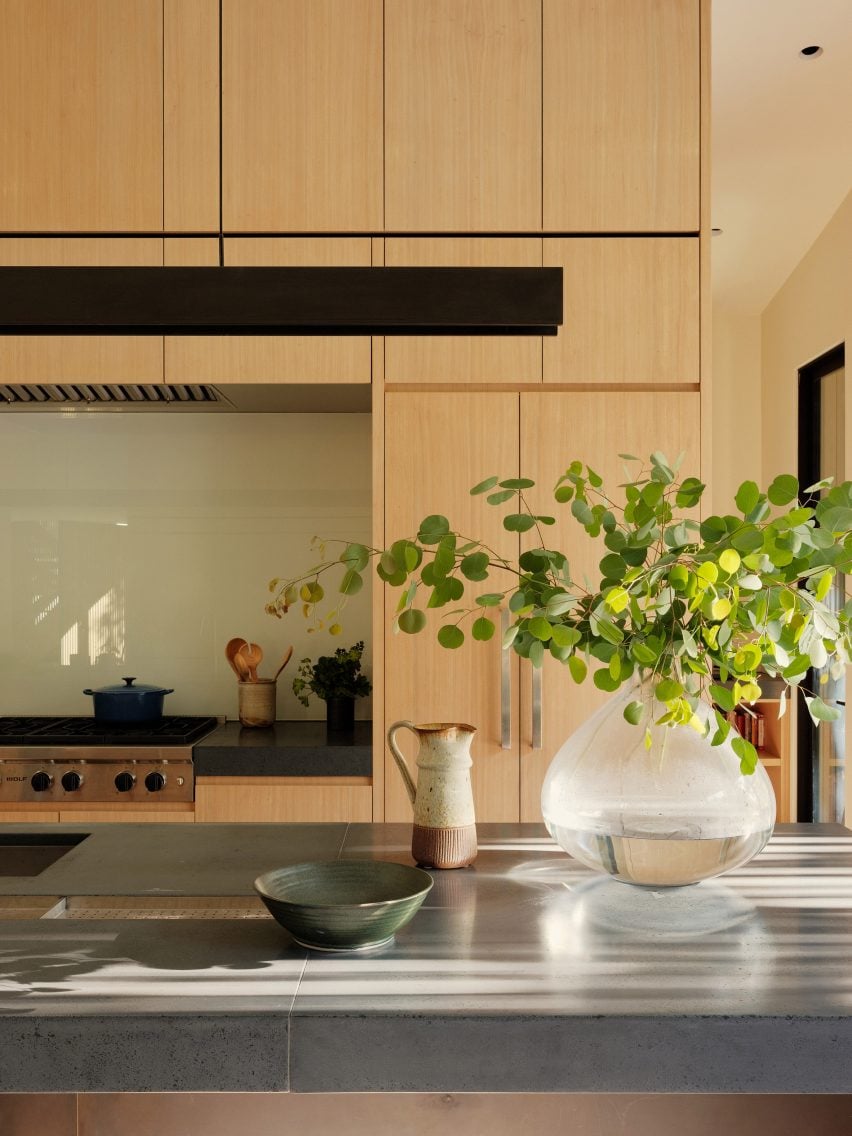
Large grey tiles are used across the countertops of this wooden kitchen, which Field Architecture designed within a house in California.
They form part of the natural-looking material palette used throughout the home, for which the studio drew on the surrounding Los Altos Hills landscape that includes a creek and large oak trees.
At Bismarck House in Bondi, Andrew Burges Architects used a palette of what it described as “outdoor materials” across the ground floor.
Alongside exposed brick, concrete and steel elements, this utilitarian palette includes tiled kitchen worktops and is intended to blur the boundary between the inside and robust exterior of the home.
From Mystic Warlords of Ka’a to Dungeons and Dragons to scientific breakthroughs, the iconic kitchen and open floor plan of Sheldon and Leonard’s apartment from The Big Bang Theory has housed many laughs and even more Bazingas. And when you look a bit closer, particularly at the kitchen, it’s clear to see that the design and functionality of this beloved space is thoughtful and well executed. Move over Schrödinger’s Cat, there’s no uncertainty that while the kitchen appears chaotic on the exterior, under a Scion toaster, batman cookie jar, periodic table of element chart, and mathematic equations, that this kitchen has a lot of exciting features that find themselves still trending even in today’s industry. Set phasers to stun and get ready to be stunned by these practical elements of the iconic kitchen.


.png?width=4501&height=2493&name=MicrosoftTeams-image%20(45).png)