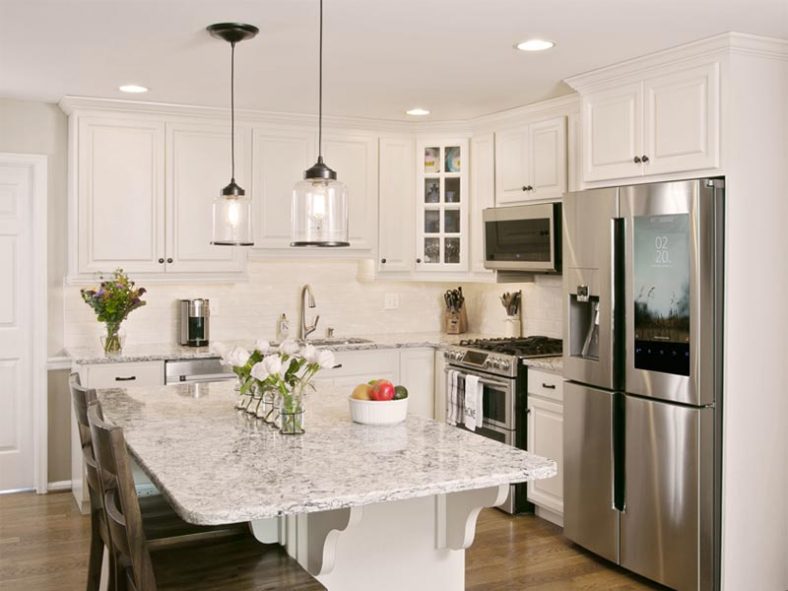
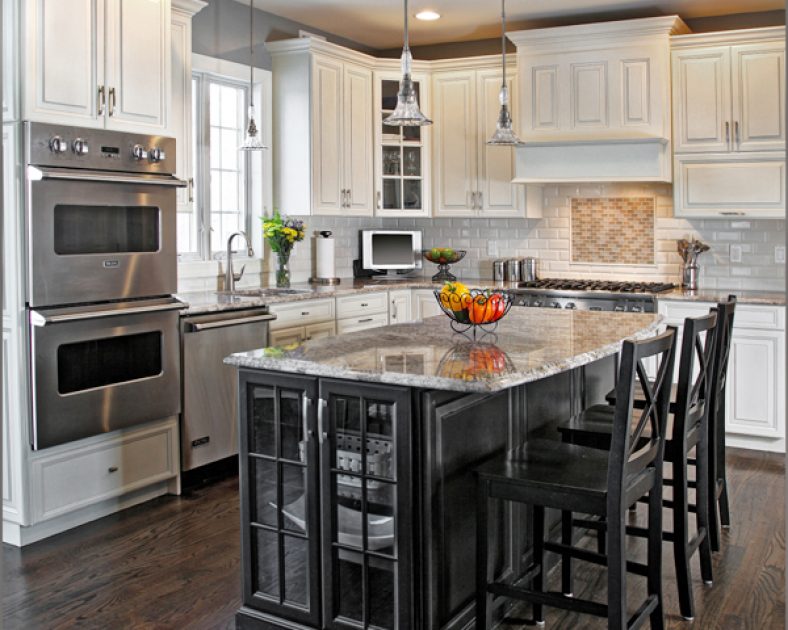
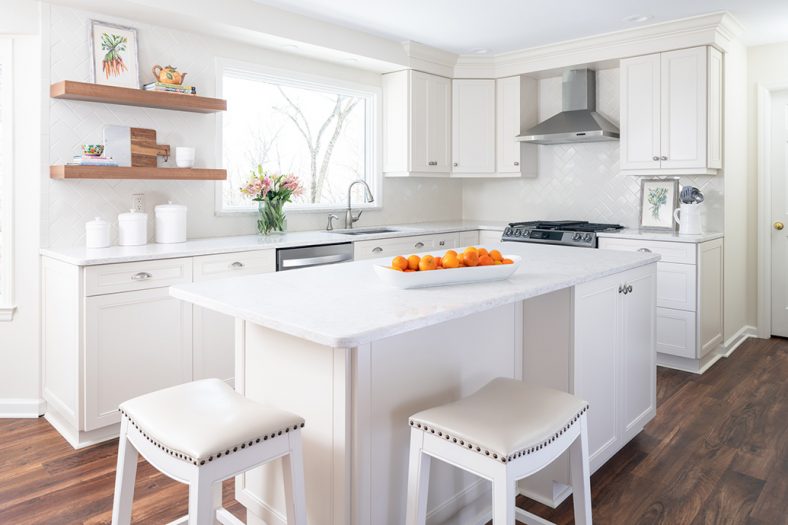
Pendant lights have been popular for quite some time—largely since the choice for a kitchen island prevails decade after decade. In the island’s post-war beginnings, as kitchen spaces began to become larger, there was rarely designated task lighting for the kitchen; rather, overhead lighting sufficed for all spaces—with a separate fixture over the eating area.
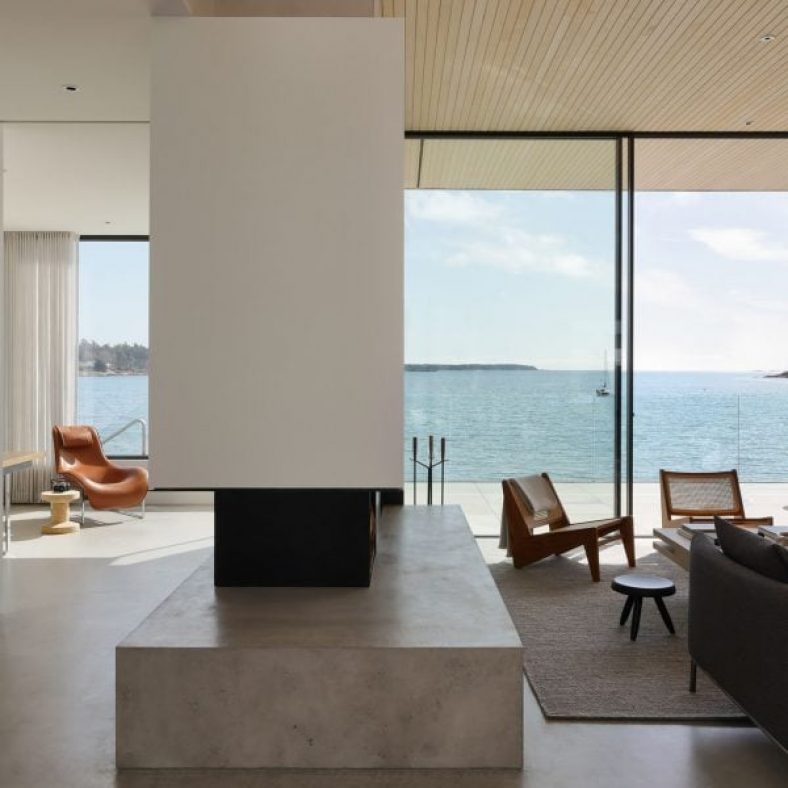
Bringing the ocean inside was the primary goal of interiors studio Falken Reynolds when designing this waterfront home on Vancouver Island.
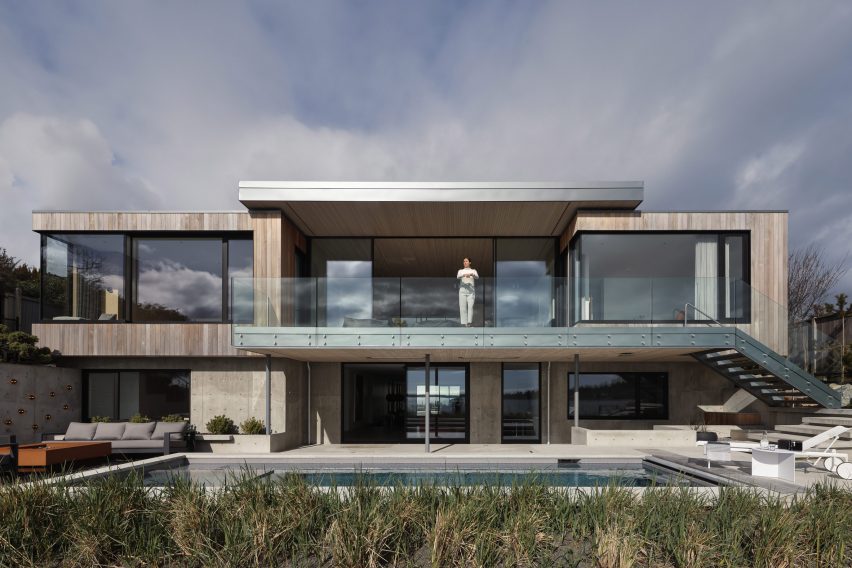
The modern house at the southern tip of the island in British Columbia, Canada was completed by architect Chris Foyd of local firm Bo Form for an active couple with three sons.
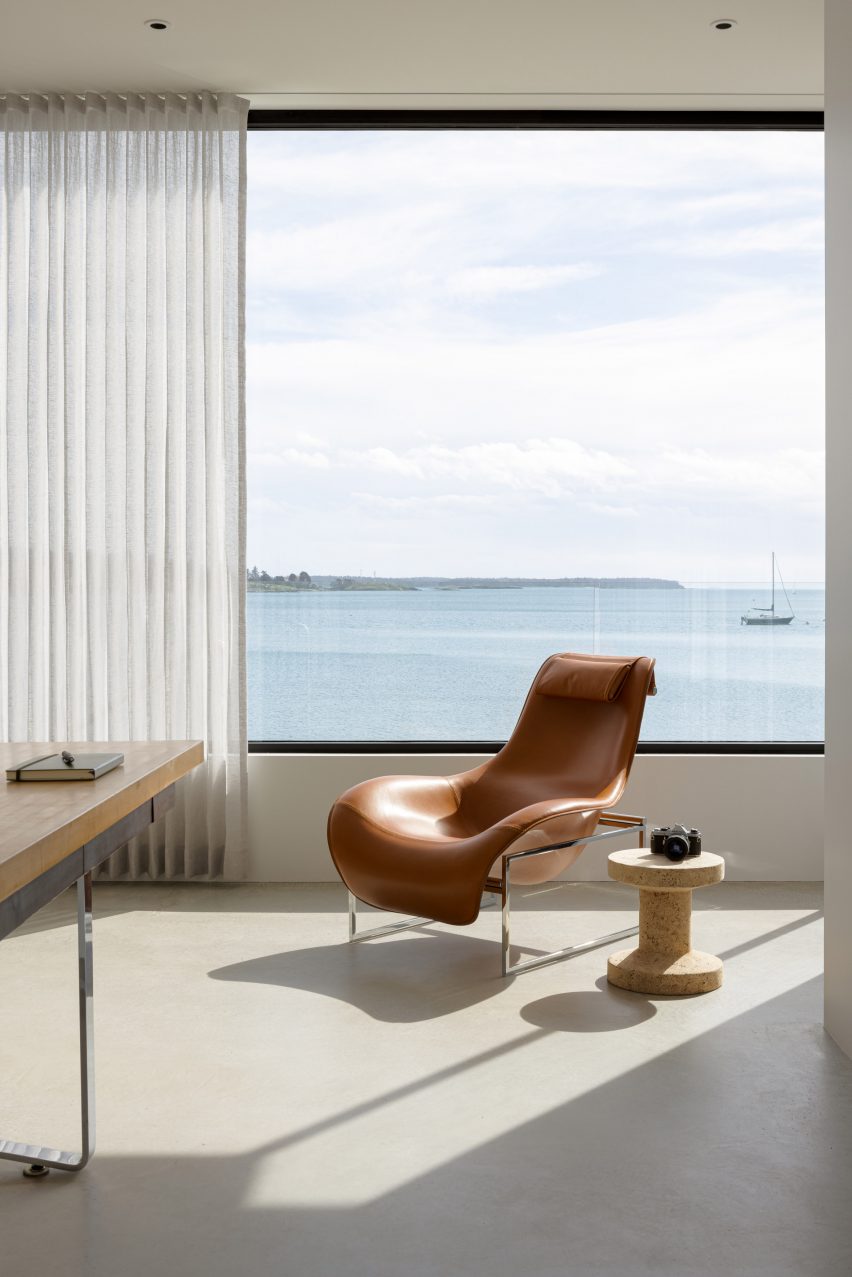
Maximising views of the ocean was Falken Reynold’s principal focus for the interiors
The family relocated to Cadboro Bay from prairie city Edmonton, and wanted to maximise their coastal location after living so far from the sea.
“The client had a clear vision for the house – a very pared back, durable and minimalist interior but with warmth and subtle sophistication,” said Falken Reynolds principal Chad Falkenberg, who led the design of the interiors.
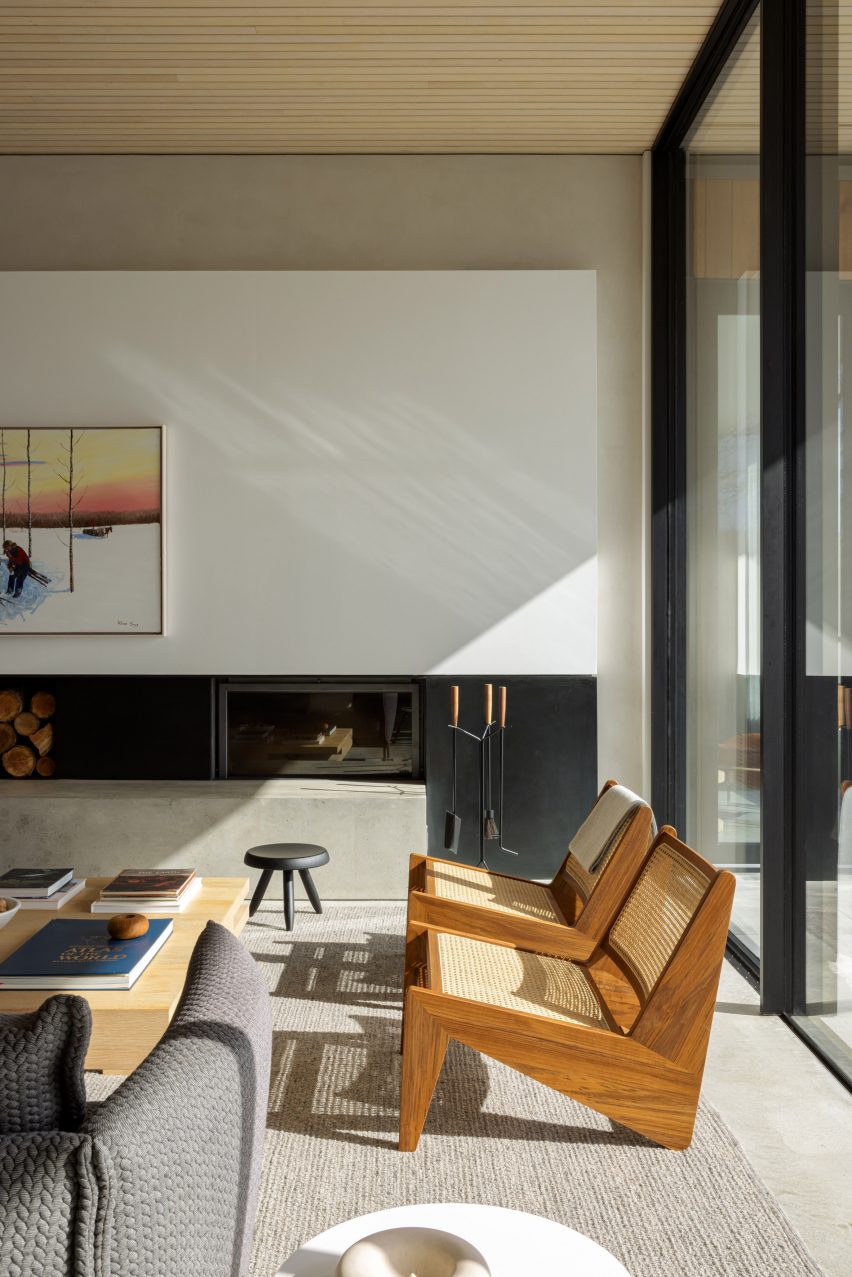
Low furniture helps to prevent blocking sightlines to the outdoors
Measuring 5,400 square feet (501 square metres), the house appears like a bungalow from the street, while its lower level is tucked underneath and faces the ocean.
Upstairs is an open-plan kitchen, dining and living room, a primary suite and two more bedrooms, as well as a study, powder room and mudroom.
A selection of Danish and Italian midcentury pieces are placed throughout the home
Downstairs, at pool and beach level, are two further bedrooms, a large home gym, a media room and a rec room.
The expansive views of the bay through huge floor-to-ceiling windows on both floors are the focus of every space.
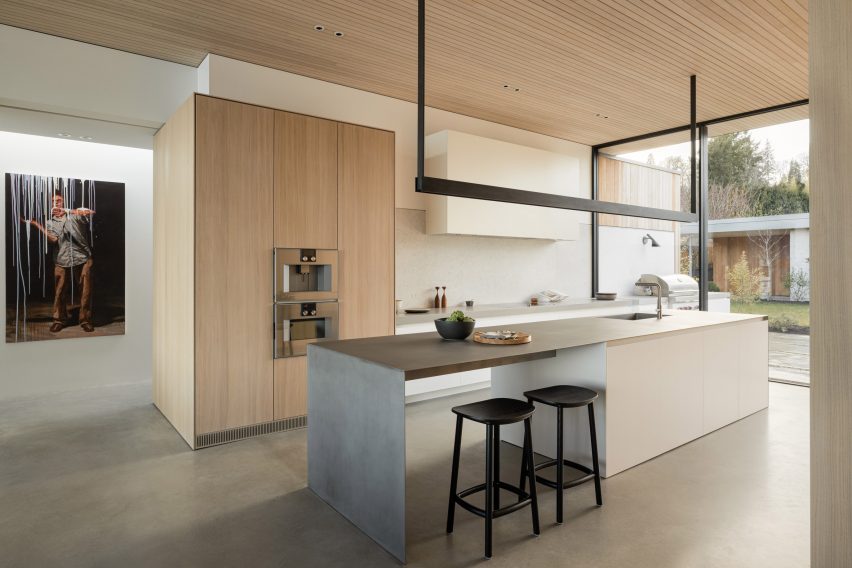
The neutral colours and materials echo the tones of the beach
“We wanted to bring the peacefulness of the natural environment inside,” Falkenberg said. “When it came to the detailing we drew a lot of inspiration from modern Belgian architects who are masters at warm minimalism.”
Low furniture, neutral tones and natural textures together create a casual and serene mood in harmony with the scenery outside.
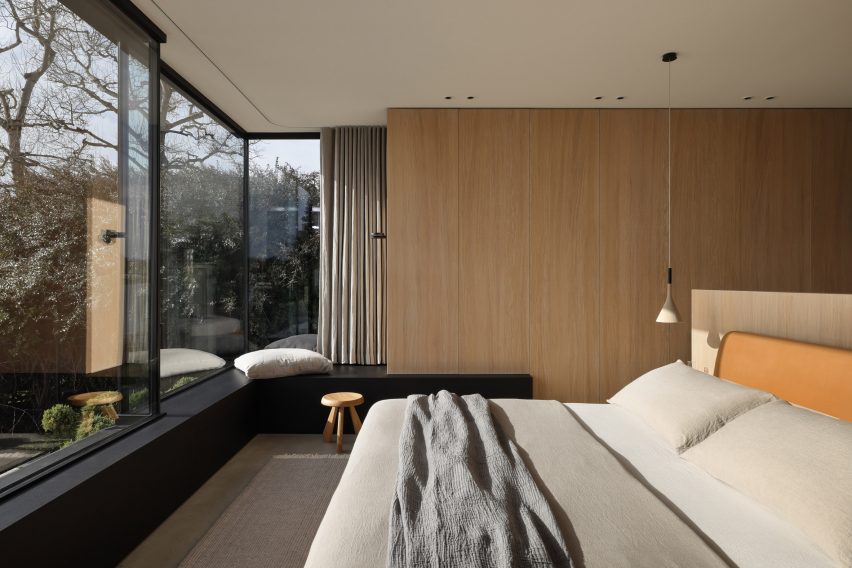
The primary suite is located on the upper level and overlooks the water
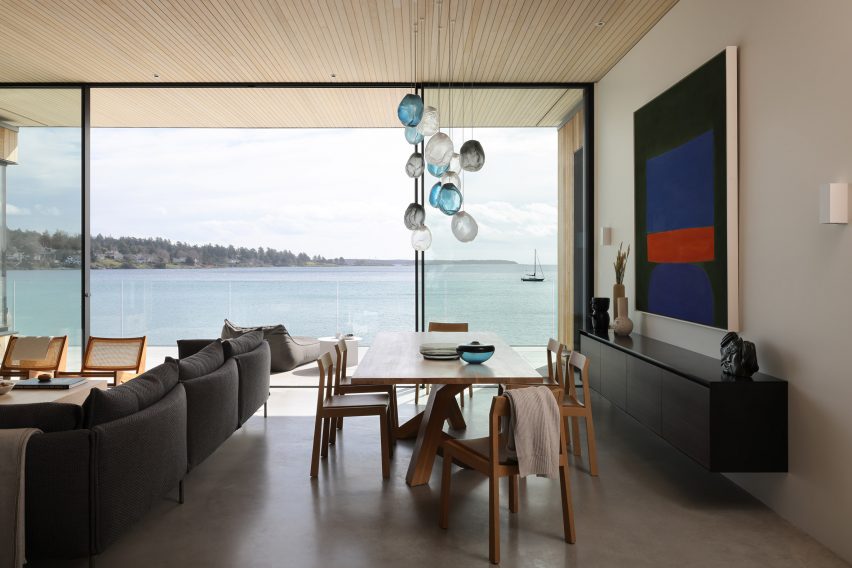
“The palette is an extension of the beach: grays, whites and wood – light and desaturated for the oak millwork and hemlock ceilings – including the oak furniture in the dining room, living room and bedroom,” said Falkenberg.
The pared-back materials, most of which were sourced locally, also help to highlight the family’s collection of mid-century Canadian art.
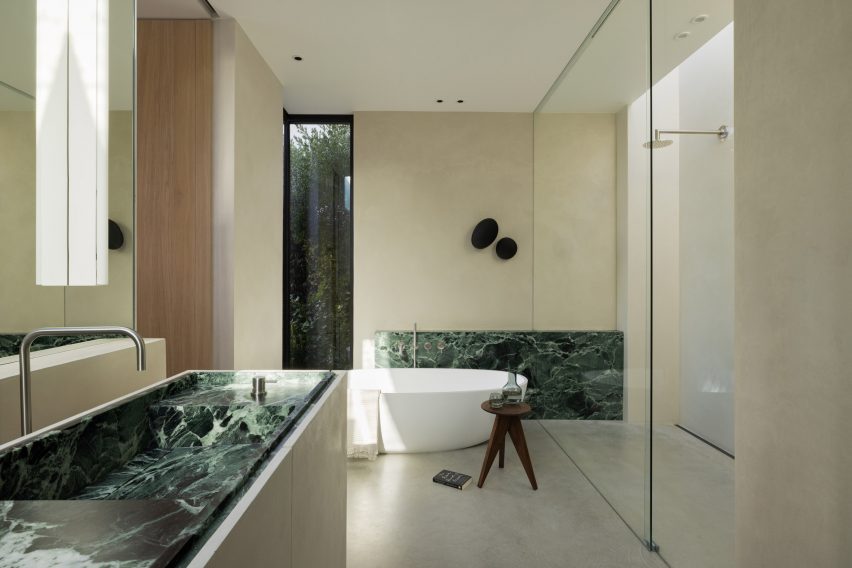
Paintings displayed throughout the home add bold splashes of colour, along with pieces like a glass chandelier by Bocci over the dining table and green marble in the bathroom.
Along with a selection of Danish and Italian modernist furniture designs, these details help to give the spacious home a more intimate feel.
Green marble adds colour in the bathroom
“The large open spaces and expansive views could easily have felt vacuous with the minimalist approach,” Falkenberg said.
“The trick was to balance the clean lines with subtle details that add just the right layer of warmth to the spaces.”
The house was designed by Bo Form and is positioned on the southern tip of Vancouver Island
Based in Vancouver, Falken Reynolds has completed several minimal residential interiors in and around its home city.
Despite the rise in contemporary and farmhouse designs, traditional kitchens are still among the most popular kitchen styles. Their basic color palette and elegantly-accented design scheme create a beautiful space that will stay within style trends for a long time.
The key feature of traditionally designed kitchens is their attention to detail; each room area should have detailing and embellishments that look layered but not overbearing. If this is a kitchen you’re dreaming about, don’t hesitate to reach out to kitchen remodeling experts who can guide you through the seven basic features of traditional-style kitchens and help you incorporate them into your own remodel.
No Architects‘ extensive revamp aimed to retain the character of the house, which was built in the 1920s in a romantic style that references arts and crafts-style English villas.
“Our addition refers to the original facade details and is hardly recognisable as separate to the original house,” the studio’s co-founder Jakub Filip Novák told Dezeen.
Commenters had nothing but praise for the project.
“Love the clean lines, the simple gestures, the quiet flourishes,” wrote one. “With the historic muted greens and blues complementing the wood, it reminds me of Shaker modernism here in the States. Really beautiful spaces.”
You can also subscribe to Dezeen Agenda, which is sent every Tuesday and contains a selection of the most important news highlights from the week, as well as Dezeen Daily, our daily bulletin that contains every story published in the preceding 24 hours.
Are you getting ready to upgrade to your kitchen with new flooring? If so, take stock of your options. Flooring is more challenging to replace “after the fact.” By choosing flooring that complements your lifestyle and preferences, you’ll benefit from a style and finish that will withstand the test of time.
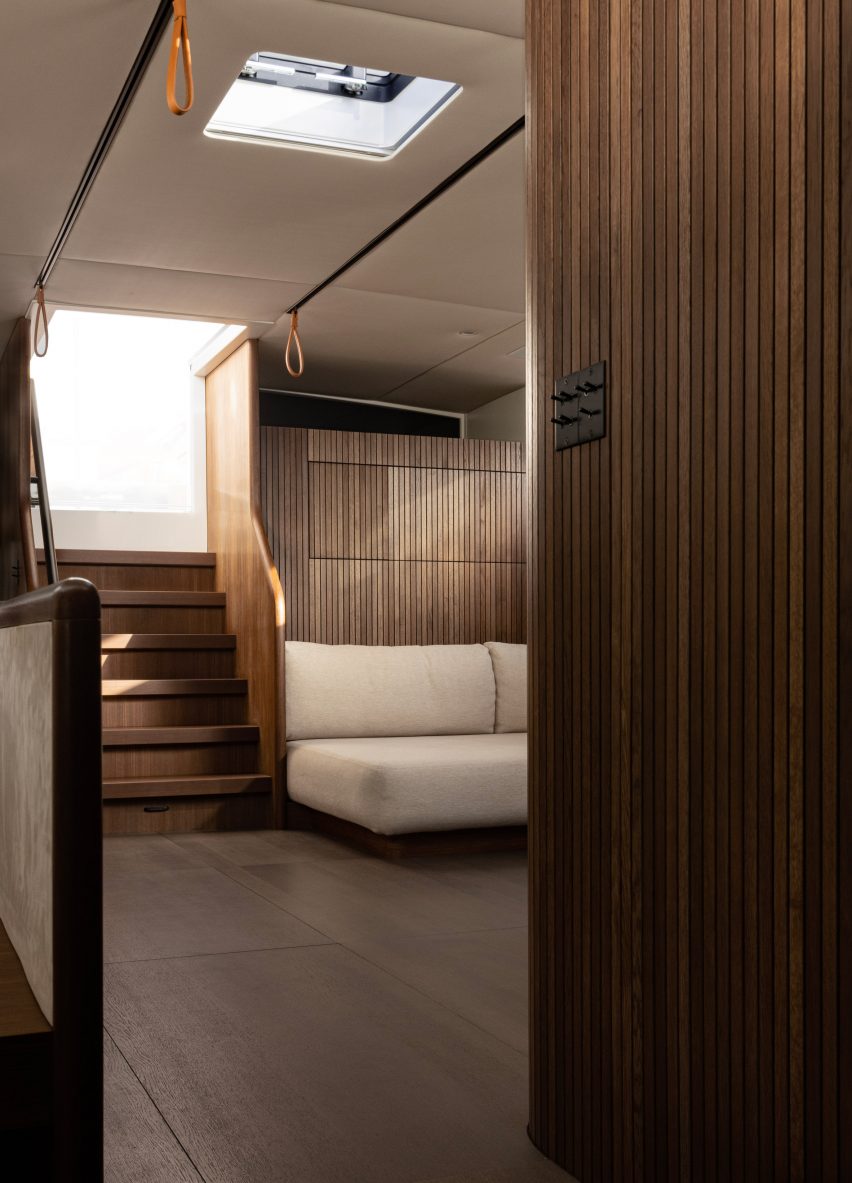
Wood-lined walls meet supple suede furnishings inside this restrained interior, designed by Danish studio Norm Architects for a luxury yacht.
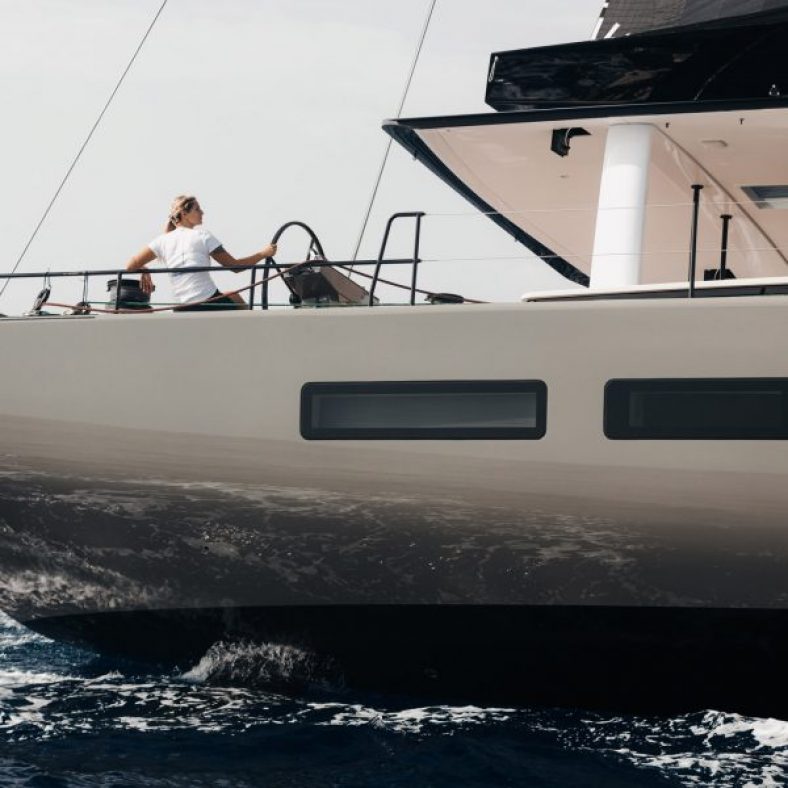
Manufactured by German shipyard Y Yachts, the Y9 sailing yacht is almost 30 metres long and designed to be used by families and bigger groups, leading Norm Architects to strip the interior down to its essential features.
Norm Architects has applied its signature minimalist aesthetic to the Y9 yacht
“This way, the pared-back interior has room for the life lived within – a simplified space, yet still rich in details and thoughtful in terms of material choices,” the practice explained.
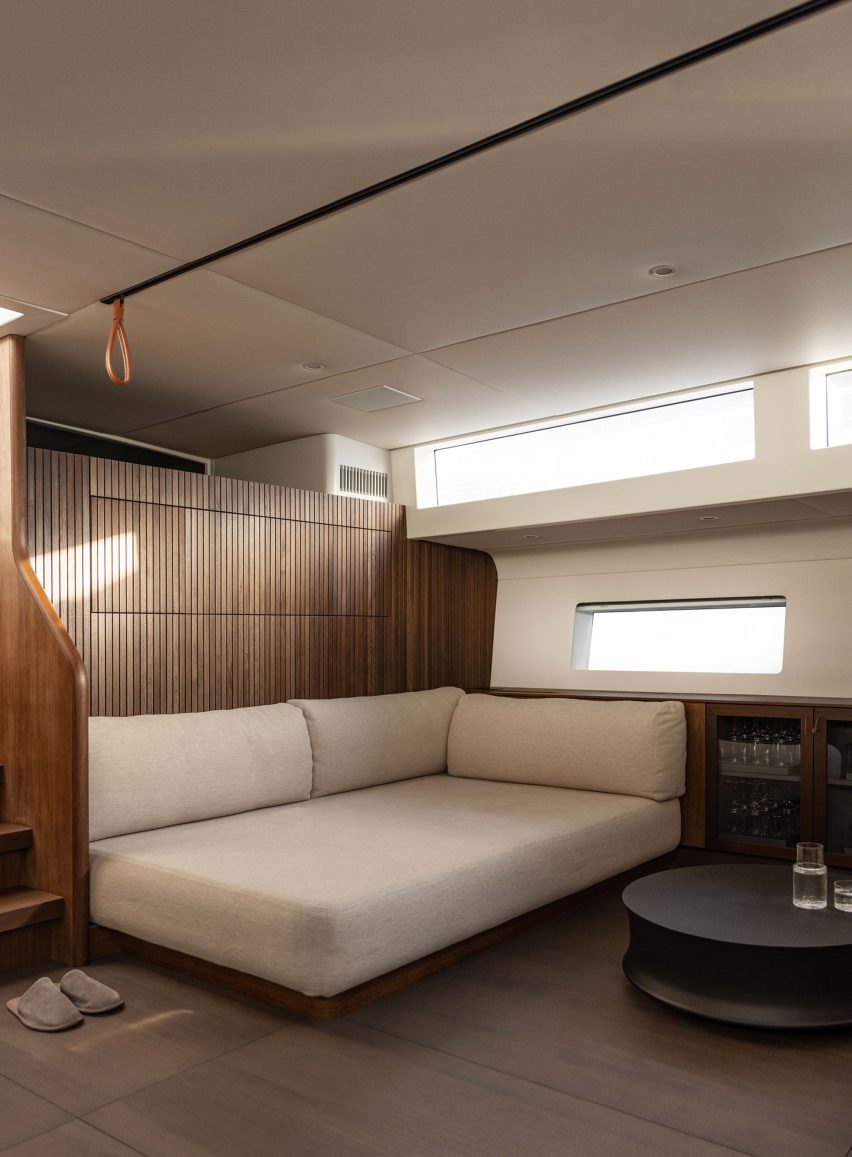
The starboard side of the Y9 houses an intimate lounge, which has a built-in corner sofa topped with oatmeal-coloured cushions.
The yacht’s lounge has a comfy corner sofa
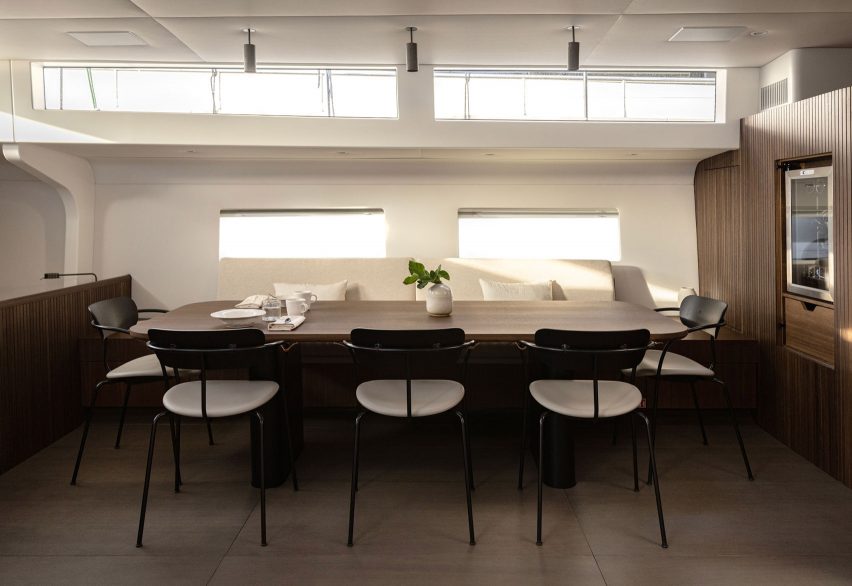
Adjacently lies the dining area, anchored by a large wooden table that can host up to eight guests.
This is accompanied by a bench seat and a series of slender black-framed chairs which, when waters are rough, can be discreetly secured to the table with leather clips.
Up to eight guests can gather to eat around the dining table
Leather handles were also fixed to the ceiling above so that passing guests and crew can steady themselves.
“The security requirements are met in style through elegant, built-in furniture that appears unfixed to create a homely feel, ultimately accomplishing an understated luxury,” the practice explained.
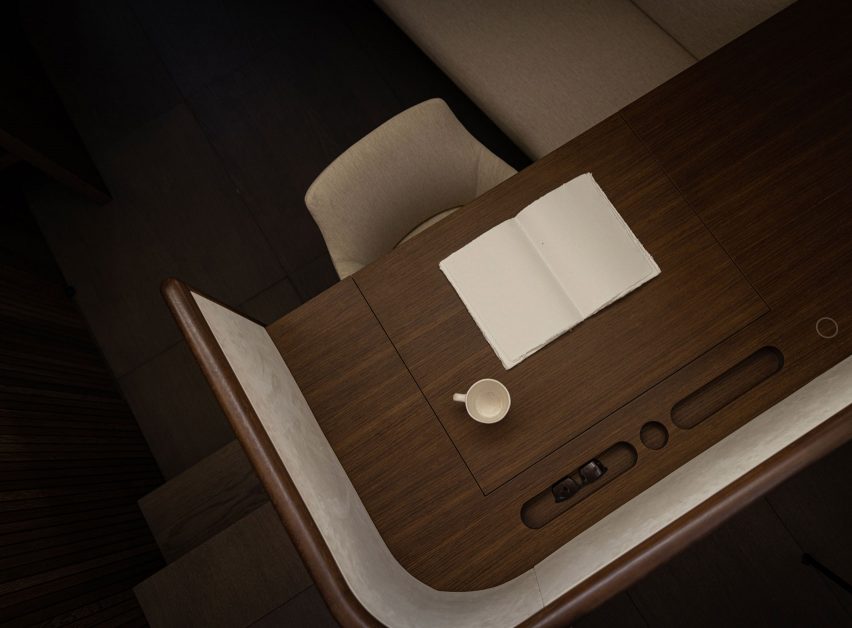
A short flight of steps leads up to a small study, separated from the dining area by a low wooden partition.
The bow of the yacht accommodates the principal bedroom.
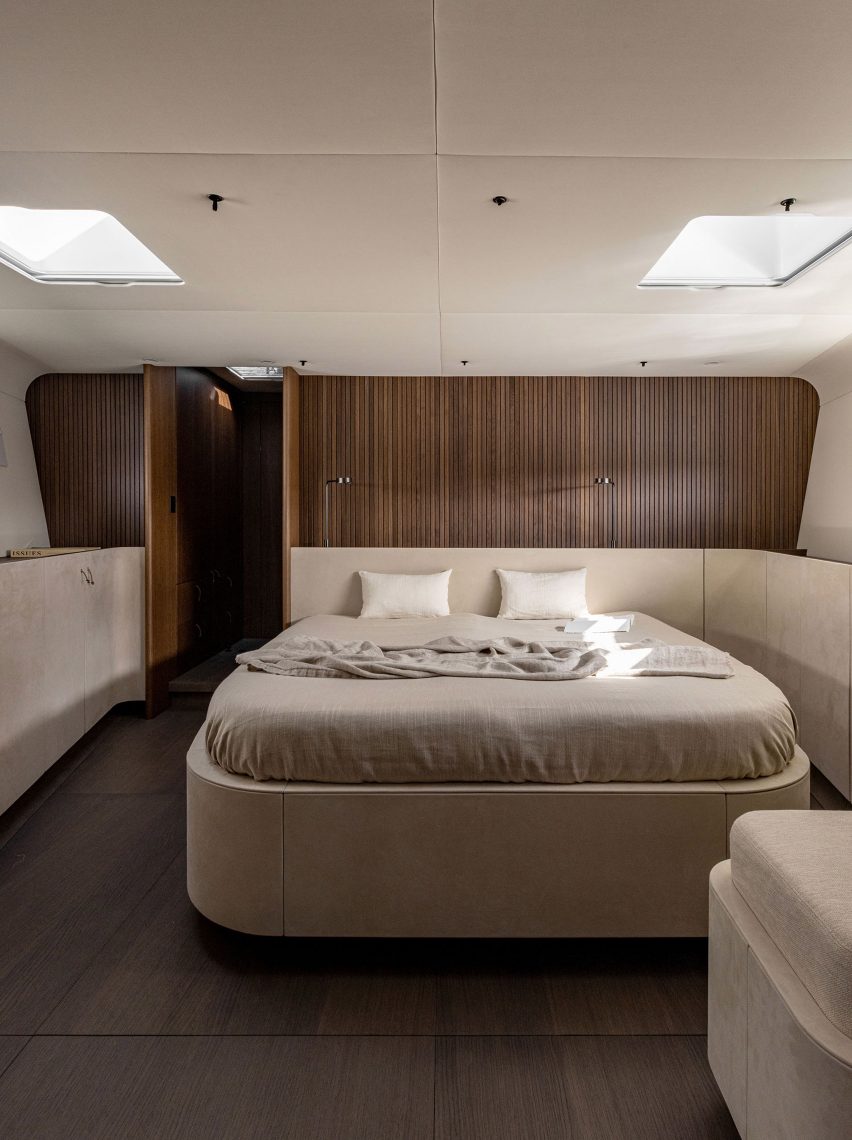
Its bed is framed by a headboard upholstered in beige suede that extends to form a band around the lower half of the room, concealing built-in storage cupboards. The same suede was also used to cover the bed’s chunky base.
A small study is tucked away behind the dining area
Where possible, corners throughout the boat were curved or rounded off in order to create what the practice describes as “simpler, more coherent spaces with fluent transitions”.
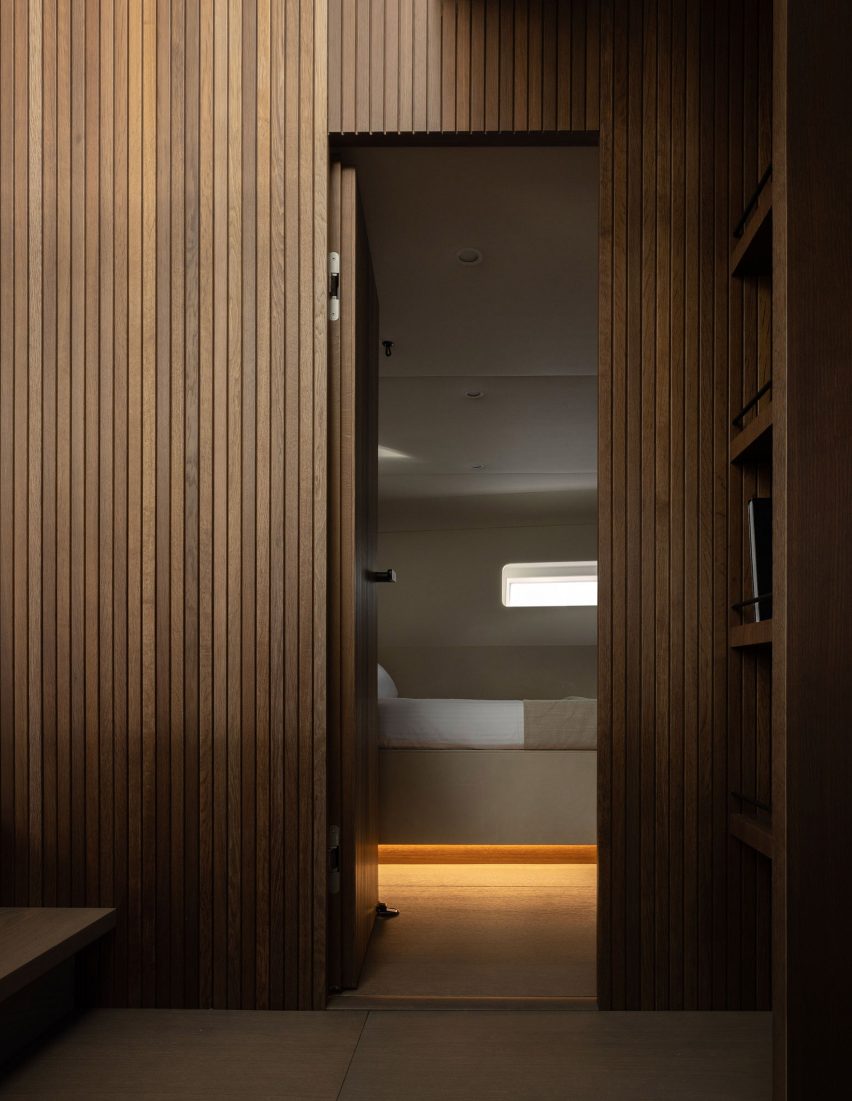
The walls of the Y9 are also lined with vertical wooden beams to make the rooms onboard appear loftier.
Beige suede wraps around the yacht’s principal bedroom
Lisbon-based Pedra Silva Arquitectos has teamed up with Spanish design studio Astet to convert a former clifftop farmstead on Portugal‘s west coast into a destination for surfers.
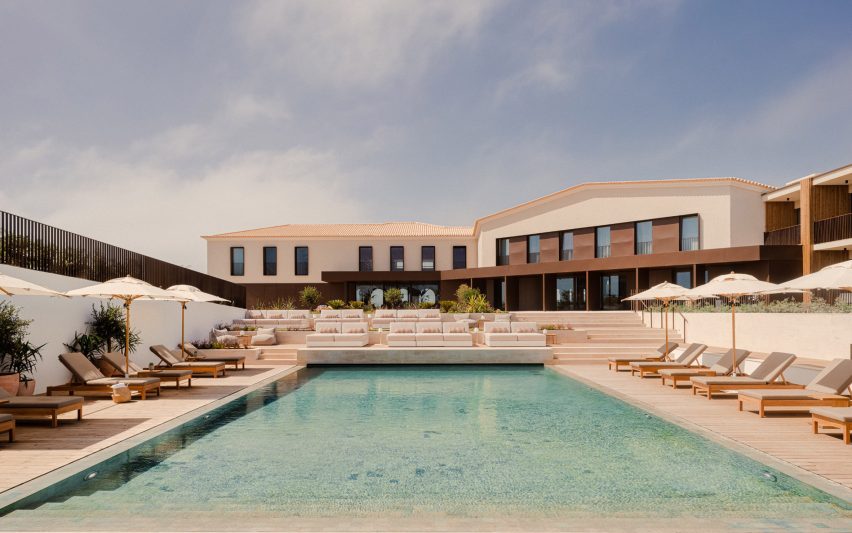
Aethos Ericeira is a 50-room hotel positioned high up on sandstone cliffs, overlooking the beach on a stretch of coastline known to offer some of the best waves in Portugal.
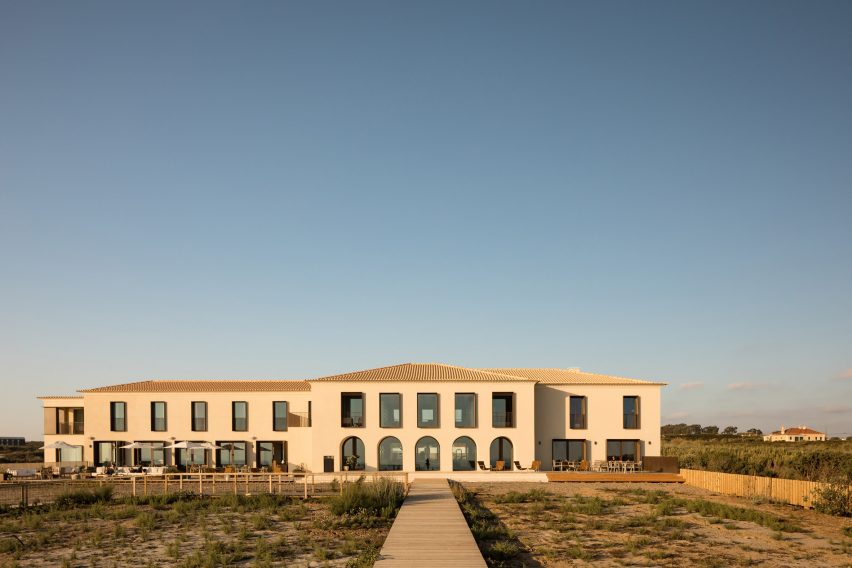
Aethos Ericeira occupies a converted farmhouse. Photo is by Francisco Nogueira
Pedra Silva Arquitectos oversaw the building work, which included reworking the facades, while Astet replanned the spatial flow and designed the visual aesthetic of the interiors.
Their design draws from its setting, combining references to the rural landscape with elements of surf culture, and also taking advantage of the elevated view.
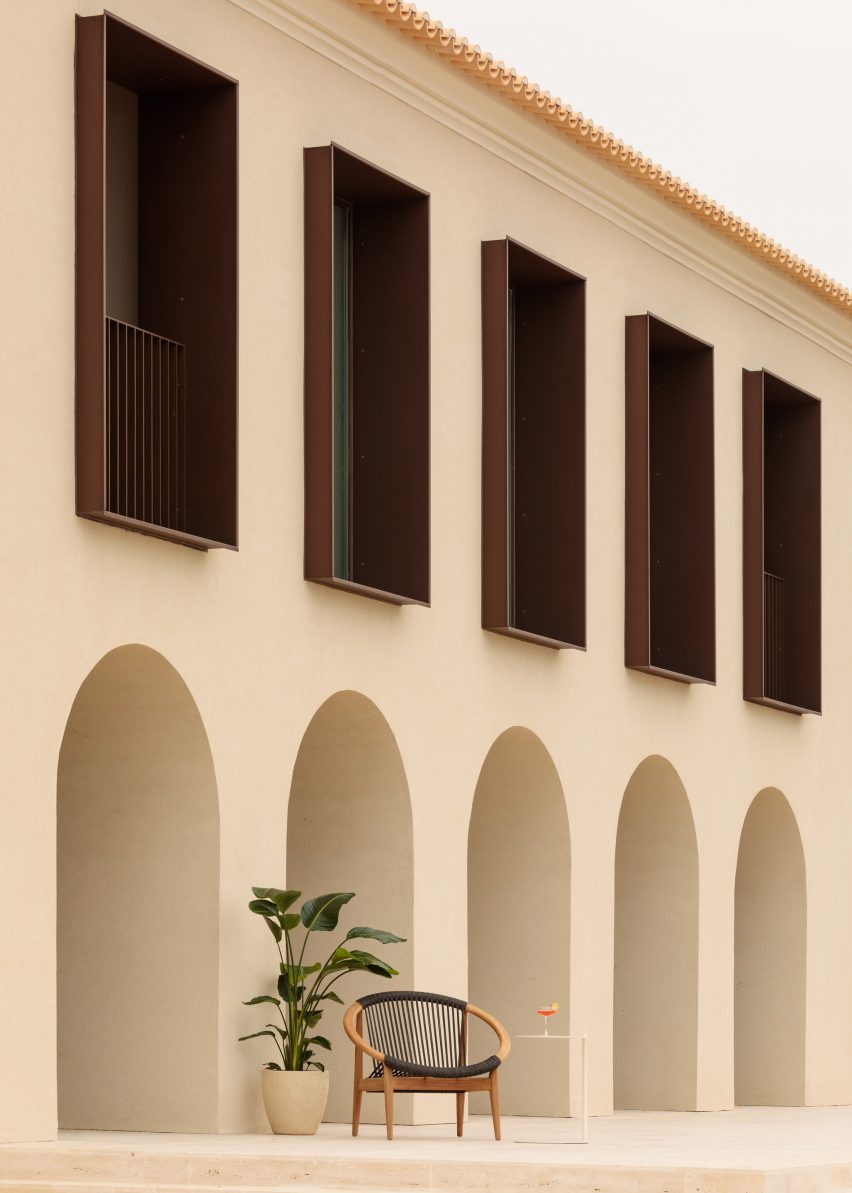
The original facade is updated with protruding box windows. Photo is by Francisco Nogueira
Grand windows, simple furnishings and an earthy colour palette help to create an environment where visitors can feel relaxed and connected with the setting.
“When we came across the property, we immediately knew it was a unique opportunity – a secluded destination on top of a 40-metre cliff, surrounded by lush fields with unrivalled ocean views,” said CEO and co-founder Benjamin Habbel.
“The building, a former farmhouse turned into a rehab centre, had been abandoned for many years,” he told Dezeen. “Despite its bad shape, we saw huge potential.”
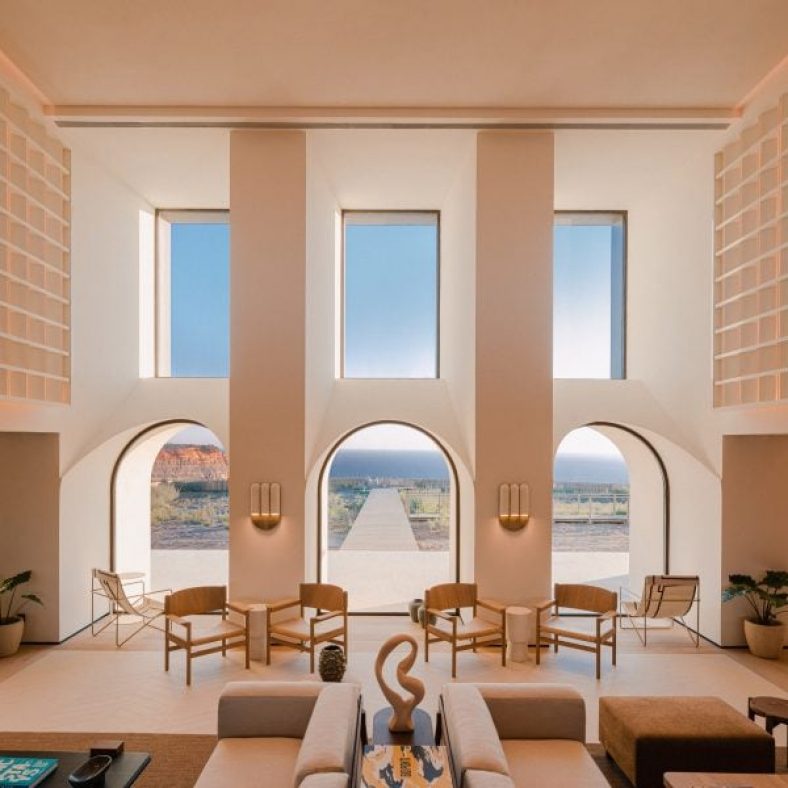
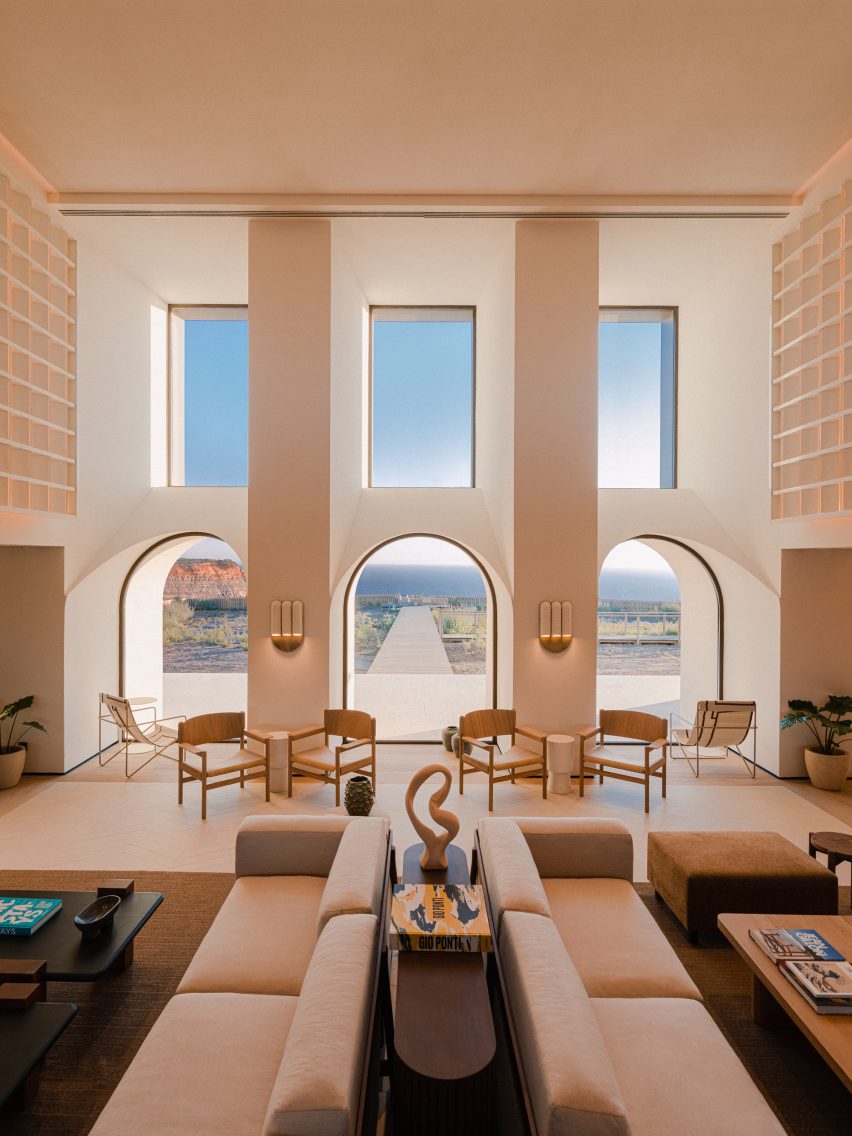
Arched windows are a key feature in the lobby. Photo is by PION Studio
The venue is one of five properties under the Aethos brand, along with locations in France and Italy.
Like its sister venues, the ethos behind Aethos Ericeira is to promote mindfulness among guests, by offering wellbeing-focused spaces and experiences.
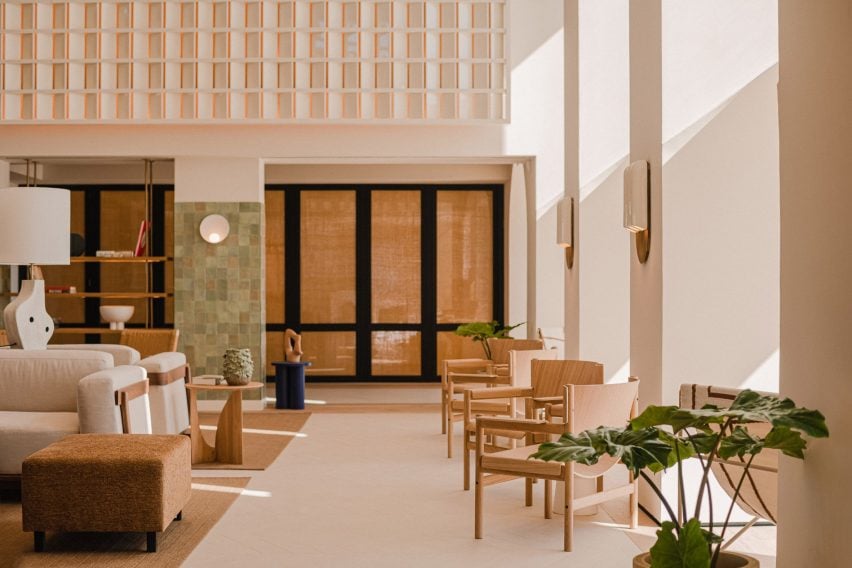
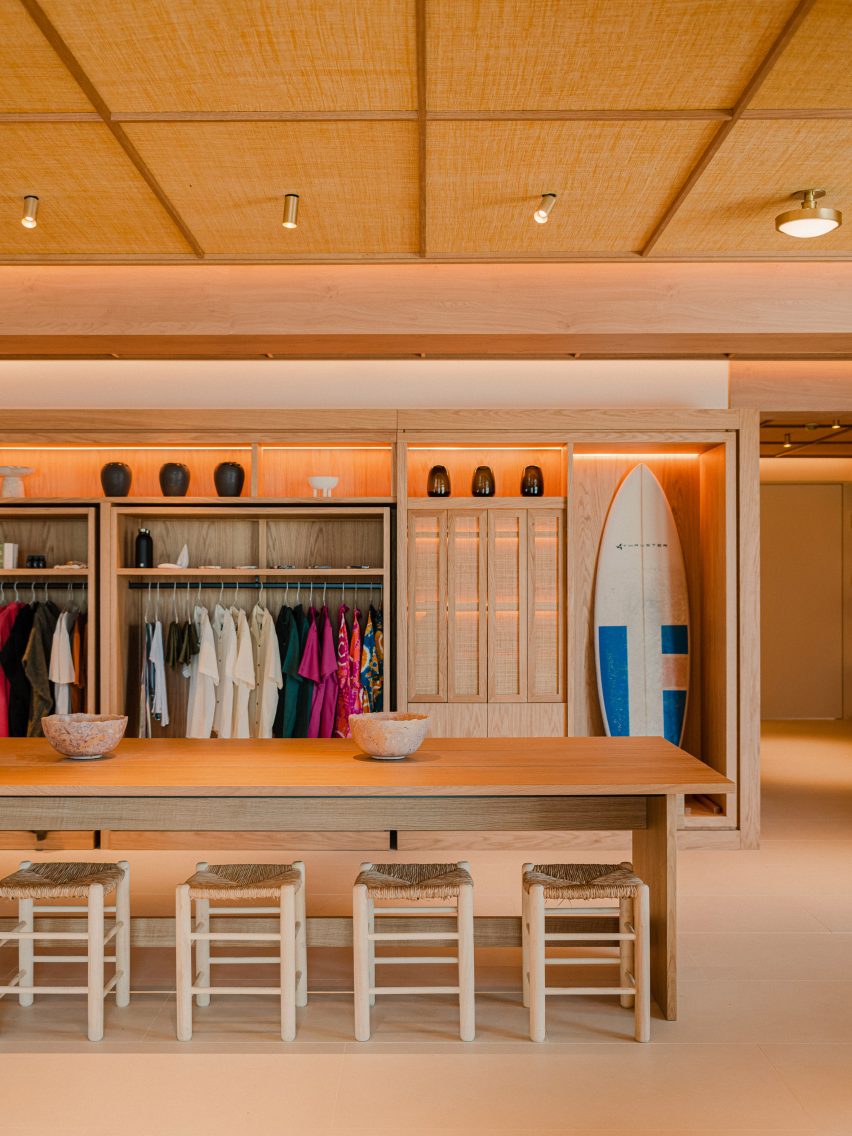
The materials palette includes wood, rattan and soft-green tiles. Photo is by PION Studio
For Pedra Silva Arquitectos, this meant bringing a greater sense of cohesion to the existing buildings and the various extensions that had been added over the years.
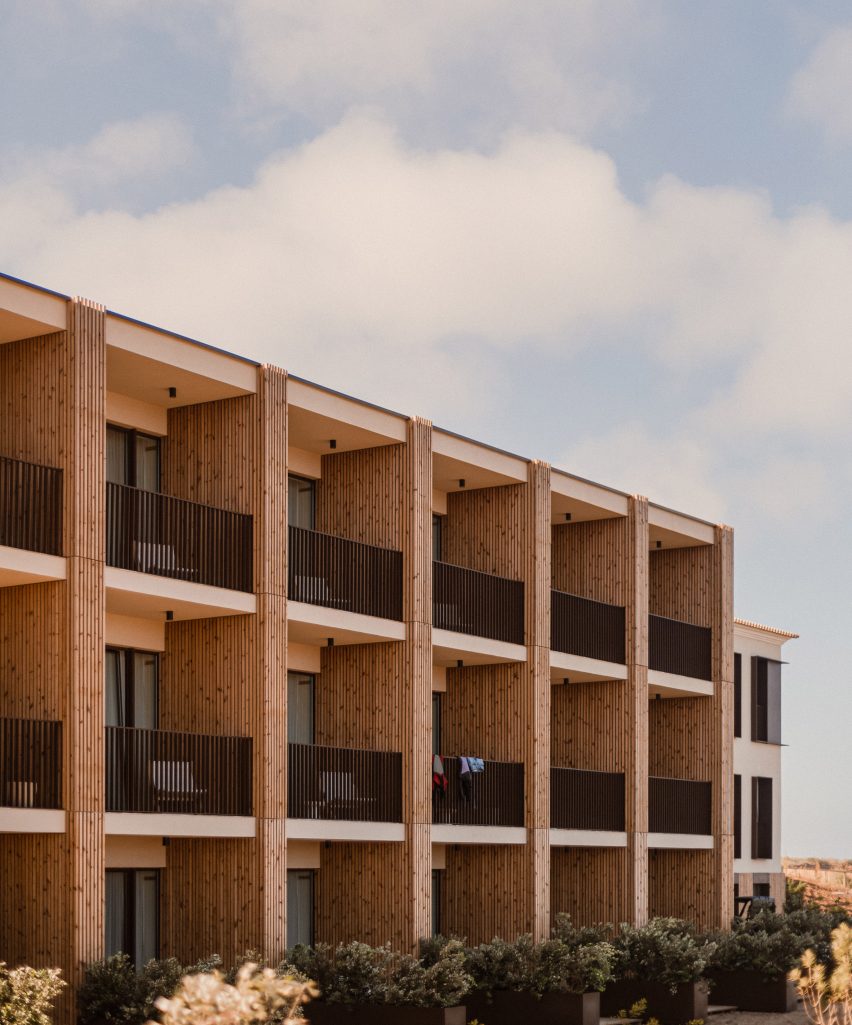
The old farmhouse was kept simple, with light-rendered walls, a clay tile roof, arched recesses and protruding box windows. Meanwhile other parts of the building were updated with timber slats and metal panelling.
“We felt the solution was to establish a clear distinction between old and new, restoring the existing building to something closer to its original state, and giving recent extensions and new construction their own distinct character,” said studio founder Luís Pedra Silva.
“For the areas of more recent expansion, the challenge was to achieve a contemporary look and feel that was well integrated,” added architect Bernardo Nadais.
“We achieved this by combining a strong materiality with surgical instances of demolition – removing some sloped roofs, opening up the balconies – allowing us to reinterpret the facades into clearer shapes and volumes.”
Timber slats clad one of the newer buildings. Photo by PION Studio
Astet’s interior design strategy centred around the year-round experience.
The materials palette incorporates warm natural materials like wood, velvet and rattan, but also brings in cooler surfaces that include marble and stone.
A swimming pool is framed by the buildings. Photo by PION Studio
“Ericeira can be great and sunny but there are a few months where it’s windy and rainy, so the number one goal was for rooms and common spaces to function in the summer and be cosy in the winter,” said Astet’s Ala Zureikat.
“Yet we didn’t want to be too literal and use Portuguese tiles, because I think that’s the first thing that everyone associates with Portugal,” he told Dezeen. “We wanted to achieve a more sophisticated twist.”
The hotel is designed for surfing enthusiasts. Photo is by PION Studio
The most distinctive space is the hotel reception, which is characterised by the original arched windows, soft-green tiles and large louvre screens.
The bedrooms are more minimal, with custom headboards, muted fabrics and wooden flooring.
“The door of the room is a full-size mirror, so wherever you are, you always have a view of the ocean,” said Zureikat.
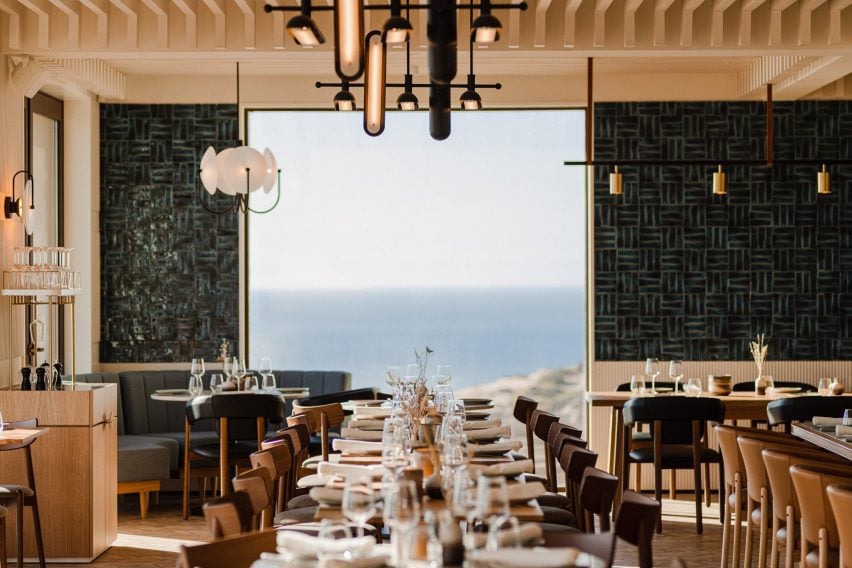
Onda is the hotel restaurant. Photo is by PION Studio
Aethos Ericeira facilities include a restaurant, a gym, a heated saltwater pool, a meditation and yoga deck, and a spa with hammam, hot slab and treatment rooms.
Landscape works help to create easy flow between these spaces, and link up with pathways leading to the beach.
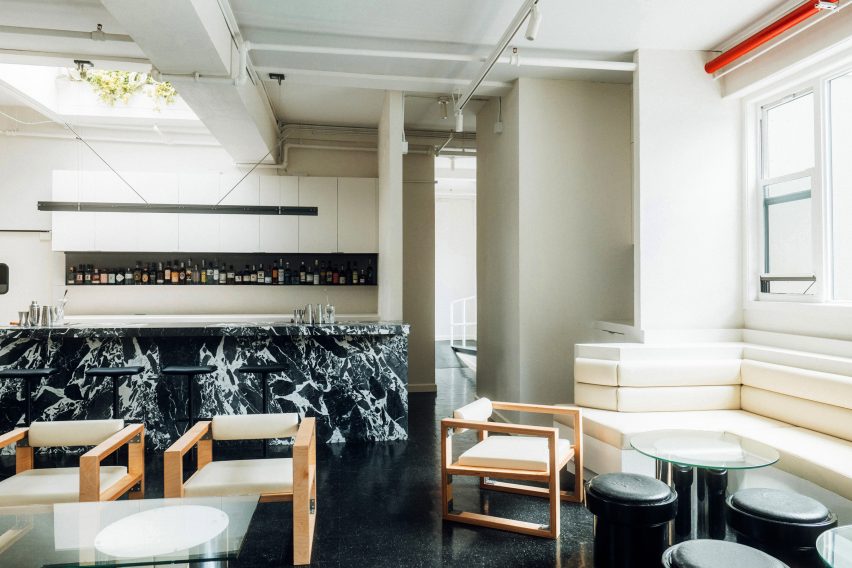
Public Records co-founders Shane Davis and Francis Harris have added a bar and lounge on an upper floor of their multi-purpose creative venue in Brooklyn.
Upstairs is the latest addition to Public Records, which was opened in 2019 by musician Harris and creative consultant Davis, who led the design of both the original spaces and the new lounge.
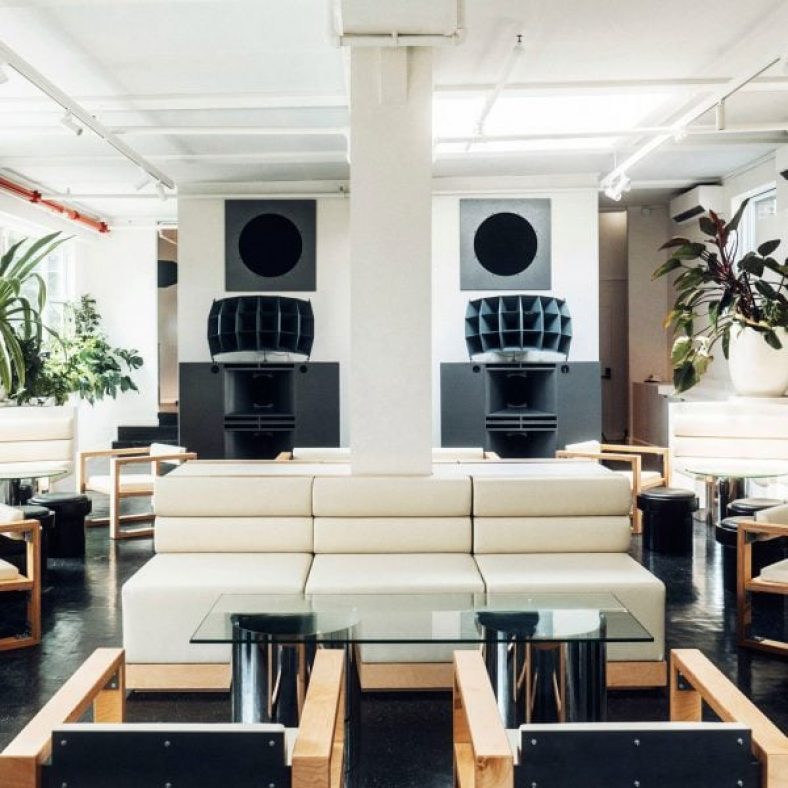
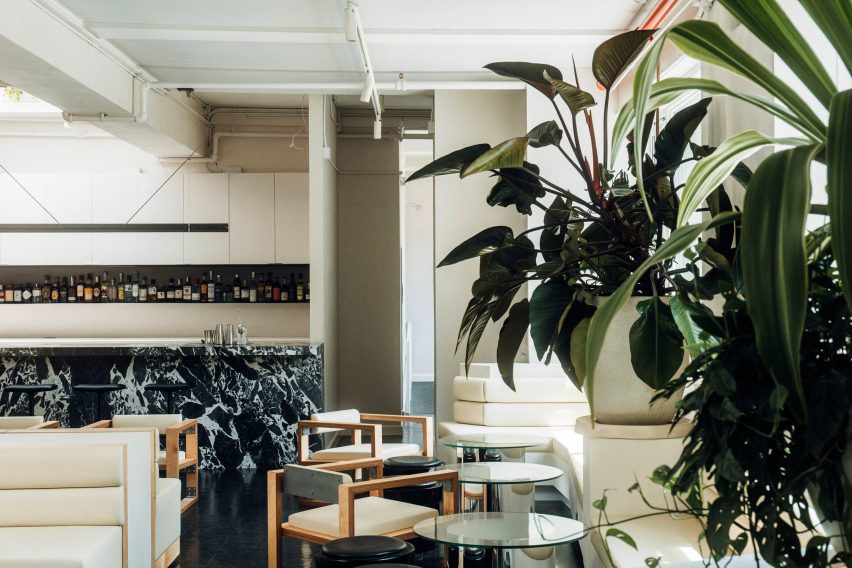
The Upstairs lounge at Public Records is anchored by a dark marble bar and glossy black floor
The extension joins a variety of programmed areas in the industrial brick building, including a cafe and record store, a plant-based bar and restaurant, an outdoor garden and a Sound Room for live performances.
For Upstairs, Davis collaborated with DSLV Studio on the interiors, Arup for the acoustics, and a cast of makers to renovate the upper-level space – once occupied by Retrofret Vintage Guitars.
A “DIY approach” was taken to the design of the space, which involved multiple collaborators
“We felt that people would value a space that inspires more intimate connection than our other spaces,” said David. “This framework then provides opportunities to explore our ideas and showcase those of our collaborators on various scales, whether it be a sound system, a chair, an event series, or a cocktail.”
The room is anchored by a dark, patterned marble bar, which together with the glossy black floor contrasts the mostly white walls and furniture.
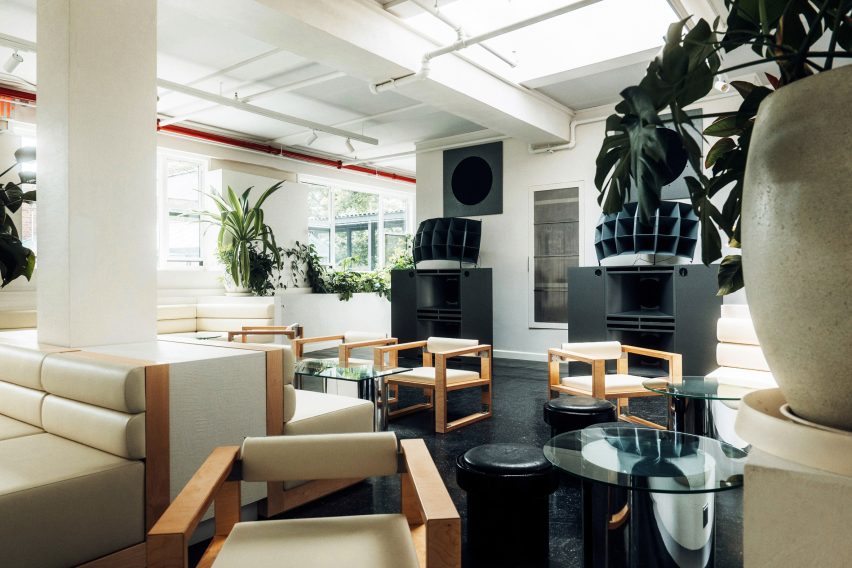
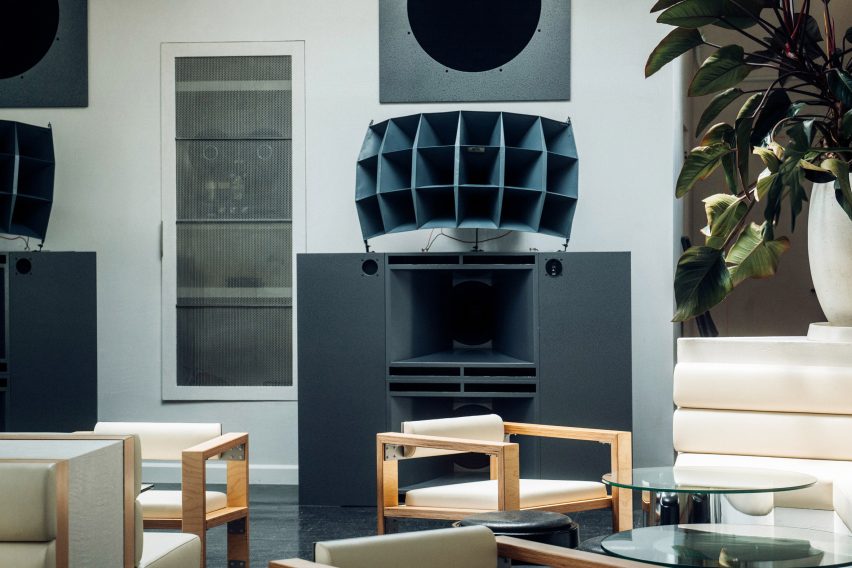
Particular attention was paid to the sound quality in the space, which includes large subwoofer speakers by OJAS
Particular attention was paid to the sound quality in the space, where walls are furred out and undulated to bounce music around the room from large subwoofer speakers.
These are housed in cabinets by Devon Turnbull of OJAS and positioned against the back wall, with either side of the cabinets containing a diverse array of equipment including a reel-to-reel tape player.
Custom furniture pieces include the PR Lounge Chair, designed with local fabricator Joe Cauvel
Patrons will be able to choose from a curated selection of records and CDs available to play during gatherings, events and parties.
“Intentional listening on an audio system that showcases the practices of production in the music space allows for a deeper understanding and appreciation of the cultural significance of musicians and producers who are an integral part of how we shape our perception of the world,” said Harris.
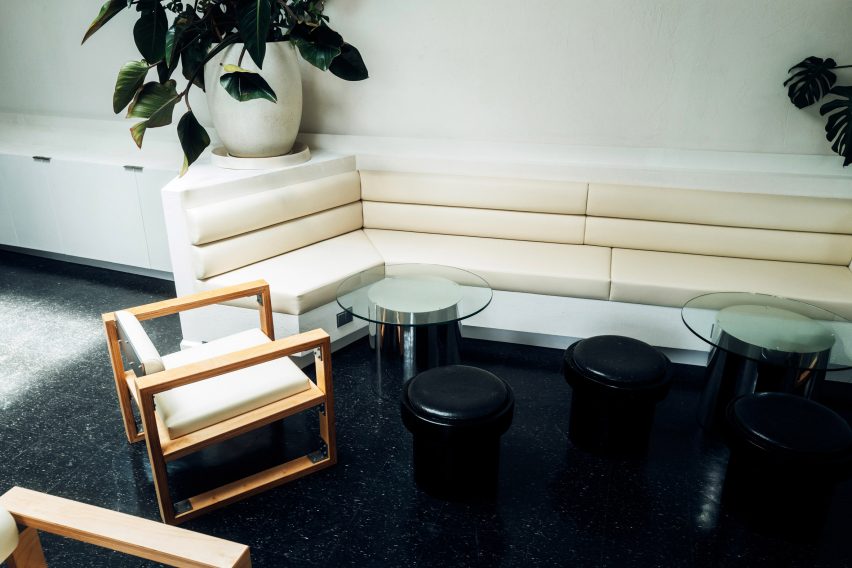
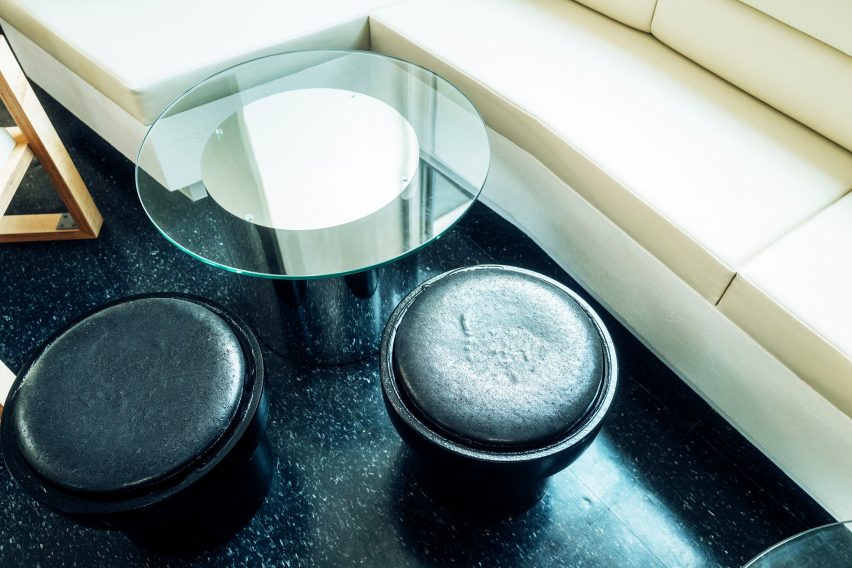
Wrapping the room are cream leather banquettes, accompanied by circular glass tables, and black ceramic and foam stools commissioned from Zurich-based artist Cristian Anderson that are reminiscent of used paint buckets.
Also scattered through the space is the custom PR Lounge Chair, designed with local fabricator Joe Cauvel and constructed of plywood and steel with exposed joinery.
Exposed ductwork and services found throughout the old industrial building are also present in Upstairs
Exposed ductwork and services found throughout the building are also present in Upstairs, which continues the same “DIY approach” taken to all of Public Records’ spaces.
Brooklyn has no end of venues that act as community hubs, workspaces and nightlife spots geared towards its thriving creative population.
Black ceramic and foam stools by artist Cristian Anderson are reminiscent of used paint buckets
Among others are The Mercury Store performing arts centre in Dumbo and the 77 Washington artist studios in the Navy Yard.
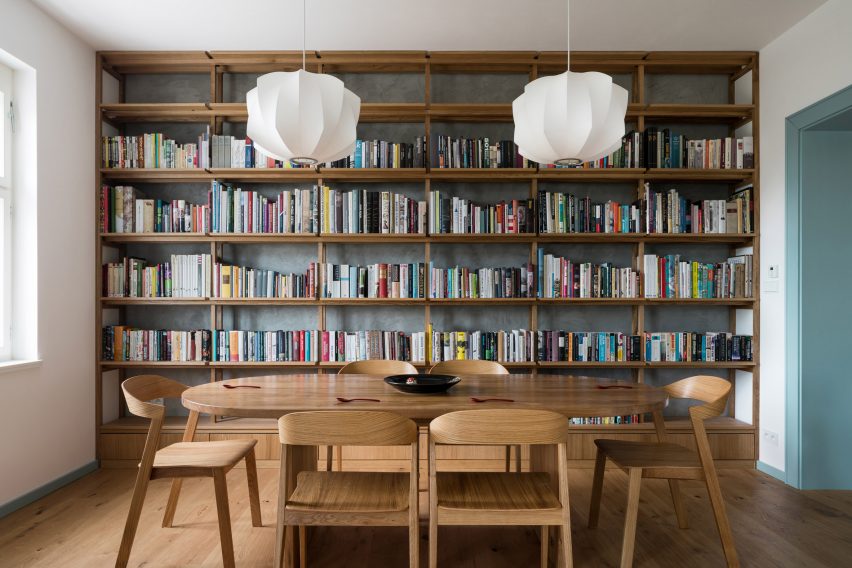
Czech studio No Architects has renovated and extended a 1920s villa in a Prague suburb, adding bespoke joinery and modern details that complement the original architecture.
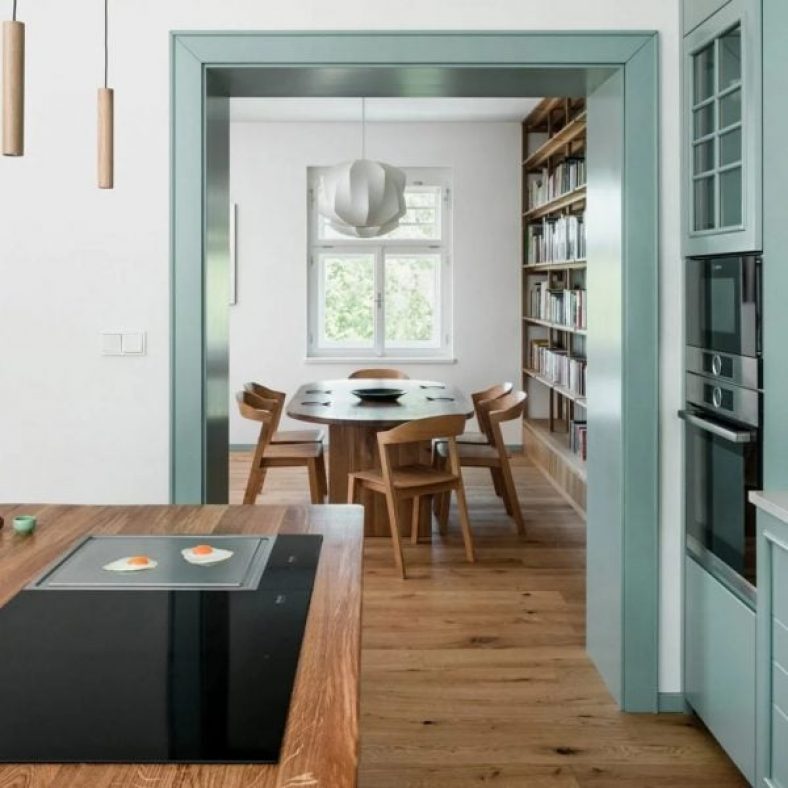
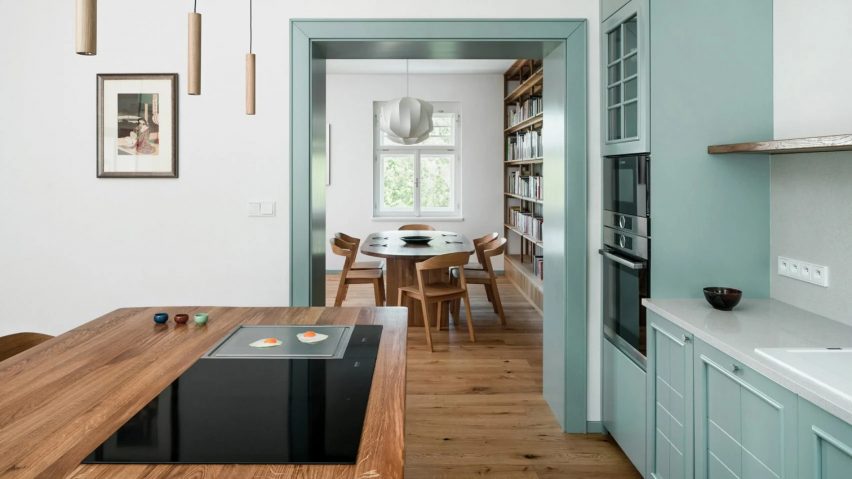
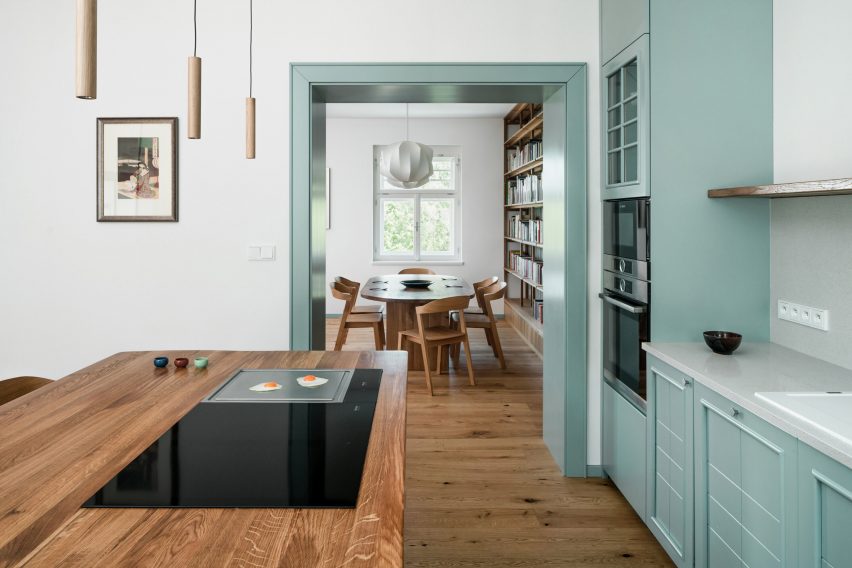
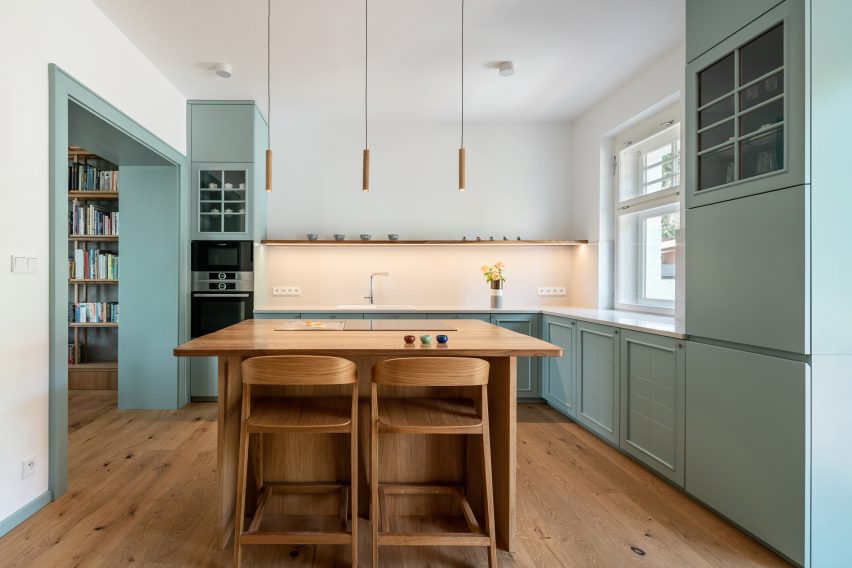
The joinery on the ground floor was painted duck-egg blue
The extensive remodelling and extension aimed to retain the character of the house, which was built in the 1920s in a romantic style that references the steep-pitched roofs and brick cladding of arts and crafts-style English villas.
No Architects removed all of the existing floors, ceilings and non-load-bearing walls of the semi-detached property and added a side extension to accommodate containing a ground-floor guest suite and a bedroom on the first floor.
Bespoke joinery was added throughout the interior
The extension utilises the same palette of clay roof tiles, painted brick and a pumice stone plinth in order to produce a timeless aesthetic that is in keeping with the original architecture.
“Other contemporary extensions in this neighbourhood got very old very quickly and don’t fit in well anymore,” Jakub Filip Novák told Dezeen.
“Our addition refers to the original facade details and is hardly recognisable as separate to the original house. The connection between the new and old parts is not just via design, but it seems seamless even by structure and same ageing of material.”
The interior layout was reconfigured to modernise the villa
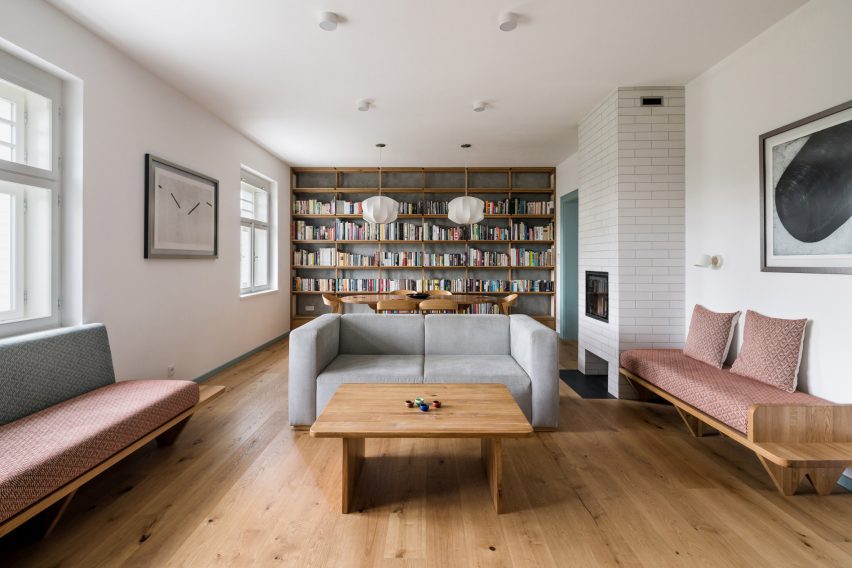
The revamped interior has a contemporary layout, with an open living and dining area linked to the adjacent kitchen. A new doorway in the rear elevation provides direct access from the kitchen to the garden.
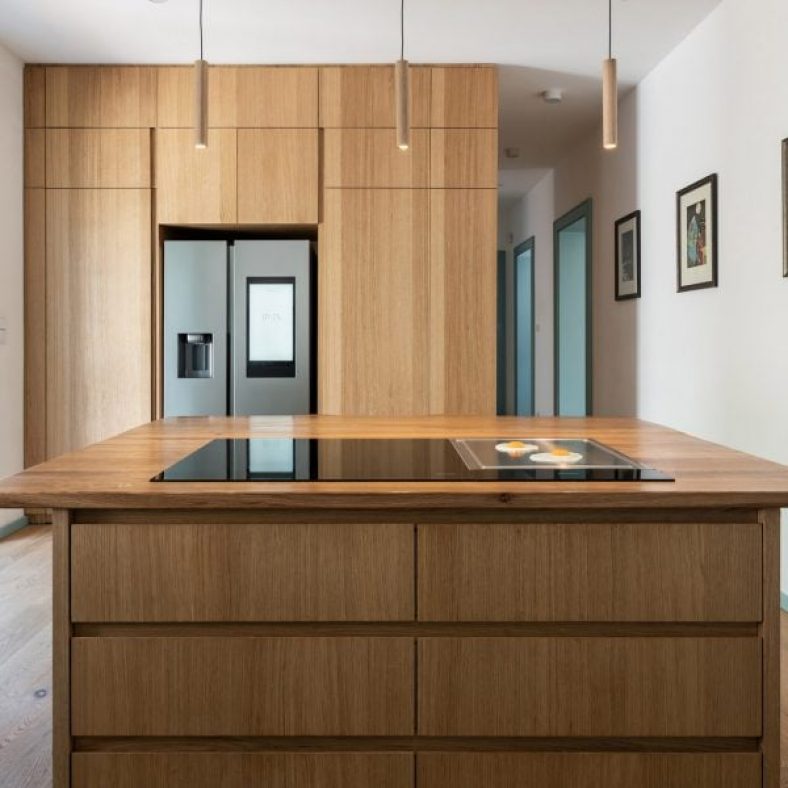
A custom-built unit next to the back door discreetly conceals a pantry and toilet, along with plenty of storage and space for the refrigerator.
No Architects designed bespoke joinery added throughout the house to make optimal use of the available space and to create a sense of aesthetic consistency between the various rooms.
“The living space consists of many details and we like to frame them because it helps connect plenty of technology and infrastructure which surround us in any house,” said Novák.
“It’s also an economic decision,” he added, “because every square metre of living space in Prague is expensive so it is rational to use it sensibly. We see joinery as part of such thinking, uniting architecture, construction and technology.”
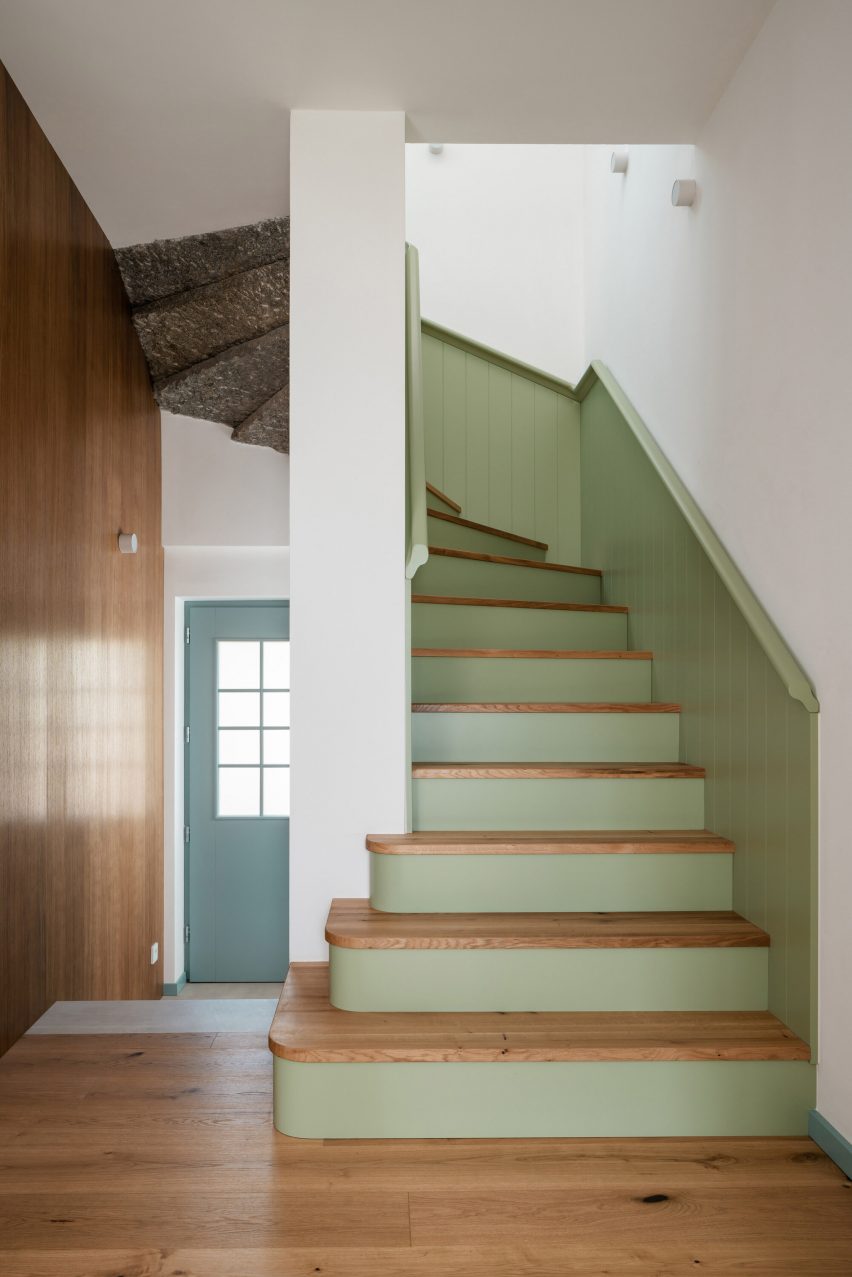
Green woodwork adds a splash of colour to the staircase
Some of the interventions were painted in pastel shades that add a distinctive character to the spaces. The upper floor and staircase feature green woodwork, while the ground-floor joinery is painted a shade of duck-egg blue.
The clients spent part of their lives working in Japan and the United Kingdom, so some of the colours and details reference these experiences.
The decorative panelling and exposed radiators on the first floor recall traditional British houses, while the minimal bench seating in the living room and the tiled porch evoke Japanese living.
The studio designed built-in seating in the living room
A small door on the first-floor landing provides access to a previously unused space above the entrance that now contains a private play area accessible only by the children.
Throughout the project, No Architects adapted existing features to give them a new purpose or to enhance the character of the building while ensuring it meets the client’s requirements.
The bespoke joinery was designed to optimise space in the home
“We work with intuitive ‘memory of architecture’ and aesthetics which belongs to the original era but we don’t follow it directly,” Novák added, “we just use it to make a nice place that makes the most of the potential which is in the atmosphere of the house.”
No Architects’ founders met while studying at the Academy of Arts, Architecture and Design in Prague. The studio combines the disciplines of art and architecture to produce detailed-oriented solutions that reflect their clients’ requirements and personalities.
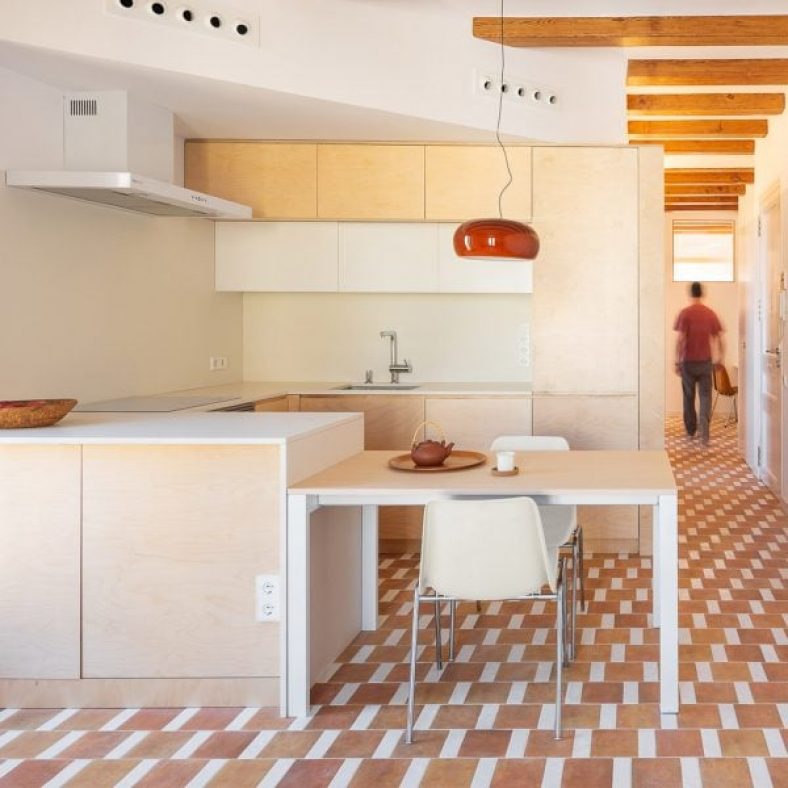
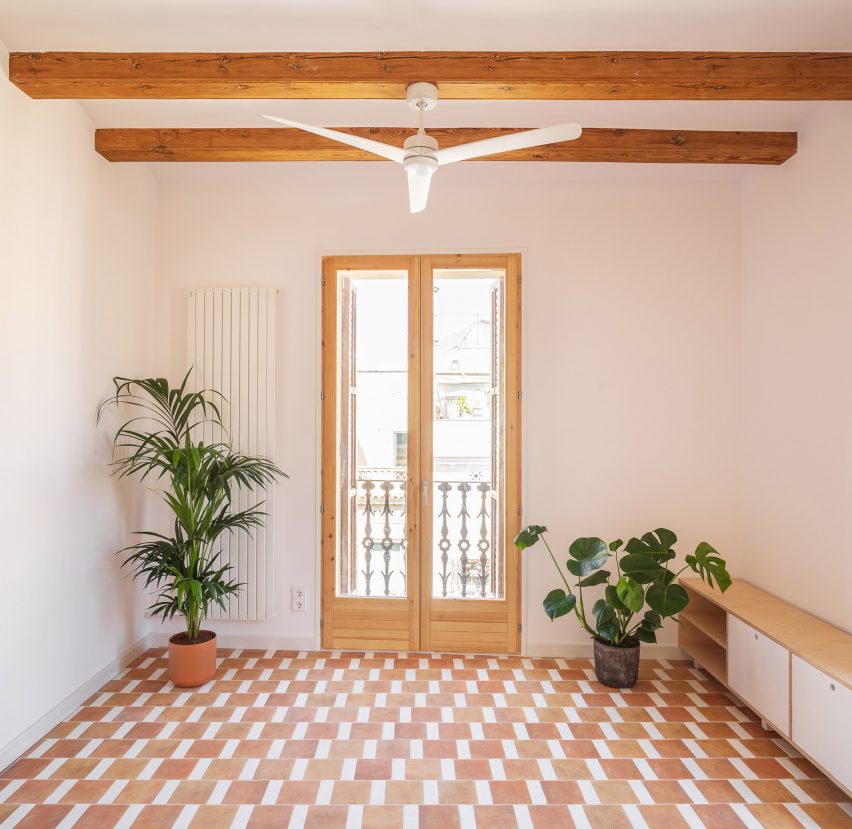
Barcelona architecture studio Parramon + Tahull has renovated a traditional apartment in the city’s Gracia neighbourhood, adding birch plywood joinery and ceramic tiling to complement the building’s original features.
The apartment is home to a family of four, which has lived there for several years and wanted to carry out a significant overhaul of the outdated interior.
Parramon + Tahull has renovated an apartment in Barcelona
The clients asked local architects Lluís Parramon and Emma Tahull to oversee the transformation of the space to provide an open living area and kitchen, along with separate bedrooms for each of their two daughters.
The apartment is located on the upper floor of a five-storey building dating from the 1900s. A previous renovation undertaken around 20 years ago had altered the layout and destroyed most of the original features.
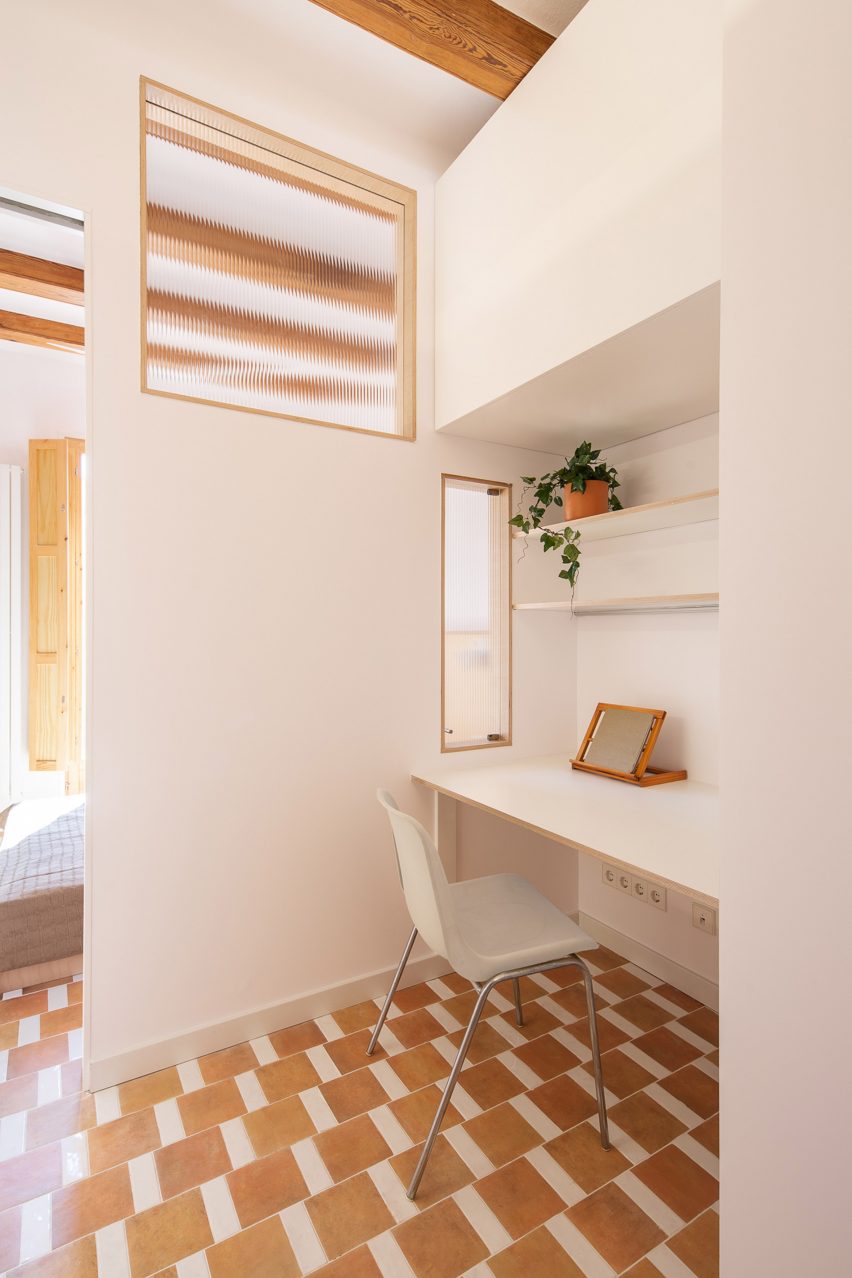
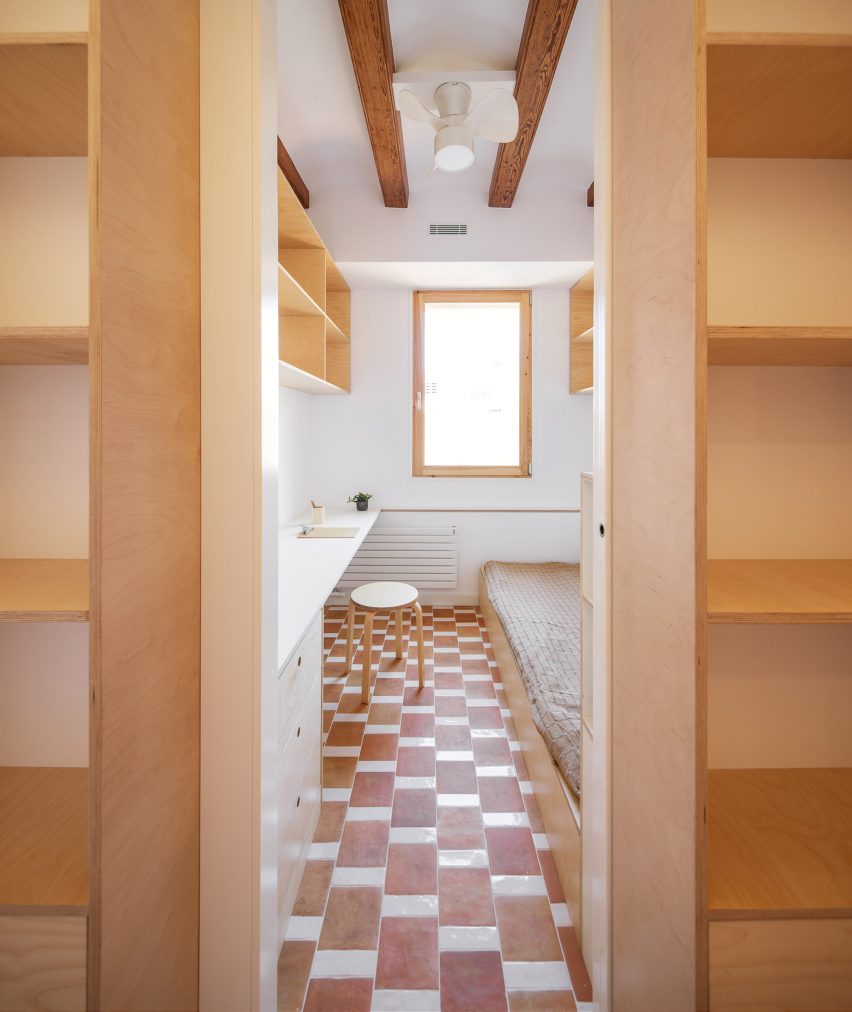
The studio added bespoke joinery including a small built-in desk
Parramon + Tahull began by removing all of the existing partition walls in order to create a brighter and more practical series of spaces within the compact floor plan.
The rearranged interior also provides plenty of usable storage and restores some of the original details, including wooden beams that had been painted white by the previous owners.
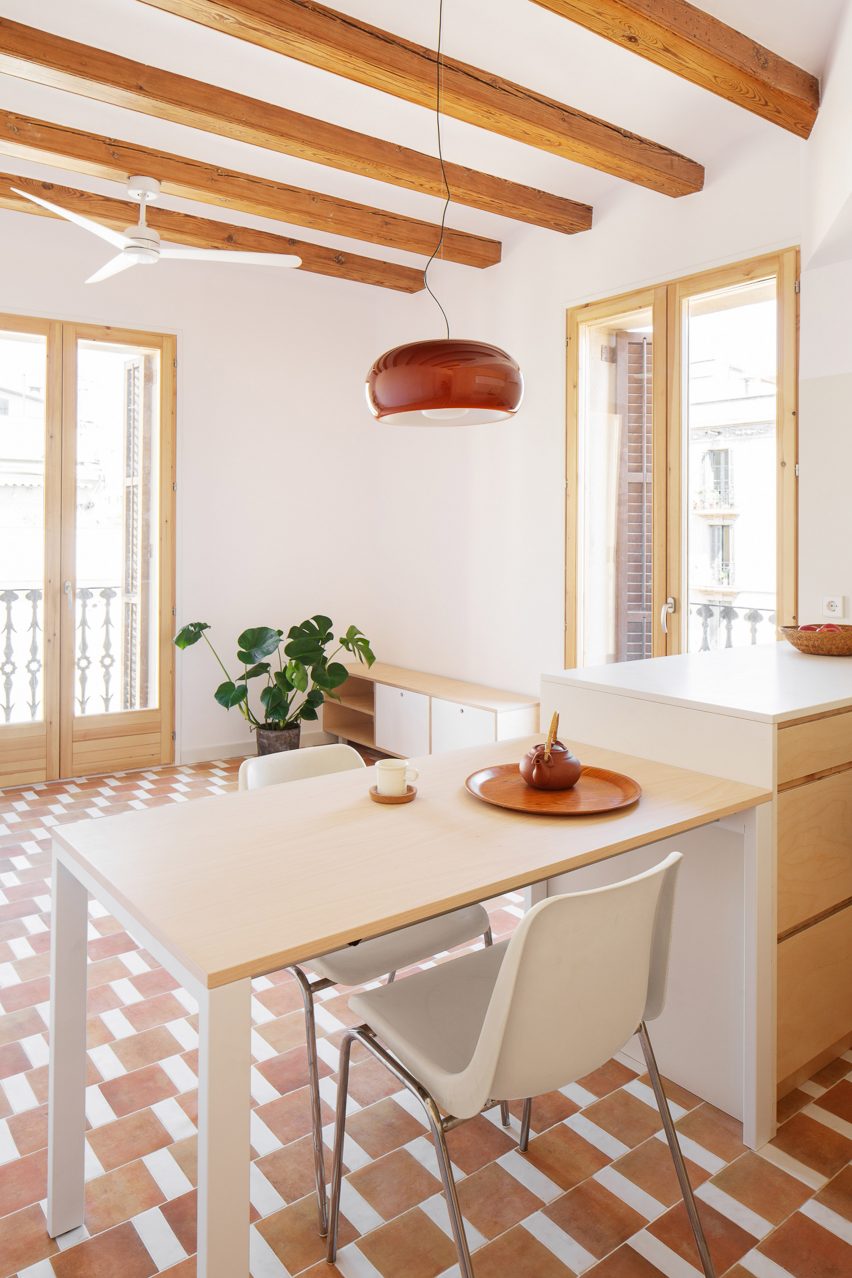
Terracotta tiles cover floors throughout the apartment
“We wanted to bring natural light into all the spaces and to achieve a sense of flowing, continuous space despite the limited surface area,” Tahull told Dezeen.
“We were interested in working with natural materials and returning some of the original spirit of the building to the apartment.”
Bespoke joinery is also provides storage in the bedrooms
Due to its small size, the architects paid close attention to the choice of materials and layout in order to create a serene, spacious feel.
“To achieve all the client’s goals, we had to work on a very precise scale of detail, designing all of the furniture to measure in order to take advantage of every square centimetre,” Tahull explained.
The interior utilises a palette of predominantly natural materials, chosen to complement the wooden beams while providing an element of tonal and textural contrast.
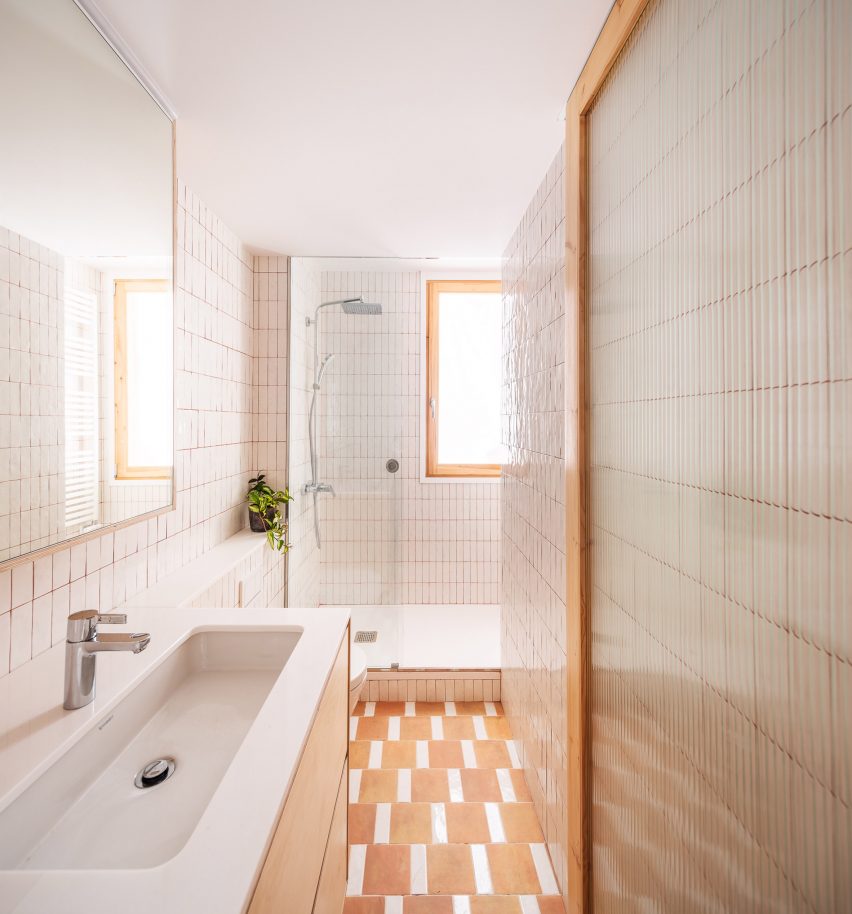
Parramon + Tahull chose ceramic tiles from Spanish manufacturer Wow to create a continuous flooring surface throughout the entire apartment, including the kitchen and bathroom.
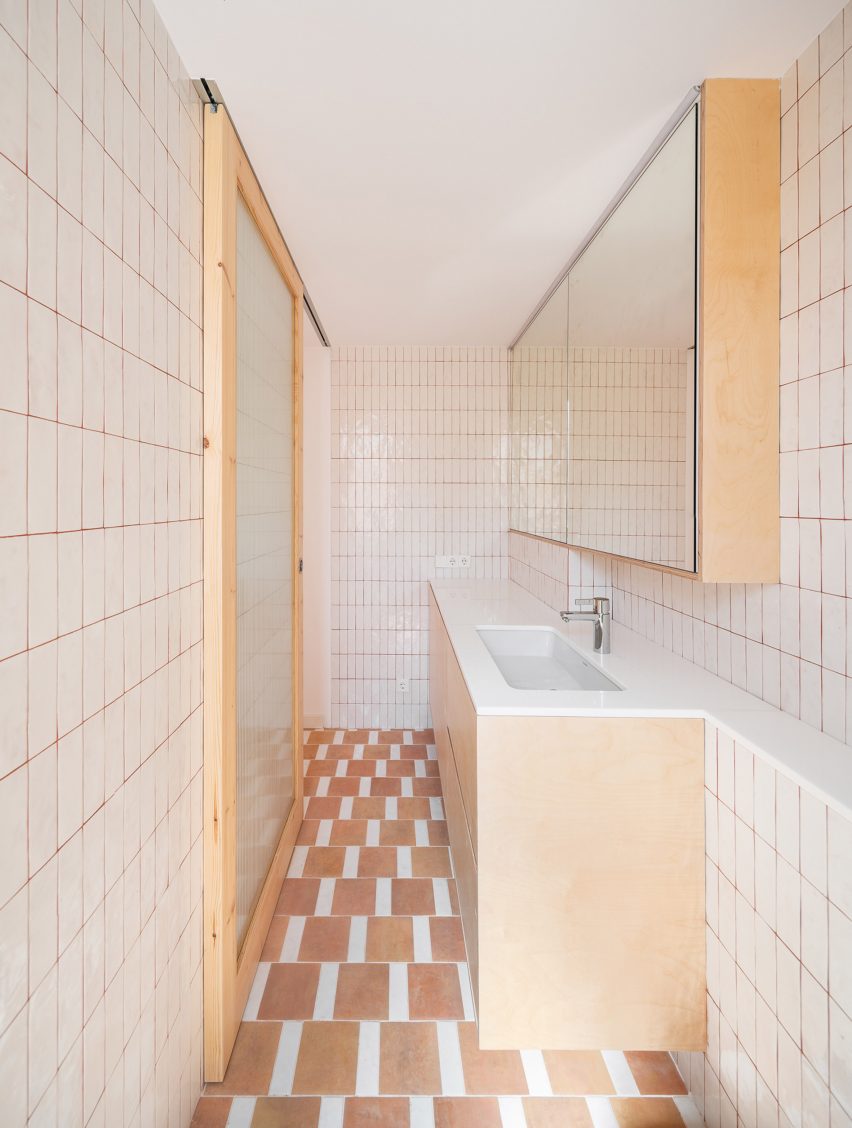
Glossy white tiles clad the walls in the bathroom
“We were looking for a small-format tile so the feeling of space would be bigger,” Tahull added. “We also wanted to play with a tapestry-like colour scheme that included white, because white gives a great luminosity and echoes the white of other elements.”
The white and terracotta-coloured tiles include different formats, textures and surface finishes ranging from glossy to matte.
White grout is used for the floors throughout the rooms, while the bathroom walls are clad in white tiles with contrasting reddish grout.
Reddish grout provides a visual contrast
Bespoke fitted cabinetry made from birch plywood provides practical storage in every room, as well as in the hallway. Along with the tiles, the wood forms a consistent element that unites the spaces.
Lluís Parramon and Emma Tahull founded their studio in 1997. The office focuses on delivering comfortable, contextual and energy-efficient architectural projects for private and commercial clients.