Across all the different dog breeds, there are several different coat textures that come in a variety of hair types, lengths, colors and patterns. A brindle dog coat is a very distinctive “tiger stripe” of darker streaks over a lighter base coat color running along a dog’s back. Brindle is a coat pattern and not a dog breed; there is no brindle dog breed.
Why do some dogs have brindle coats?
Just like other features on a dog, a brindle dog coat is a matter of genetics. A dog inherits half his genes from his mother and half from his father, and this makes up the dog’s unique genetic data, including the resulting coat color and pattern.
Only eight genes make up a dog’s coat color. One of these, known as the agouti gene, must be present to produce a brindle coat pattern.
A dog’s coat color is made up of only two pigments: black (eumelanin) and red (phaeomelanin). The amount of melanin in the dog’s body will determine all the fabulous color variations in between the dark and red colors.
The brindle color chart: a range of darks and reds
The black pigment on a dog’s coat produces color variations, such as a range of browns referred to in the dog fancy as “liver” and grays that are called “blue,” along with a range of diluted versions of these colors. Similarly, the red coat colors range from deep red to orange, creams, yellows and tans.
The distinctive brindle coat “tiger stripe” can be found in all these color ranges. Even though the coat pattern is described as a stripe, it’s sometimes blended into the fur and isn’t particularly distinct. The brindle pattern can even appear in blotches, too.
The terms ‘reverse brindle’ and ‘black brindle’ are used to describe a brindle dog coat with a high concentration of darker stripes. This causes the brindle pattern to look reversed. Interestingly, a brindle coat can develop as your dog ages. So, a solid-colored pup could develop stripes as he gets older.
These dog breeds are known for having brindle coloring:
Boxer
French Bulldog
Greyhound
Whippet
Dutch Shepherd
Great Dane
Akita
Russell Terrier
American Staffordshire Terrier
Dachshund
Cane Corso
Bullmastiff
Bull Terrier
Plott Hound
Cardigan Welsh Corgi
Mixed breed dogs can also carry the brindle gene.
Brindle dogs in books
Dogs with brindle coat patterns are often sought-after and have appeared throughout literature. Some of the more famous brindle dogs include Jock, a brindled Staffordshire Bull Terrier mix and the companion of author Percy Fitzpatrick, who wrote a book, Jock of the Bushveld about their travels in the South African bushveld.
Author Laura Ingalls Wilder also featured a brindled Bulldog named Jack in the early books of The Little House on the Prairie series.
Kristina Lotz has been a writer on all-things animal for over a decade. A former CPDT-KA dog trainer, she has competed in agility, herding and rally with her dogs. Now, she clicker trains her horse! Follow life on her farm @MeridaTheBitless.
Of course, you want your dog to live his best life. Adding puzzle toys to your pup’s daily activities can really improve his well-being. They can also be useful during times he can’t go outside because of inclement weather or if he’s unable to participate in rigorous activities because of a health issue or because he’s a senior.
How do you use dog puzzle toys?
Puzzle toys for dogs range in sizes, difficulty level, materials and activities, but the ultimate goal for your dog is to solve a challenge and get to a treat. Many dog puzzle toys are interactive, and your dog must learn to swivel or move a lever away or press a button to get to his prize. Once your dog figures out how to get to the food, there are often options to increase the difficulty level.
In addition to providing a fun activity for your dog, puzzle toys:
Improve problem-solving skills
Stimulate the mind
Keep the dog busy
Help provide exercise
Help tire the dog out
Prevent boredom
Help brain development in puppies
Help keep seniors’ minds sharp
Help relieve anxiety or stress, if the dog puzzle isn’t too difficult
Build confidence
Can be used as a type of slow-feeder bowl to slow down dogs who scarf down their food, risking bloat or intestinal upset
Enrichment activities are important for a dog to have a well-rounded life. Note: Take the calorie count of the treats or kibble in the toys into your dog’s daily food allowance.
How to choose a puzzle toy
It’s important to choose the right toy for your dog as each dog has his own preferences. Some like to chew, while others like to chase things.
Dog puzzle toys vary in their level of difficulty as well as their material. Some are very easy to maneuver but others are more challenging. If your dog is new to puzzle toys or is a puppy, start with one that’s easy to figure out. You don’t want your pup to get frustrated or give up. Engaging with the toy should be a rewarding, pleasurable experience! When choosing a dog puzzle toy, take into account the following:
Level of difficulty
Your dog’s toy and play preferences
Durability and strength of toy
Ease of cleaning
Size of the toy
Remember to always supervise your dog when using the puzzle toy. And you need to rotate toys so that your pup doesn’t become bored with them.
The original Kong, which costs from $7.99 to $25.99 on Chewy.com. This is a tried-and-true toy that all dogs should have. It’s great as a stress-relieving chew toy that also helps prevent boredom. The Kong can also be used to help a dog enjoy his crate and occupy his time. It comes in various strengths from puppy, senior, classic and extreme, depending on how forcefully your dog chews. For safety, so that the toy doesn’t wedge in your dog’s mouth and potentially obstruct his airway, the Kong also comes in various sizes:
X-Small for dogs up to five pounds
Small for dogs up to 25 pounds
Medium for dogs between 15 and 35 pounds
Large for dogs between 30 and 65 pounds
X-Large for dogs between 60 and 90 pounds
XX-Large for dogs 85 pounds and over
The interior of the Kong is relatively easy to clean with soapy warm water and a clean toothbrush, rinsing well afterward. You can fill it with a variety of safe fillings, such as pate moist canned food and freeze it so that it takes some time to get the filling out. This toy is on the easy scale.
Pet Zone IQ Treat Ball by Cosmic Pet at cosmicpet.com
The Smarter Toys Pet Zone IQ Treat Dispenser Ball Dog Toy, which costs $9.49 and $14.95 on chewy.com. It comes in a small and large version, can be dismantled for cleaning and can be filled with kibble and even a few small treats. To show your dog how it rolls —literally — roll it and have a few kibbles fall out. Rolling and chasing the ball is fun, rewarding and exercises your canine companion. This is a relatively easy toy, though it may take a while to empty because of the maze-like inside. Note this is not a chew toy.
The KONG Wobbler comes in a small and large version and looks somewhat like a doggie bowling pin. It costs $14.99 and $19.99 on chewy.com. A dog bops it with his nose or paw and a piece of kibble or treat comes out. Then, the toy returns to an upright position. This is a relatively easy toy for a dog to figure out. The Wobbler can help a dog build confidence in new experiences as well as provide physical and mental exercise.
The RundA Snuffle Mat for Dogs costs $29.99 on Amazon.com. This washable mat’s made of soft fabric with upright pieces of material with nooks and crannies where treats and kibble can be hidden. As long as a dog doesn’t chew the mat, it’s great because it encourages his natural foraging instinct to hunt for food. After all, dogs have a “nose brain.” At first, you can scatter a few kibbles on top of the mat, eventually placing them deeper when your pup understands what’s expected.
Nina Ottosson Dog Tornado Interactive Treat Puzzle Toy by Outward Hound; outwardhound.com
The Nina Ottosson tornado puzzle by Outward Hound is $14.44 on Amazon.com. It’s an intermediate-level puzzle where the dog needs to swivel the pieces apart to reach the prized kibble or treats. It’s a great toy for problem-solving and building confidence with new experiences. For extra interest and difficulty, you can place bone-shaped pieces that are provided over the kibble that must also be removed by your pup. Not a chew toy, the plastic can be washed.
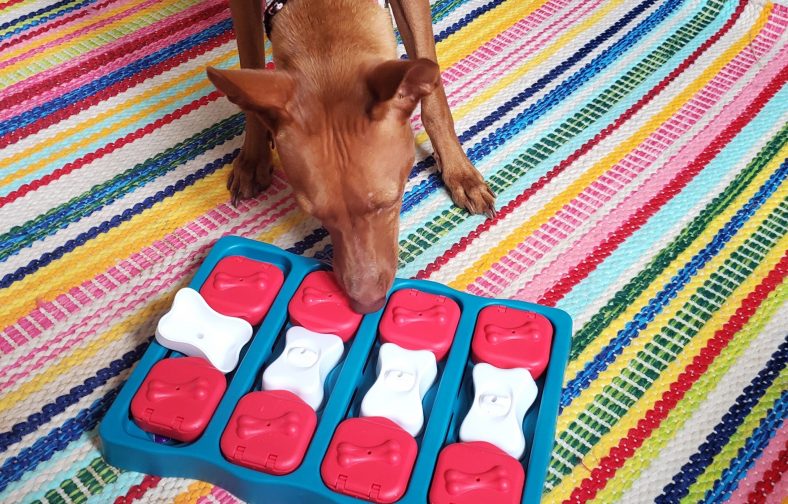
Nina Ottosson Expert Level MultiPuzzle by Outward Hound; outwardhound.com
The Nina Ottosson MultiPuzzle, Expert Level, sells for $32.99 on Amazon.com. This is one of the more challenging puzzles where your pup needs to spin, slide and unlock various pieces to reach the desired kibble or treats. Figuring out how to solve this complicated puzzle toy can build your canine companion’s confidence and improve his problem-solving skills. As long as this puzzle toy’s not too difficult for him, your pup can also learn how to deal with slight frustration and be rewarded when successful. The MultiPuzzle can be washed and isn’t a chew toy.
There are many reasons to give your beloved canine puzzle toys. They help provide mental and physical exercise and prevent boredom. Providing enrichment activities is important for our dogs to have well-rounded lives. After all, who doesn’t want his dog to enjoy life fully and have fun?
There are different levels of dog-friendly apartments. While some apartments will simply allow you to have pets, others welcome your dogs with open arms and provide extra dog-friendly amenities to help you and your dog enjoy living the apartment life.
What features to look for in a dog-friendly apartment?
The most basic level of a dog-allowing apartment lets dogs live with you. There may be restrictions to the number of dogs, the size of the dog and the type of dog. When searching for a truly pet-friendly apartment, here is what to look for:
Allows more than one dog
Allows dogs of all weights and types
Has a dog-potty area, including a dog waste trash can and poop bag dispenser
Has dog water areas (bowl or running dog fountains)
Holds dog events or activities
Pet spa or pet washing area
Offers discounts or packages to local pet service providers (vets, groomers, dog walkers or pet sitters)
Providing a dog potty area is very important. A grass area, turf grass or gravel space where your dogs can do their business can make a dog lover’s life much easier. If not, you have to buy your own apartment dog potty system like the Porch Potty system, which has turf grass and a tray of absorbent litter underneath. An example of a very dog friendly apartment is at Fidus Pet Communities in the Dallas, Texas area, where each apartment includes a doggy door that leads to either a private fenced yard or a porch relief system.
Is there a dog-loving community within the apartment building that supports each other and gets together for fun doggy events and activities? At State and Chestnut in Chicago, pet amenities include on site dog runs, a pet spa and monthly yappy hours for residents and their pups to mingle.
Does the apartment building provide other amenities like a dog waste station, water station or small dog park with benches and canine agility equipment? Some dog-friendly apartment communities even offer onsite dog walking, doggy daycare and grooming services. Avalon Communities has a partnership with VCA Animal Hospitals and offers residents with pets discounts of veterinary services, like a free first wellness exam and 10% off ongoing veterinary services.
What are the challenges in finding a dog-friendly apartment?
When finding a dog-friendly apartment, look into restrictions and rules. It’s not uncommon for apartment buildings to limit the number of pets, the weight of the dogs or the dog breeds. Other apartment buildings require a temperament test to make sure your dog is safe around humans and other pets. Some common restrictions include:
The number of pets you’re allowed to have
The maximum weight your dog can be, which is typically less than 30 pounds and therefore, naturally restricts certain dog breeds
Allowing cats, but not dogs
Certain breeds or types of dogs may be banned
Most dog-friendly apartments will charge a pet deposit or a pet fee, which may be nonrefundable.
How to find pet-friendly apartments?
When searching for apartments online, there’s typically a filter option that lets you search for only pet-friendly rentals. Aside from a pet-friendly apartment, check that the surrounding area is convenient and has the amenities that you need, such as nearby veterinarian hospitals, dog parks, groomers and doggy daycare.
Don’t give up your search. Finding a dog-friendly apartment that fits the needs of you and your dogs takes time. Start by asking the right questions about dog friendly amenities in both the apartment complex and the surrounding neighborhood.
That doggie unicorn who doesn’t shed at all really doesn’t exist.
A dog may shed seasonally once or twice a year — or even all year round. But there are some dogs who do shed much less than others. How much mixed breeds shed depends on genetics.
When dogs have two copies of the high-shedding variant of the MC5R gene, they shed the most. Dogs with one high-shedding copy and one low-shedding copy are moderate shedders, and dogs with two of the low-shedding genes are low shedders. He says most Poodles have two copies of the low-shedding genes.
The RSPO2 furnishings gene (dictating whiskers and eyebrows) interacts with the MC5R gene. Dr. Bell says that because the furnishings gene is dominant, dogs with one or two copies have furnishings (longer whiskers and eyebrows), and dogs with no copies have smooth faces. And if a dog has furnishings, she is less prone to shed — especially with one or two copies of the MC5R low-shedding gene.
The KRT71 gene, which controls curly vs. straight coat, also plays a role in shedding. Dr. Bell says curly is dominant, so it only requires one copy of the gene. Dogs with curly coats tend to be low shedders. Plus, there are other genes — like FGF5 for hair length — that also influence shedding.
Low-shedding dogs
Though there are no true non-shedding mixed breed dogs, or purebreds for that matter, there are low shedders.
Dr. Bell says that dog breeds with furnishings traditionally are low shedders, and having a curly coat makes them shed even less.
Low-shedding dog breeds include:
Poodles
Bichon Frise´
Havanese
Schnauzer
Brussels Griffon
Portuguese Water Dog
When it comes to mixed breed dogs, Dr. Bell says it depends on the genetics of the parents, and there are no guarantees simply based on dog breed for lower shedding.
“None guarantees low/no shedding, as some Poodles — and other curly dogs — have only one copy of the furnishings or curly gene,” he says. “Only half of their offspring — when mated to a dog without the furnishings gene — will have a curly, non/low-shed coat.”
Dr. Jessica Hekman, a behavioral geneticist in New Hampshire and founder of the Functional Dog Collaborative (FDC) says mixed-breed dogs with some Poodle lineage may be high or low shedding, depending on which gene versions they inherited.
“In general, breeds that have ‘furnishings’ plus a long coat tend to produce dogs that shed a lot less than otherwise,” she says. “There are no true no-shedding breeds. Hair is going to grow and eventually come off.”
She says many breeders produce multi-generation Oodles (Poodle mixes) in which they select for the lowest possible shedding coat using genetic testing. Dr. Hekman says Poodles mixed with Golden Retrievers produce lower shedding dogs than Golden Retrievers alone. But she emphasizes it’s not so much about the breed as much as the furnishings and long-hair genetics. So even a Poodle mix can be high shedding depending on the genetics.
Shedding light on dog fur
Whether a dog is a high or low shedder depends on genetics more so than a specific dog breed. A mixed breed may inherit genes that will result in less shedding — or more shedding. If you are looking for a low-shedding dog, get to know dog breeders who specialize in less shed. Or you can take a chance on a randomly mixed breed, and you might win the low-shedding lottery. Or not.
Most of us have heard that chocolate is not good for dogs, but just how bad is it? And what happens if dogs eat chocolate? It actually depends on how much and what type of chocolate a dog eats. (Yes, some types of chocolate are actually worse for dogs than others.) Read on to find out everything you need to know about dogs and chocolate toxicity.
Are certain types of chocolate worse for dogs? Photography by Katie_Martynova/Thinkstock.
1. Methylxanthines are the real reasons for chocolate poisoning in dogs.
Two substances found in cacao (chocolate’s main ingredient) called methylxanthines (theobromine and caffeine) are to blame for dogs and chocolate toxicity. On that note, anything containing caffeine is also toxic to dogs, including coffee (especially beans and grounds), tea (especially tea bags), energy drinks, soda and over-the-counter caffeine pills.
2. Some types of chocolate are worse for dogs than others.
Different types of chocolate contain different levels of theobromine and caffeine. The more concentrated the chocolate product, the more actual chocolate it contains and the more dangerous it is for dogs to consume. “Baking chocolate is the worst,” says Scott Fausel, medical director of VCA Sinking Spring in Sinking Spring, Pennsylvania. “Things that are just chocolate sweetened like brownies are usually less intensely toxic.”
Types of chocolate from most (the worst chocolate for dogs) to least toxic for dogs are as follows:
Unsweetened dry cocoa powder
Baking chocolate
Dark chocolate (above 60 percent cacao)
Semi-sweet/bittersweet chocolate
Milk chocolate
White chocolate (white chocolate is not a problem as it contains none of the dangerous methylxanthines found in true chocolate products)
3. The amount of chocolate your dog consumes plays a part.
Small dogs are affected by smaller amounts of chocolate than large dogs. For instance, a 50-pound Lab will probably be fine even if he eats an entire Hershey’s milk chocolate bar, but if a Chihuahua ate that same milk chocolate bar, she could be in trouble. That said, you should always call your vet or a poison-control hotline if your dog ever consumes any type of chocolate, even if you just think your dog might have eaten chocolate. “If in doubt, better to have the pet checked out,” Dr. Fausel advises. “Typically, the veterinary hospital will treat the pet for the potential toxin if there is a suspicion.
4. Yes, dogs and chocolate can be a fatal combination.
The theobromine and caffeine in chocolate can cause serious cardiovascular problems. “Rapid heart rate can then lead to abnormal heart rhythms, which in the worse-case scenario can even lead to the heart failing to beat properly and death,” Dr. Fausel explains. “It can also lead to neurologic signs. You might notice the pet being jittery, possibly with tremors, or just acting very restless, anxious and more excited than normal.”
What should you do if your dog eats chocolate? Photography by Indigo-stock/Thinkstock.
5. If your dog eats chocolate, time is of the essence.
“The first thing to do would be to call either a local or emergency veterinary clinic, or if you have a number to a poison-control center for pets, call that number directly and try to get an idea from those folks what action you need to take,” Dr. Fausel says. Note that charges apply when calling poison-control hotlines.. The most known one is the ASPCA Animal Poison Control’s Center Phone Number, which is 888-426-4435. You can call 24 hours a day, every day of the year. According to the ASPCA, it’s important that you collect the evidence — any remaining packaging from the chocolate candy or treats so you can your veterinarian or the poison control center know:
• What type of chocolate it was
• How much chocolate was eaten
• What kind of filling, if any, was in the chocolate (fillings like raisins or macadamia nuts are also toxic)
If not too much time has passed since your dog ingested the chocolate, the vet might induce vomiting to get as much out as possible, then administer activated charcoal, which absorbs the toxins so they can be expelled from the body. “The patient will typically be given intravenous fluid therapy at a fairly high rate to try to increase the rapidity of the elimination of the chocolate,” Dr. Fausel explains.
7. With quick treatment, most dogs will survive after eating chocolate.
“As long as it’s caught at the earlier stages almost all patients will survive even fairly large ingestions,” Dr. Fausel says.
8. Chocolate is also bad for cats.
Cats however, rarely try to consume chocolate. Felines don’t usually seek out sugary treats since they lack the taste receptors for sweet things.
Thumbnail: Photography by Liliya Kulianionak / Shutterstock.
Read more about dogs and chocolate on Dogster.com:
You know the look — that puppy-dog-eyed glance. Your dog raises his eyebrows, flashes a fretful face and you stop in your tracks.
You’ll do nearly anything to appease him. Treat? Car ride? Steak? Gucci collar? $500 orthopedic bed?
Recent research reveals that our emotional response to those puppy dog eyes is part of an intense bond between humans and dogs that has likely been in the works for tens of thousands of years.
What are puppy dog eyes?
So, what exactly are puppy dog eyes? “I describe it as (dogs) looking either worried or sad. Just that sad face. They get the wrinkles on the skin of their head,” says Anne Burrows, a biological anthropologist and professor at Duquesne University in Pittsburgh.
We’re drawn to those puppy dog eyes because dogs and humans communicate through eye contact and facial expressions. Researchers say that when dogs and humans lock eyes with one another, there’s an actual physiological reaction that produces what’s called “the love hormone.”
“When humans and dogs gaze into one another’s eyes, both species release that hormone, oxytocin. We don’t seem to do that when we look into the eyes of any other animal. It’s the same hormone that mothers release when they gaze into their newborn baby’s eyes,” Anne says.
Anne and her colleagues wanted to find out what underlays this unique affinity between dogs and humans — and they made some groundbreaking discoveries. “I was beyond excited,” Anne says.
In 2019, the team found that dogs have a facial muscle called the levator anguli oculi medialis, which allows them to make those puppy-dog-eyed looks and raise their eyebrows — but the domesticated dogs’ ancestor, the wolf, does not have that muscle.
“We looked at a variety of dog breeds as well as just mixed breeds,” Anne says. “We found that most dogs we examined have this muscle in their eyebrow region. But we didn’t find it in any of the wolves that we examined.”
Anne’s newest research, released earlier this year, discovered that dogs have significantly more “fast twitch” muscle fibers in their faces than wolves. This allows dogs to make facial expressions rapidly, similarly to how people can quickly change their facial movements.
“Dogs and humans have facial expressions and facial muscles, much more alike than dogs and wolves,” Anne says.
Researchers hypothesize that dogs — that evolved from wolves — developed these characteristics to communicate better with humans.
As a dog lover, Anne knew these discoveries were significant. “We were just so happy because you don’t often have big wins in life. I just came home, and I hugged my dog,” Anne says.
So how did dogs develop these physical traits to capture our hearts with just one look? Let’s rewind about 33,000 years.
The evolution of puppy dog eyes
During the Upper Paleolithic Stone Age period, likely in Siberia and Western Europe, humans were cave-dwellers living in camps among wolves. Scientists theorize that some of the tamer wolves likely started hanging around, hoping to get a scrap of food, and caught the eye of humans who felt an emotional connection to the wolves.
“The friendly wolves probably had the ability to make this puppy dog eye expression and along with that became acceptable to have around your camp,” Anne says. “I think it was just like, ‘This wolf is pretty friendly. Let’s let this one stay with us.’ It just started the process of companionship.”
As these friendlier wolves started breeding, evolving into domesticated dogs, they appeared to have developed the levator anguli oculi medialis muscle and faster twitch facial muscle fibers than wolves. “I think it just accidentally evolved,” Anne says.
The results of the research are raising enthusiastic eyebrows among other scientists.
“I think these findings offer very compelling evidence that dogs have evolved to interact with humans. These findings show how well-adapted dogs are for life in the human social niche: their facial musculature has altered to allow them to be more effective at communicating with people,” says Erin E. Hecht, an assistant professor in the Department of Human Evolutionary Biology at Harvard University.
So the journey of wolves into dogs and the bond between humans and dogs may have started because cave dwellers gazed into some wolves’ eyes, thought they were cute — and it changed the world.
“The evolution of puppy dog eyes is just one more way that dogs have hijacked the bonding pathway that was supposed to be reserved for our babies. I’m not sure there’s anything like it anywhere else in the animal kingdom,” says Brian Hare, a professor of psychology and neuroscience at Duke University.
Humans and dogs evolve together
Anne adds that during the time wolves were domesticating into dogs, they may have also played a role in the evolution of humans.
“Humans became more domesticated themselves,” Anne says. “Our brains became bigger. Men and women stopped being so different in sizes. We started to settle down in one place; instead of these nomadic cave dwellers, you start to see the onset of at least temporary houses that people built.”
The connection shared between dogs and humans possibly impacted both species physically and emotionally. “It’s a deep, strong bond,” Anne says. “We changed one another’s anatomy, one another’s physiology. We changed one another’s brains.”
How puppy dog eyes affect us
Just in case you need confirmation: dogs likely know how to work us over. They have mastered how to catch our eye. They’ve been perfecting that manipulating puppy-dog-eyed look since the Stone Age.
“It seems like the only explanation,” Anne says. “It’s all tied to mutual gaze.”
And that gaze is something dogs reserve just for us. When your dog interacts with other dogs, they mostly communicate through smell, play bows, tail wags and hackling of their fur. “But they don’t use facial expressions with one another the way that they use facial expressions with people,” Anne says.
The next time you hear about someone running into a burning building to save their dog — or a dog that risks his life to rescue his pet parent, it might just be because the 33,000-years-long love affair between the two species has resulted in an attachment like no other.
“People love dogs so much because dogs love us so much,” Anne says. “Dogs just get us in a way that no other animal does.”
(Note: No dogs or wolves were harmed for the purpose of Anne’s studies mentioned in this article.)
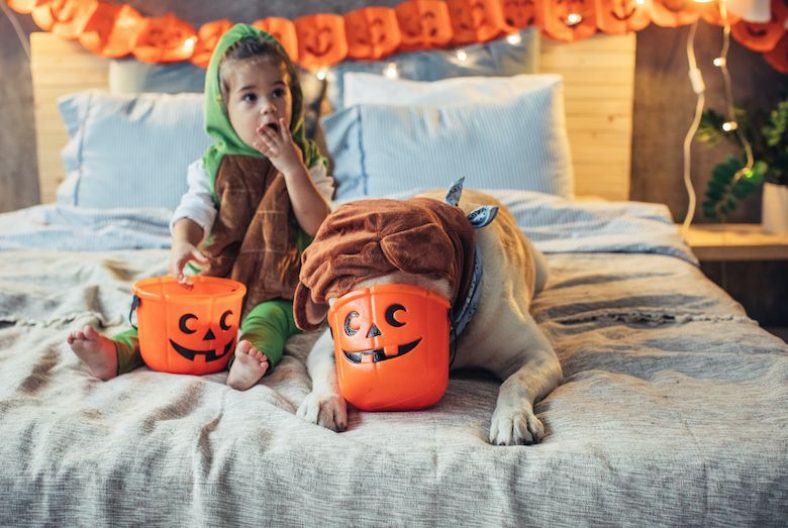
Whether you go the cute, spooky or current pop culture route with dog Halloween costumes, there are lots of boo-licious options for 2022. If your dog isn’t thrilled with the idea of dressing up, we listed some simple Halloween dog accessories that are likely to be 100% pup-approved.
Halloween costumes for dogs:
$19 and up. Disney’s Hocus Pocus Ride on Sanderson Sisters; chewy.com$63. Ice cream scooper set (with personalization option); icecreamtreestudio.com$24.99. Willy Wonka Costume; petsmart.com$24.99. Thrills & Chills Halloween shark dog costume; petsmart.com$15 and up. 80s Retro Kid; chewy.com$14.50 and up. Pupbucks apron; Wafflestash on etsy.comRainbow costume | $19.99. urbanoutfitters.comMaverick Top Gun Flight Suit (custom fit) | $85. wontoncollection.com$13. Wizard Dog Costume; target.com$15 and up. Deer dog costume; chewy.com$13. Unicorn Plush Hoodie; target.com$29.99. The Little Mermaid Ariel Plus Size Pet Costume; halloweencostumes.com
Halloween accessories for dogs:
$12.47. Star Wars Chewbacca Fuzzy Fleece Dog Hoodie; petsmart.comGlow-in-the-dark bow ties | $9.50 to $11.50 depending on size. littleosbows.comSquad Ghouls Bandana | $11.21. redbubble.comDog mohawk | $18 to $22. Such A Punk Pets on etsy.com$10. Witch’s Scritches Hat; barkshop.com$32. Be My Boo dog collar; thefoggydog.com
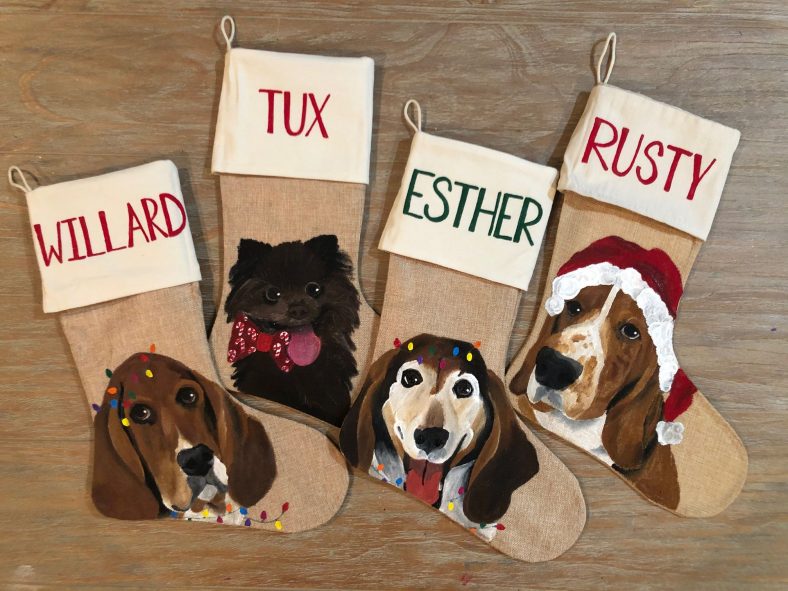
If you’re looking for the perfect stocking, check out these adorable offerings from artist Melodie Musick. Other than regular grade school and high school art classes, Melodie is mostly self-taught but has loved drawing and painting for as long as she can remember.
Melodie opened her Etsy shop (RaeRussellDesigns) in 2019, starting with portraits and tote bags. When she came across a cute, jute stocking she thought might be fun to work with, she painted one for her dog. After posting it on Facebook, everyone loved it, and she actually got quite a few orders based on that post. So, she added it to her shop, and it has grown from there — she’s now in her fourth year of creating and selling the stockings.
A lifelong animal lover, Melodie is particularly taken with dogs. “I grew up with dogs, cats, horses, cows, you name it,” she says. “But there is something about dogs. I love their personalities, their capacity for love and forgiveness and how unique they are.”
Her own dog, 11-year-old Trooper Russell, is an inspiration to her. “He didn’t have the best first part of his life,” Melodie says. “There was some abuse and some bad situations, but now he is nothing but a ball of love. When I adopted him, I gave him the name Trooper because that’s what he is — he just keeps on going no matter what, giving love to everyone he meets.”
One of her favorite parts of painting the stockings is seeing the photos she’s sent by customers. “I love their names, their expressions, and I love knowing that they are so loved that their humans want a painting of them,” she says. “I wish every single animal could be that loved in their lifetime.”
See more of Melodie’s dog stockings on her Etsy shop and on Facebook and Instagram @raerusselldesigns.
While you’re searching for the perfect personalized dog stocking , check out these other artists:
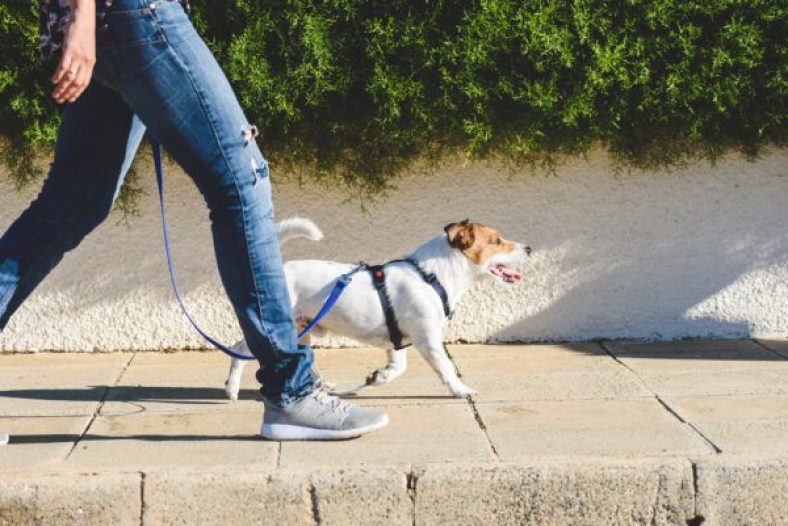
Walking a dog has little to do with “heeling.” It does have to do with offering your dog the choice to stop and smell her world — and yes — it can be done without pulling you down the street. Unless you are going to compete in obedience trials, there’s no need to teach a dog to heel when you leash train a dog. Instead, teach loose-leash walking. Your dog learns that whenever she hits the end of the leash, with the slightest tension, she’ll learn to release her own tension. Therefore, we can give our dogs whatever length leash we want, depending on the environment we are in. If there’s no one else on the sidewalk, let your dog have the entire 6-foot leash, to roam freely, stopping and smelling as she chooses. If someone else is heading toward you on the sidewalk, simply shorten the leash and when the dog feels the tension, she will then release that tension and walk on this shorter leash. When the way is clear, go ahead and give her the full length of leash again.
Sniffari has become the go-to word for letting dogs sniff to their hearts’ desire, while walking on a loose leash. Leash walking must be fluid, given what is happening in the moment and in any given environment. When we offer this kind of freedom to dogs, we are meeting their instinctive needs to use their strongest sense to their fullest delight, making walks more enjoyable for them and for us. Of course, we want to be able to have control of our dog on leash for obvious safety reasons and because there is a leash law in most states, but this doesn’t mean we must make them walk at our side, at heel, taking away their basic need and right to be a dog and do what dogs do — sniff. It’s the humane thing to do.
Paul Owens, the Original Dog Whisperer, says that the most important part of training a dog to walk on a leash is being prepared before even beginning leash training. Setting dogs up for success with regard to safety, comfort and money (motivation) are necessary steps to ensure compliance and a strong desire to be part of the leash-training game. Here are those steps:
Safety and comfort start with a properly fitted harness for your dog’s size and unique shape while making sure that your dog is unable to slip out of
High-value treats — cut up pieces of chicken, hot dogs, turkey or cheese are key to When you and your dog have mastered loose-leash walking, you can wean your dog off treats, but it’s always a good idea to keep treats with you so that if your dog needs reinforcement as she grows, you’re right there ready to reinforce the training.
A 6-foot leash. The best and most common type of leash for general walking is one that is 6-feet long. It gives the dog ample room to explore and smell her world. Pat Miller, of Peaceable Paws and contributor to Dogster’s sister publication Whole Dog Journal, says, “Stay away from retractable leashes.” If your dog learns that the leash lengthens when she pulls on it, it’s likely to make loose-leash training a much bigger challenge, to say nothing of the hazards of a retractable leash tangling up around legs — yours, your dogs and those of another dog or human.
And lastly, I agree wholeheartedly with Paul, that training dogs is fun. If we’re having fun, our dogs are having fun. So, keep that smile on your face.
How to teach a dog loose-leash walking
Have your high value treats in your treat pouch, a 6-foot leash attached to a well-fitted harness and start on familiar turf (your own backyard), with no distractions.
Marking a wanted behavior can happen with a clicker or the word yes. I mark with a yes because I find it’s easier to say yes than it is to hold a clicker, a leash and pay the kind of attention to what I’m doing and my dog all at the same time.
Keep your hand at your side or at your belly button, so you’re not tempted to pull on the leash. Locking your hand to your belly button or your side the entire time, so that there is always slack in the leash, gives your dog the chance to realize that you’ve moved and can catch up. The minute you see your dog moving toward you, mark it and treat.
Begin by standing still with your dog near you and say yes and treat. Repeat, yes and treat a few times so your dog is being rewarded for just being near you on a tension-free leash.
Start to walk, just a couple of steps, paying attention to your dog. If she gets up and goes with you, mark the behavior — yes — and treat, even if it’s the slightest movement. Any movement to be closer to you, gets a yes and treat. Stop and start a few times, so that every time you take a step, your dog does too.
Gradually take more steps, saying yes and treating, every 2nd or 3rd step.
Then, begin to make right-hand turns. Every time your dog makes the turn without you putting any pressure on the leash, say yes and give a treat. Remember, you’ve got a 6-foot leash, so the dog has a moment to catch up to you when you make a tur Reward the tiniest movement toward you. Taking too many steps in between turns can distract your dog, so make a lot of turns.
Once your pup is consistently moving with you, begin to speed up and slow Before you know it, your dog is walking with you, turning with you, moving faster and slower with you and all on a loose leash. Remember, keep sessions short — 5 minutes the first few sessions in your yard.
Once your dog has the hang of loose-leash walking, take the training into the real Do so gradually, in new places (your front yard), without distractions because the new place is distraction enough.
Start adding distractions like people or a dog across the street. You want to gradually increase distractions along with new places, so that you don’t overwhelm your dog and the dog can be successful. Practice everything you did in your yard in the real world. Little by little goes a long way to having your dog walk appropriately on a loose leash. And most of all — practice, practice, practice!
I have had horses all my life, as well as big dogs, and my horses walk on a loose lead just like my dogs. It’s not about strength; it is about teaching your dog how and then being consistent. It doesn’t matter if you start from a puppy or a big, strong, rescued adult dog. You can teach any dog — at any age — how to walk on a loose leash by following this simple method.
It’s not magic, it just takes time and patience to teach. Dogs aren’t born knowing how to walk on a leash, so help them learn and you’ll both reap the benefits.
Let the dog SMELL
When we understand what dogs need to thrive in our human dominated world, we can give up the mindset of control and think more about seeing the world through their eyes and nose. The strongest sense a dog has is her nose and when we don’t allow her time to sniff, we are depriving her of her most innate instinct. Why would we do that, especially when for many dogs, going for a walk is the highlight of their day? Alexandra Horowitz, best-selling author of Inside of a Dogand many other books, created this wonderful Ted-Ed, video, showing How Dogs Smell and once you watch it, walking your dog will never be the same.