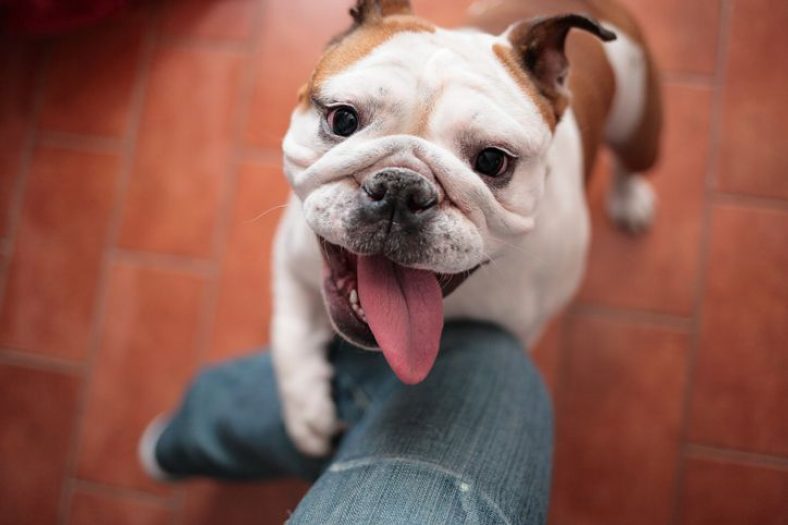
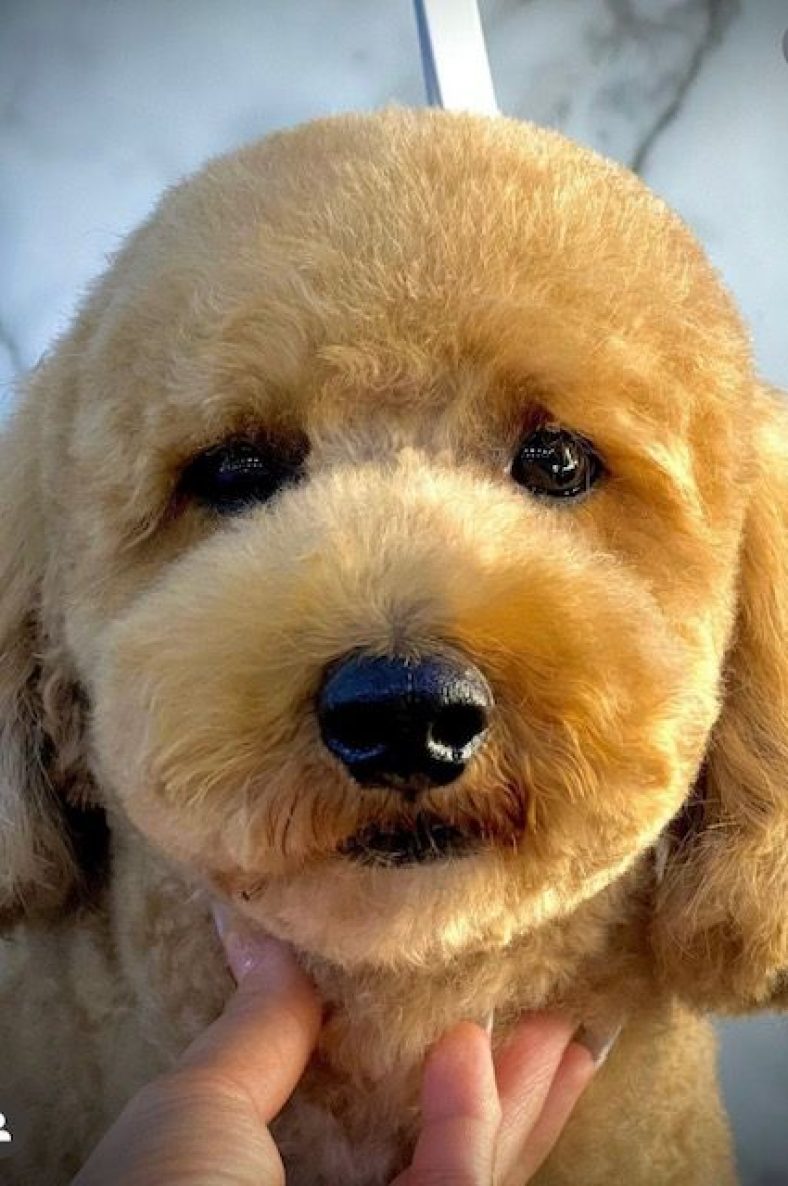
It’s common for puppies and young adult dogs to pee when excited. Instead of squatting or lifting a leg, they may urinate while standing, walking, jumping or running. They may also involuntarily pee during active playtime, petting sessions and high-energy greetings. Excitement urination is not something your dog can control, says Holly Lewis, founder of Cold Nose Canine. You should not scold your dog because he may become fearful of peeing in front of you.
Why do dogs pee when excited?
Puppies also urinate when they are keyed up because their bladder muscles are still growing. While most young adult dogs grow out of excitement urination, Holly says not all dogs do. A 2020 study published in Frontiers in Veterinary Science also found that neutered or spayed adult dogs were more excitable than intact adult dogs.
How to stop dogs from peeing when excited
You cannot teach your puppy not to pee when excited because it isn’t something he can control. Time is the best solution because most puppies outgrow excitement peeing as they reach physical maturity around 12 to 24 months old.
But Holly says that you should teach family members and guests how to interact with your dog until he gets his ya-ya’s out. She suggests using a low, calm voice. Take slow, steady breaths, and do not fidget or make small, repetitive movements. Completely ignore your dog until he settles down.
Tips for managing your dog peeing when he’s excited:
If you greet and play with your pup outside, there is no clean-up!
Put a puppy pee pad or newspaper down where your dog greets people to make cleaning up easier.
Take him on frequent bathroom breaks and walks to empty his bladder.
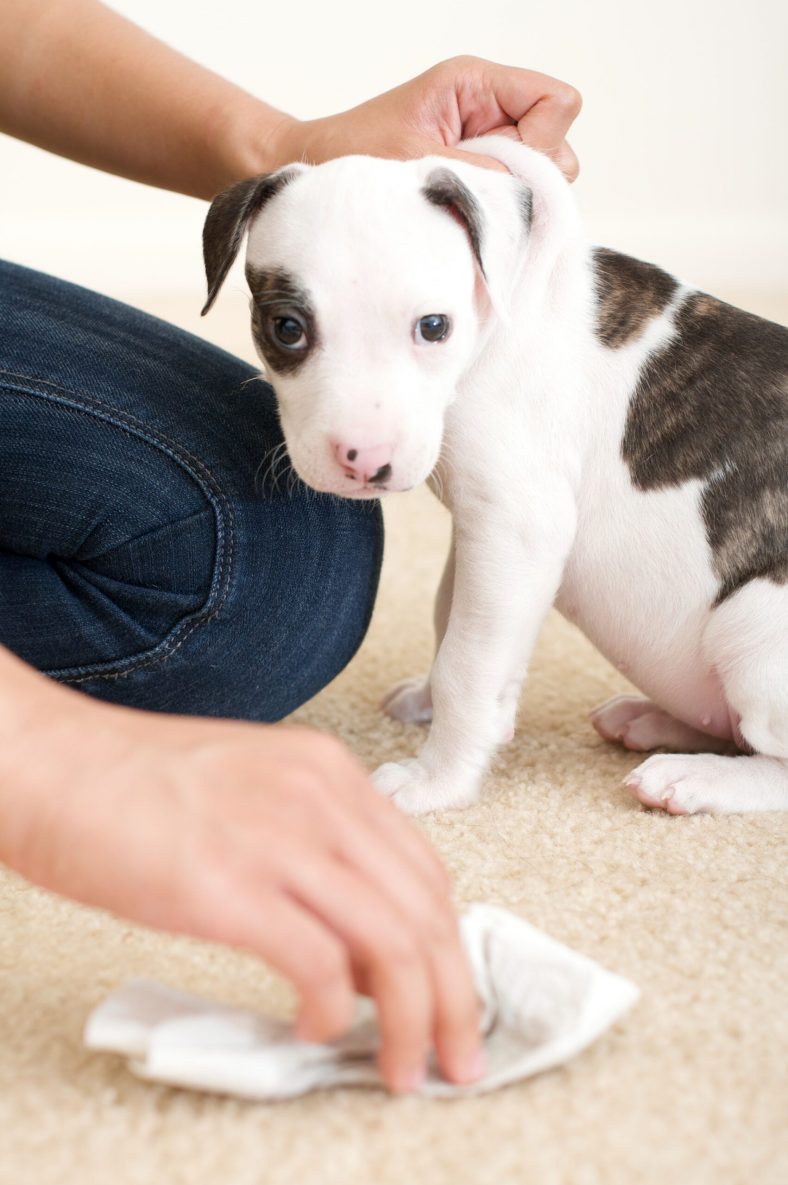
If your dog pees on the floor, ignore him and quietly clean it up. Seems too harsh? Praise will confuse your pooch, and punishment can cause submissive urination.
Submissive urination vs excitement urination in dogs
Excitement urination in dogs is often confused with submissive urination. Submissive urination happens when your pup is shy, anxious or scared. It is the canine equivalent of, “You are in charge, so I do not want any trouble!” Holly says your nervous or shy dog loses bladder control because he feels emotionally overwhelmed. Submissive urination helps him get ready to flee. When he empties his bladder, he is making himself lighter.
When to get your dog professional help
If your dog flattens his ears, licks his lips or hunches his back, submissive peeing might be a behavioral issue. It needs to be addressed by a positive reinforcement-based dog trainer. Health problems like diabetes and urinary tract infections can also cause inappropriate peeing. Many products on the market can soothe your canine’s stress, from dog anxiety wraps to CBD dog treats. Talk to your vet about which dog calming aids are best for your pup. Just remember he is not peeing when he is excited or scared to make you mad.
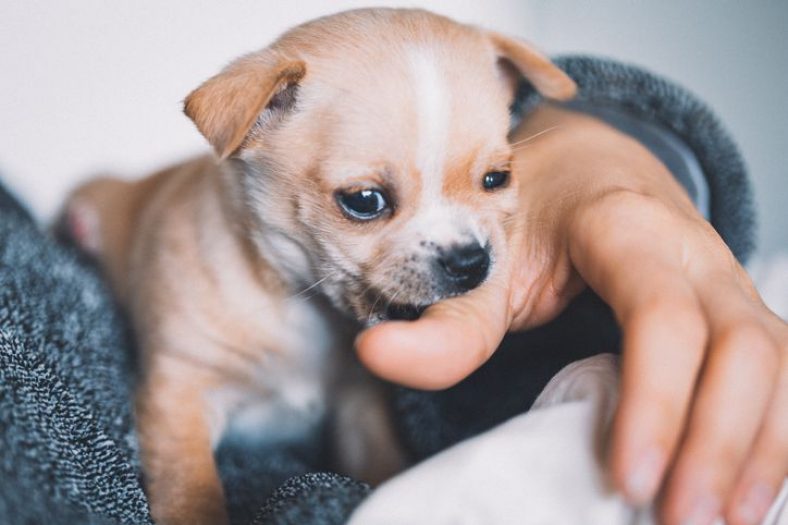
Biting is frustrating behavior for new puppy owners, but the behavior is very natural. Puppies aren’t trying to be mean or destructive when they bite at people or things, they are just exploring the world. That said, it’s important for puppies to learn to keep their mouths to themselves at a young age to prevent behavioral problems in the future: a puppy mouthing or biting is more socially acceptable than an adult dog mouthing at people. Training a puppy not to bite takes a patient and gentle approach.
Puppies bite people and objects for a variety of reasons, including exploring the world through their mouths. As a result, biting and chewing are normal parts of puppy development. Common reasons that your puppy might be biting you or things around your house include:
Teething — As they grow and develop, puppies lose baby teeth and their adult teeth grow in. This process often actively happens right around the time that puppies go home to their forever families. Just like how human babies can be irritable when teething or stick everything in their mouths while trying to massage their gums, the same is true for teething puppies. Many puppies chew or bite at things to relieve discomfort from teething.
Stress relieving — What do puppies have to be stressed about? They eat, sleep and play. But, there is a lot to be stressed about — their world is confusing and changing. Puppies are adjusting to all kinds of new situations, people, places and experiences. Mouthing and chewing help puppies reduce some of that stress.
Boredom — When puppies and dogs are bored, they look for things to chew. Chewing is fun and a way that they can entertain themselves. This is something to encourage (with dog-safe chews) because it’s good for our puppies.
Play —Young puppies often haven’t mastered a skill called bite inhibition, or awareness about using their mouths while playing. Young puppies generally learn from their littermates to modulate how much and how hard they can bite while playing. When you bring a young puppy home, they may still be developing and refining these skills.
How to train a puppy not to bite:
Step 1: Make sure the puppy has lots and lots of outlets for safe and appropriate chewing, including puppy-safe chews and toys specifically designed to be chewed. We don’t want to stop our puppies from chewing, we just want them to chew on safe and appropriate things.
Step 2: Supervision is very important for puppies. Set them up for success by not leaving them with access to things that you don’t want them to chew. Sometimes referred to as “puppy proofing,” you need to prevent your puppy from having access to things she might bite or chew that could be harmful or damaged.
Step 3: If your puppy is biting you when you play or are engaging with her, don’t yell or punish your puppy. Instead, when your puppy bites, make a high-pitched crying sound and then redirect your puppy with a toy that’s safe and appropriate for hr to bite or chew on. By making a high-pitched crying sound, you’re telling your puppy that the biting hurts. Doing this mimics, the same feedback puppies get from their littermates about how to bite softer or less while playing.
Step 4: Be consistent while playing with and training your puppy. Puppy bite training should be something everyone in the family is on board with by consistently gently redirecting your puppy to safe chew toys.
How to stop puppy biting: a recap
The best way to stop a puppy from biting is to prevent inappropriate biting as much as possible by providing your puppy with plenty of appropriate things to chew. When your puppy bites things he shouldn’t, redirect him to toys that are appropriate for tugging and chewing. If your puppy bites at you, he isn’t trying to be mean. Don’t yell at your puppy or scold him. Instead, make a crying noise mimicking what his littermates would do. Then, redirect your puppy to play with, mouth and bite an appropriate toy or chew.
Choosing an easy-walk harness for your dog requires you to look at your dog’s current training needs, age, level of pulling and size as well as your budget. The PetSafe Easy Walk Harness is one of the most popular ranging in price from $20 to $30. It is available in most pet supply stores, brick and mortar and online, as well as the Petsafe website.
What is an Easy Walk Harness?
An Easy Walk Harness’ most prominent feature is that the dog’s leash is clipped to the front of him. The advertisement of being a “no-pull dog harness,” which an Easy Walk Harness is, is often the main reason a dog owner is drawn toward this style. Trainers, who use positive re-enforcement techniques, will often choose them over prong, shock or slip collars, because of the ability to easily and safely refocus and control the dog without the risk of harming the dog physically or mentally.
Although people tend to refer to any no-pull harness as an easy walk harness, they aren’t. Easy Walk Harness is a brand name, much like Kleenex is a brand name for tissue. The Petsafe Easy Walk Harness was developed by a veterinary behaviorist in 2004. It is a simple looking harness with a strap that fits around the girth of your dog’s chest behind his front legs and a second strap that loops from the original around the front of your dog’s chest in front of his front legs sitting near the top of his breastbone. The area to clip the leash is on this front strap and is secured to a loop that mirrors that found in a martingale collar. If the leash pulls, the loop pulls out bringing the two sides of the strap together making it tighter.
The PetSafe Easy Walk Harness isn’t the only no-pull harness in the category with the martingale feature. Erin Mahoney, a dog trainer certified by the Animal Behavior College, identifies this as a safety feature that, when sized correctly, can keep your dog from getting out of the harness.
What size Easy Walk Harness should you use?
These harnesses are usually sized based on the girth or “chest width” of your dog. Using a tape measure, measure the biggest part of your dog’s chest, where the harness strap will fall. It will wrap around the rib cage from your dog’s shoulders down to approximately 1 inch behind his front legs. Some brands, like PetSafe, include a second strap measurement guide that goes over the breast bone from the two points it would connect with the first strap. Sizes range from petite or extra small to extra-large. Petsafe includes approximate weight in their sizes while other brands, like Kurgo, offer breed size comparisons. Refer to the harness brand’s website for specific measuring and sizing instructions.
Once you receive the harness, read instructions or watch videos that the brand has available to get the fit correct. It’s important that the front strap fit snuggly and doesn’t fall down. If that happens, the harness could be putting pressure on the wrong part of your dog’s body, which could injure your dog.
What is the Gentle Leader easy-walk style harness?
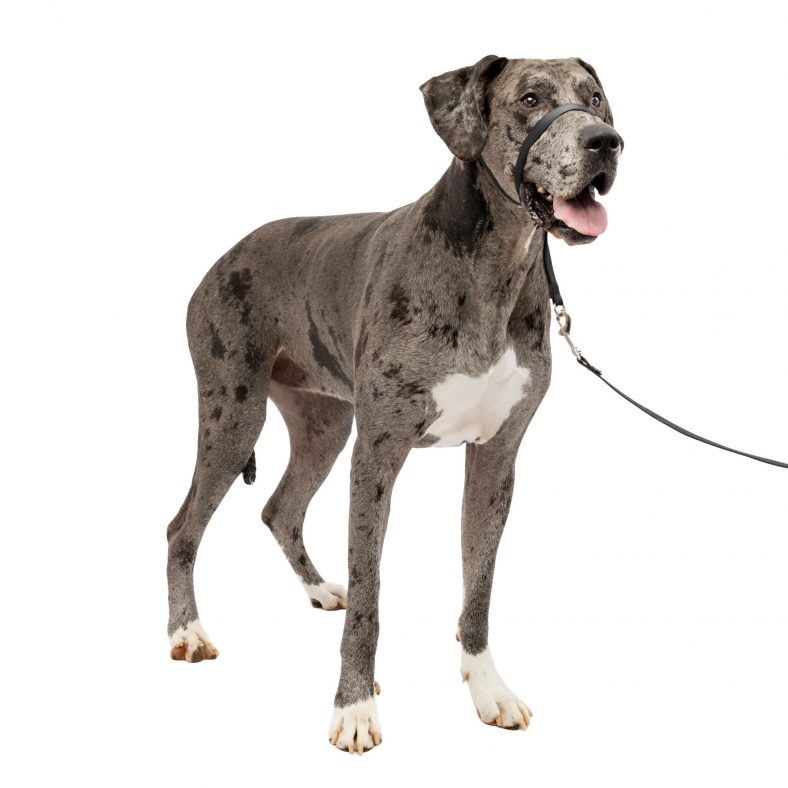
The Gentle Leader is another Petsmart product. It is a collar style easy-walk tool. It looks like a collar with an additional loop that goes around your dog’s nose. It sits high on the snout so that it does not act like a muzzle. Your dog has the ability to drink, pant, bark, play ball, etc. The headcollar style makes it very easy to redirect your dog’s focus when needed since you can control where his nose is pointing.
The head collar can outperform the harness in a couple of ways. Redirecting is easier and you have the ability to control a dog from lunging or jumping up. This style cannot be used for all breeds. Those with flat or short snouts won’t be able to get a fit that is effective. It also often requires additional training to get a dog used to and comfortable with the style.
There are other brands of head collars or head halters. Sizing is usually done by measuring your dog’s neck or by weight.
Who should use an easy-walk style harness or halter?
Erin uses the Easy Walk Harness when training puppies who are still developing physically, so that there is no concern with harming the trachea like there may be with a gangly and energetic puppy on a collar. She will also choose this type of harness when working with aggressive and strong pullers. Erin believes all dogs using these harnesses should understand focus/eye contact, leash pressure, “wait”/“sit” and “leave it” commands.
This style of harness will work for almost all dogs, although if fit or sized incorrectly, a dog could injure himself. These harnesses work by giving the owner control of the dog but are designed to do so with restricting as little movement as possible. In 2013 Dr. Christine Zink pointed out to Dogster’s sister publication, the Whole Dog Journal, that she, at the time, didn’t believe there are any no-pull harnesses that are non-restrictive. Since that article, there have been front clip harnesses whose design takes into account Christine’s concern.
This is the original and brand name Easy Walk Harness. It is easily available at most pet stores in store and online. The cost is approximately $23. Petsafe offers other easy walk harnesses styles, which range from $26 to $38. The Petsafe Easy Walk Harness is the brand Erin is most likely to use in her training.
The Balance Harness Buckle Neck was one of the top front clasp harnesses when a comparison was done by Whole Dog Journal in 2017. One of its key features is how its design differs from other easy-walk harnessess. This harness has a strap that sits low around the dog’s neck, one strap around the dog’s ribcage sitting further back than other styles and a strap connecting them that runs down the dogs back and down his chest. Without a strap going across the chest, this style allows for complete freedom of movement of the dog’s shoulders, limiting the issue Dr. Zink has about these types of no-pull harnesses. All straps are adjustable making the harness easy to fit to any dog and they encourage a double lead that latches to both the top and front of the harness for the most control. The Balance Harness Buckle Neck is approximately $40 and can be purchased at Sitstay.com and Amazon.
This brand looks more substantial compared to other strap styles. You can see that it includes additional padding on the straps focusing the extra cushion on the dog’s back and front chest. The model also has a handle on the back for extra control and the back d-ring leash hook option. The Walk About Harness is available on Kurgo’s website for approximately $34. It is also available online at Chewy.com and Amazon.
Ruffwear is known for its active dog gear. Its front clasp harnesses are a full padded harness style and because of this they don’t have the martingale safety feature found in the strap style harnesses. It does have more padding which means more comfort, as well as both front and back leash connection options which can be useful for dogs in active situations like hiking. Along with an ID pocket to keep dog tags quite, the harness also has a light loop for a dog safety light like The Beacon. The cost of the harness is approximately $50 and is available on the Ruffwear website as well as online at REI.com and Amazon.
The Gentle Leader discussed earlier is nylon with a padded nose loop. It is approximately $20 and can be purchased on the PetSafe website, at most pet stores in person and online as well as Walmart.com and Amazon.
Like the Gentle Leader this halter is designed to control a dog by a strap over the nose. It has a slightly different design that looks like a collar with a strap around it that then loops over the nose. It makes it easy to turn the halter into a collar and makes it more difficult for the dog to escape from the restraint. The Sporn Head Halter is approximately $30 on the brand’s website as well as Chewy.com and Amazon.
A front clasping Easy- Walk Harness is an effective training tool that, when used properly, can help you and your dog enjoy stress-free walks.
As the number of monkeypox cases grows in the U.S. and around the world, many dog parents are asking, “Can my dog get monkeypox?” or “Can I give my dog monkeypox?” and even “Can I get monkeypox from my dog?” Let’s examine the facts about monkeypox in dogs and how you can keep your family safe.
What is monkeypox?
Monkeypox is a virus related to human smallpox. After human smallpox was globally eradicated in 1980, monkeypox has become a most important public health virus and is closely monitored worldwide. Monkeypox is a viral infection in many mammals, particularly nonhuman primates and African rodents.
Monkeypox gets its name because it was first discovered in research monkeys in 1958. In addition to nonhuman primates (monkeys and apes), African rodents (such as rope squirrels, tree squirrels, African giant pouched rats and dormice) may also harbor the virus. While African rodents are suspected to be the main monkeypox virus carrier, this has yet to be confirmed.
Even though monkeypox can infect many animal species, monkeypox virus has only been found twice in the wild: First from a rope squirrel and then from a mangabey. Both animals were found in central or west Africa, according to the Centers for Disease Control and Prevention (CDC).
In the U.S. and other non-endemic regions, scientists are concerned about spillover of monkeypox to wildlife from infected people or domestic mammals, stressing the importance of infection control measures to contain the disease.
In the U.S., monkeypox transmission to humans from animals was documented in a 2003 outbreak in prairie dogs, a pet squirrel species. The prairie dogs were infected after being housed near small mammals imported from Ghana. This was the first time human monkeypox had been reported outside of Africa.
What are the symptoms of monkeypox in humans?
People can catch monkeypox from animals, but the chance of this happening in the U.S. is currently low. Based on how monkeypox has spread outside Africa, it appears you have a higher risk of contracting monkeypox from another person.
In humans, monkeypox causes fever, swollen lymph nodes, flu-like symptoms and a rash often around the genitals, hands, feet, chest, face or mouth. The rash often looks like pimples or blisters and may be painful or itchy. Some people may experience all of these symptoms, a combination of clinical signs or only a rash.
Symptoms of monkeypox in humans usually start within three weeks of viral exposure. If an infected person develops flu-like symptoms, they typically develop a rash one to four days later.
Monkeypox is contagious from the time symptoms start until the rash has healed, all scabs are gone and a healthy layer of skin has formed. Human monkeypox infection typically lasts two to four weeks.
Can I spread monkeypox to my dog?
Dogs are susceptible to monkeypox. In Paris, France, the first confirmed case of canine monkeypox was from a Greyhound living with two humans infected with the monkeypox virus.
If you become infected with monkeypox, do not surrender, euthanize or abandon your pet because of potential exposure.
Monkeypox transmission from infected people to dogs may occur through close contact, such as:
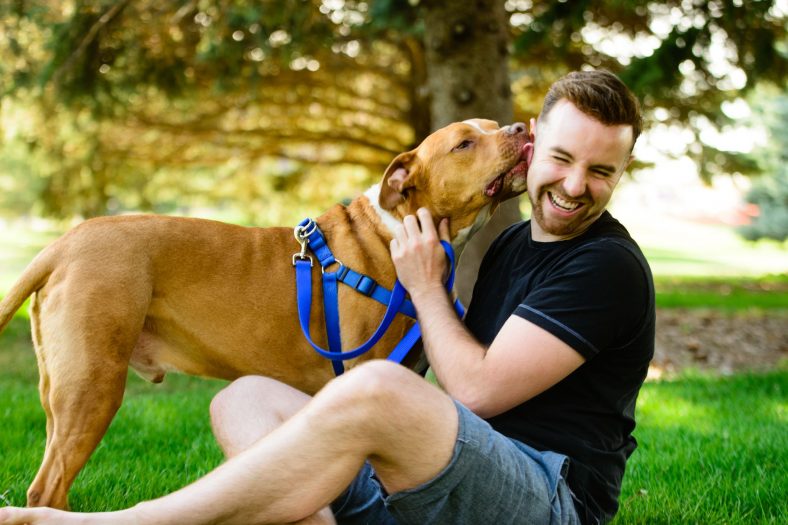
Hugging
Kissing
Licking
Sharing beds
To keep your dogs safe, people with symptoms of monkeypox, particularly the monkeypox rash (pox-like skin sores), should avoid all contact with animals.
What are the symptoms of monkeypox in dogs?
The signs of monkeypox in dogs are similar to symptoms of many common infectious diseases. Infected dogs with monkeypox may develop:
Fever
Cough
Red eyes
Runny nose
Lethargy
Poor appetite
If these signs occur in your dog, and he has had no known exposure to someone with monkeypox, it is highly unlikely to be monkeypox. Have your dog examined by your veterinarian to determine the cause of illness.
If your pet develops at least two of these signs or a pimple-or blister-like rash within 21 days after contact with someone diagnosed with monkeypox, immediately contact your veterinarian. They will advise you on what to do, including testing to confirm if your dog has the monkeypox infection.
Is there a treatment or cure for monkeypox in dogs?
There are no treatments specifically for monkeypox virus infections in humans or dogs. Because monkeypox and smallpox viruses are genetically similar, antiviral drugs and vaccines developed to protect against smallpox may be used to prevent and treat monkeypox virus infections in humans. Treatment for infected dogs will be determined by the attending veterinarian.
If you are worried your dog has monkeypox:
Keep your dog separate from all other animals, including wildlife.
Minimize contact with people for at least 21 days after the first clinical signs first appeared or until your pet has fully recovered.
Do not share beds, furniture or engage in close contact of any kind with your dog during the 21-day period.
This is especially important for households with people who are immunocompromised, pregnant or younger than 8 years, and those who have a history of atopic dermatitis or eczema.
Do not bathe or clean your dog with alcohol, bleach or other non-dog safe cleansing agents, solutions or shampoos
Follow all CDC recommendations to protect others in the home from infection.
If someone in your home has monkeypox, take these steps to protect your dog from getting monkeypox:
If the infected person did NOT have close contact with your dog after developing symptoms, have the dog stay with friends or family members outside the home until the infected person has recovered fully.
If that person DID have close contact, keep your dog at home and away from people and other animals for 21 days after the last possible contact with the infected person.
If possible, have another person in the home care for your dog until the infected person has fully recovered and been cleared by his doctor.
Your dog may need to be isolated in a facility outside the home if there are people at risk of severe disease: immunocompromised, pregnant, children younger than 8 years old or household members with a history of atopic dermatitis or eczema.
Follow all CDC recommendations to protect others in the home from infection.
Hand hygiene – the use of an alcohol-based hand rub or hand washing with soap and water – should be used by people with monkeypox and household contacts after touching rash material, clothing, linens or environmental surfaces that may have had contact with rash material.
Cover all skin rashes as much as possible by wearing long sleeves or long pants. Gloves can be considered for covering rash on the hands when not in isolation.
People with monkeypox should use well-fitting source control (e.g., medical mask), if close contact with others cannot be avoided, such as when receiving medical care.
Other household members should wear a respirator or a well-fitting mask when in close contact (e.g., within 6 feet) with the person with monkeypox for more than a brief period.
Humans can spread monkeypox to dogs, but by watching out for the onset of monkeypox symptoms, and avoiding close contact with your dog while infected, you can help stop the spread of the monkeypox virus.
Biting is frustrating behavior for new puppy owners, but the behavior is very natural. Puppies aren’t trying to be mean or destructive when they bite at people or things, they are just exploring the world. That said, it’s important for puppies to learn to keep their mouths to themselves at a young age to prevent behavioral problems in the future: a puppy mouthing or biting is more socially acceptable than an adult dog mouthing at people. Training a puppy not to bite takes a patient and gentle approach.
Puppies bite people and objects for a variety of reasons, including exploring the world through their mouths. As a result, biting and chewing are normal parts of puppy development. Common reasons that your puppy might be biting you or things around your house include:
Teething — As they grow and develop, puppies lose baby teeth and their adult teeth grow in. This process often actively happens right around the time that puppies go home to their forever families. Just like how human babies can be irritable when teething or stick everything in their mouths while trying to massage their gums, the same is true for teething puppies. Many puppies chew or bite at things to relieve discomfort from teething.
Stress relieving — What do puppies have to be stressed about? They eat, sleep and play. But, there is a lot to be stressed about — their world is confusing and changing. Puppies are adjusting to all kinds of new situations, people, places and experiences. Mouthing and chewing help puppies reduce some of that stress.
Boredom — When puppies and dogs are bored, they look for things to chew. Chewing is fun and a way that they can entertain themselves. This is something to encourage (with dog-safe chews) because it’s good for our puppies.
Play —Young puppies often haven’t mastered a skill called bite inhibition, or awareness about using their mouths while playing. Young puppies generally learn from their littermates to modulate how much and how hard they can bite while playing. When you bring a young puppy home, they may still be developing and refining these skills.
How to train a puppy not to bite:
Step 1: Make sure the puppy has lots and lots of outlets for safe and appropriate chewing, including puppy-safe chews and toys specifically designed to be chewed. We don’t want to stop our puppies from chewing, we just want them to chew on safe and appropriate things.
Step 2: Supervision is very important for puppies. Set them up for success by not leaving them with access to things that you don’t want them to chew. Sometimes referred to as “puppy proofing,” you need to prevent your puppy from having access to things she might bite or chew that could be harmful or damaged.
Step 3: If your puppy is biting you when you play or are engaging with her, don’t yell or punish your puppy. Instead, when your puppy bites, make a high-pitched crying sound and then redirect your puppy with a toy that’s safe and appropriate for hr to bite or chew on. By making a high-pitched crying sound, you’re telling your puppy that the biting hurts. Doing this mimics, the same feedback puppies get from their littermates about how to bite softer or less while playing.
Step 4: Be consistent while playing with and training your puppy. Puppy bite training should be something everyone in the family is on board with by consistently gently redirecting your puppy to safe chew toys.
How to stop puppy biting: a recap
The best way to stop a puppy from biting is to prevent inappropriate biting as much as possible by providing your puppy with plenty of appropriate things to chew. When your puppy bites things he shouldn’t, redirect him to toys that are appropriate for tugging and chewing. If your puppy bites at you, he isn’t trying to be mean. Don’t yell at your puppy or scold him. Instead, make a crying noise mimicking what his littermates would do. Then, redirect your puppy to play with, mouth and bite an appropriate toy or chew.
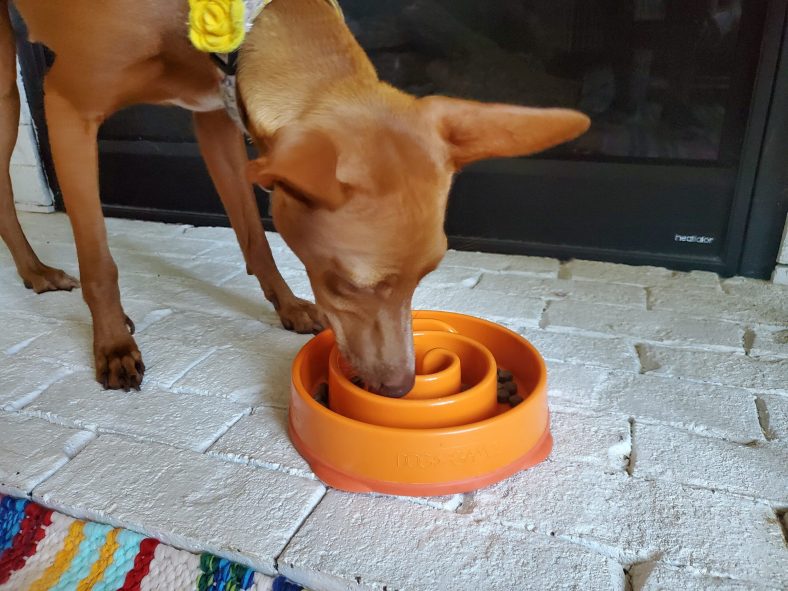
Ever watched your dog eat and think, He’s not even chewing? Many dogs literally inhale their food. This can cause them to vomit, choke or bloat, which can be deadly. So how do you get your dog to eat slower? Slow feeder dog bowls and slow feeder inserts can help alleviate these issues and provide many other benefits by making your dog eat slower.
Benefits of Slow Feeder Dog Bowls and Slow Feeder Inserts
Slow feeder bowls for dogs are food dishes with raised shapes and ridges inside the bowl that the dog must eat around to get to his food. This slows down how fast the dog eats. Marj Ediger, a professional dog trainer of 45 years, says there are many positive benefits to using slow feeder bowls with dogs, including:
Slowing the ingestion of food
Preventing choking
Preventing vomiting and other gastrointestinal discomfort
Providing mental stimulation
Preventing bloat by lessoning the amount of air dogs intake.
Dogs used to run 20 miles a day to find food, and now we hand it to them on a silver platter, says Marj. While we can’t replicate that effort and reward system for getting food, we can challenge our dogs with slow feeder bowls. Slow feeder bowls, sometimes referred to as enrichment bowls or mats, can be used with any type of dog food, whether it’s dry, wet or raw — and even some soft human foods that are safe for dogs like peanut butter, dog-friendly vegetables and fruits and plain pumpkin puree (not pumpkin pie puree).
Types of slow feeder dog bowls and slow feeder inserts
You can find all kinds of slow feeder dog bowls and inserts on the market today, including ceramic, plastic, silicone and stainless steel. Different sized bowls and varying bowl heights and groove patterns are available to accomodate large and small dog breeds.
Marj recommends the stainless-steel slow feeder bowls for dogs instead of plastic because if you leave your dog’s bowl on the floor, he may chew on it and ingest the plastic. The steel ones are durable and easy to throw into the dishwasher, she adds.
You can also buy slow feeder inserts for dog bowls. These usually suction cup to the bottom of your existing bowl. Another option is putting balls or safe toys in your dog’s dish, so the dog has to work around the object to get his food.
Cons to slow feeder dog bowls
Slow feeder dog bowls require more cleaning than a regular dog dish. Clean in all the crevices, which can be hard depending on the design. Some bowls have removable inserts — making them kind of a hybrid between a one-piece slow feeder and an insert — and these can be hard to clean as well.
Marj prefers one-piece slow feeders, as the inserts tend to be messier and harder to clean.
Choosing a slow feeder dog bowl
There are many types of slow feeder dog bowls and inserts on the market for a range of prices. Inserts are not necessarily cheaper than a one-piece bowl, it just depends on the material and brand name.
As for effectiveness, the slow feeder bowl that works best for you is really going to depend on your dog. The size of your dog’s nose and how determined he is to inhale his food may mean you try a few different bowl designs before finding one that makes your dog eat slower. The depth and the number of groves/blocks creates the difficulty level. A short-nosed breed may not need one with as many grooves or as deep as a large-breed will to slow him down.
How do I find the best slow feeding bowl?
Top-rated slow feeder dog bowls are usually easy to clean and have enough ridges to noticeably slow your dog down. You may even want to time your dog when you are trying them out, so you can really tell if you are getting your dog to eat slower or not.
Slowing down your dog’s eating time is healthy for him! In addition to slow feeder bowls, Marj suggests training your dog during his meal, or scattering his dog food around the house so he has to sniff it out. Enrichments like these are not only healthier, but more fun for both dog and pet parent.
Here are three examples of today’s slow feeder dog bowls:
Intestinal parasites, or worms in dog poop, pose a risk for puppies through senior dogs. Armed with what worms look like in dog poop, what to do next and how to easily prevent worms are simple ways to protect pups from potentially serious health problems and stop the spread.
What do worms look like in dog poop?
Of the six common intestinal parasites found in dog poop — coccidia, giardia, whipworms, tapeworms, roundworms and hookworms — only the last three are easily visible in dog stool.
Tapeworms look like little white grains of wiggly rice in dog poop and are the most common worms that owners find, says Dr. Jerica Lugo, an associate veterinarian at Doylestown Veterinary Hospital & Holistic Pet Care in Doylestown, Pennsylvania. These parasites are only found in fresh stools, though sometimes owners find them on the dog’s fur or rear end, says Dr. Ann Hill, of Canfield Vet Dog and Cat Hospital in Pittsford, New York.
Long white worms in dog poop or vomit are likely roundworms or hookworms, which resemble cooked spaghetti and are easy to spot, Dr. Lugo says.
What are the signs that your dog has worms
Other signs than seeing worms in your dog’s poop, include:
Diarrhea
Vomiting
Pot-bellied appearance
Scooting
Lethargy
Weight loss
Blood (bright red or dark tarry) in stools
If you see worms in your dog’s poop or he’s showing the other symptoms of intestinal parasites, take your pet, and a fresh stool sample, to the vet. A fecal exam is required for a definitive diagnosis of any of the all six common intestinal parasites, which is why most vets ask for a fresh stool sample to be brought in during your pet’s annual examination. They send the sample to a lab for a fecal flotation, where the dog’s fresh stool is mixed with a solution that brings the parasite eggs to the surface, Dr. Lugo says. Then you know if your dog has worms in his poop and what to do next.
For most dogs, annual checks for worms in dog poop are fine, Dr. Lugo says, but pups who go to daycare or spend lots of time with other dogs outside the home (e.g. dog parks), may need more frequent testing.
How do dogs get worms?
Puppies often are born with parasites (especially roundworms) that they get from mom in the milk or while nursing, Dr. Hill says, so it’s recommended to test pups a few times a year during puppyhood. If the parasite is not shedding eggs, it may not show up in puppies during the first couple of tests, Dr. Lugo says.
Otherwise, these highly contagious parasites are typically spread orally and environmentally. Contact with contaminated soil, an infected animal or that animal’s feces or vomit are the easiest ways for dogs to contract these nasty parasites. Dogs love to sniff, taste, walk through and roll in all types of surfaces, and they lick their paws and coats, so it’s no wonder worms can be an issue. Dr. Lugo says these are the most common ways dogs get these intestinal parasites:
Parasite
Transmission
Coccidia
From the environment when shed in feces and ingested by the dog. This especially shows up in puppy mills or shelter situations, she says.
Giardia
From the environment when shed in feces and ingested by the dog. Also, from drinking contaminated water.
Hookworm
Passed from mom through her uterus or while nursing. It also can be passed to humans in its adult form because the parasite can burrow directly into your skin.
Roundworm
Passed from mom through her uterus or while nursing.
Tapeworm
From ingesting an infected flea or animal, such as birds, reptiles or rodents.
Whipworm
From the environment when shed in feces and ingested by the dog. It can live a long time in the environment, Dr. Lugo adds.
What health concerns come with worms in dog poop?
Not all intestinal parasites cause overt symptoms, but they all pose a risk to your dog’s health. The primary concerns with worms in dog poop are vomiting and diarrhea. With puppies or those dogs with a lot of worms, they get quite thin because it affects their ability to absorb nutrition, Dr. Lugo says.
Hookworms literally hook into the host’s intestinal wall and can cause bleeding and anemia, Dr. Lugo says, and there can be skin irritation or infection if they entered from burrowing through the skin. Giardia and coccidia are accompanied by severe diarrhea that can lead to dehydration, she adds.
On the positive side, intestinal parasites remain in the dog’s intestinal track instead of traveling elsewhere, which is why feces is the key to spreading.
Can humans get worms from their dogs?
Hookworms, roundworms and tapeworms all can be contracted by humans, as well. Learn how to protect yourself and your pets below.
Dewormer is the gold standard for treating worms in dog poop. Vets typically recommend deworming dogs — especially puppies — one to two times after adoption or purchase, and then start them on prevention so they don’t get them again, Dr. Hill says.
Heartworm prevention is an excellent remedy as most can treat intestinal parasites, Dr. Lugo says. Other dewormer options include pyrantel pamoate and fenbendazole, she says, adding that some intestinal parasites require more specific treatments.
Giardia often requires fenbendazole and metronidazole.
Tapeworms are treated with praziquantel.
Coccidia must be treated with sulfadimethoxine.
For those seeking a natural option for treating worms in dog poop, there aren’t any proven effective against intestinal parasites, Dr. Lugo says. She’s seen some owners try garlic, but it’s not recommended since it can cause anemia in certain dogs that are sensitive to the vegetable.
Even some over-the-counter dewormer treatments are not strong enough to tackle these common intestinal parasites, Dr. Hill says. The best strength and dose are from a veterinary prescription, which provides the proper dose and number of treatment days, she says.
Most of the time, deworming treatments work within a few hours to days of starting to help dogs feel better and wipe out the infection, Dr. Lugo says. However, if you’re dealing with a lot of parasites or some stubborn ones, it might take several treatments.
For example, whipworms need longer treatment (every 3 weeks for 3 months), and giardia can be extremely stubborn, requiring a longer initial treatment or several treatments, Dr. Hill says. Dogs may feel better, but the parasite still can be found in the feces, or the stools remain soft.
Do I have to treat all household pets for worms?
Not necessarily, Dr. Lugo says. The best thing to do is bring in a fecal sample from each dog to see if treatment is necessary. You will need to protect other dogs in the household by monitoring the ill dog and immediately cleaning up after each bowel movement.
On the other hand, Dr. Hill says some people feel more comfortable treating the whole pack since there are virtually no side effects to using dewormers.
How can I prevent my dog from getting worms?
The best ways to protect your pet (and yourself) from getting intestinal parasites are:
Use monthly heartworm prevention.
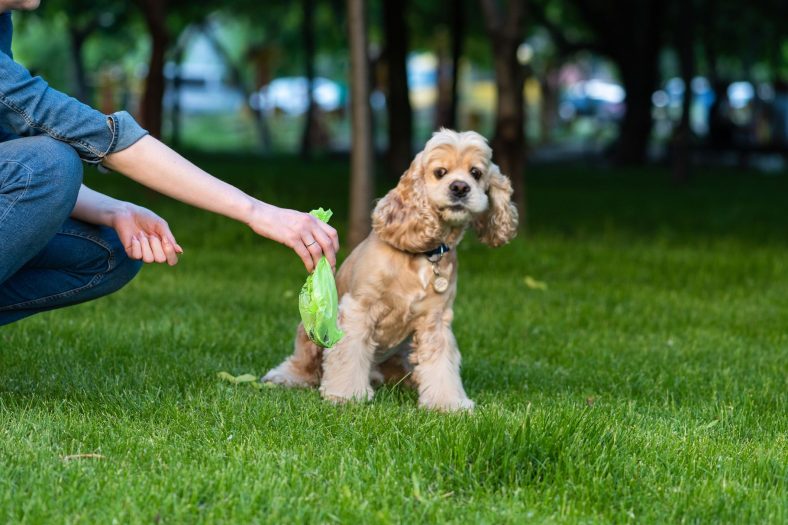
Clean up after your dog within 24 hours of him pooping and properly dispose of it.
Use good hygiene (ahem, wash your hands well each time).
Try keeping your pup from other dogs’ feces.
Bring your dog and his poop to the vet at least once a year.
Worms in dog poop are something that nearly every pet owner will deal with at some time in their pooch’s life. But if you know what you’re looking for (or at!) and are proactive about testing and treatment, you easily can protect your dog and household from a worm infestation. For additional information and resources, check out the Companion Animal Parasite Council (CAPC) Pets and Parasites website.
Raising a pit bull so he’s friendly and confident involves committing to socialization. Training your pit bull not to bite and to be well socialized around other dogs is non-negotiable. And because pit bulls have a stigma, being a responsible pet parent is part of the pittie package.
What’s a pit bull?
Pit bull isn’t a breed, but rather a collection of breeds, who descended from crossing terriers with bulldogs. Pit bulls and several other dogs with similar histories and appearances are also categorized as bully breeds, but pit bulls are commonly considered to be:
American Pit Bull Terrier (APBT)
American Staffordshire Terrier
Staffordshire Bull Terrier
American Bulldog (American Bully)
Raising and socializing a pit bull puppy
The importance of socialization for all puppies can’t be overstated, but it’s especially true for pit bulls. Socialization is the process of systematically and positively introducing puppies to literally everything in our human-centric world, especially people and other animals.
This is particularly critical during the sensitive (or primary) socialization period between 3 to 14 weeks old, where a puppy’s brain is most like a sponge. Dog breeders and dog rescues care for puppies during much of this time, so select one that has a dynamic socialization program, since you’ll pick up where they leave off.
Within the sensitive period is the first fear period, between 8 to 12 weeks, when puppies can develop lasting negative associations and fear, especially toward people and other dogs. So, if an activity or situation/environment starts to go south:
Stay calm and keep good mojo flowing
Remove the offensive stimulus (or the puppy) from the situation
Turn the situation into a happy time: give treats, belly rubs, etc.
Follow up immediately with a quick fetch of the ball, tug of the toy or other fun activity
Don’t punish the fear of a “new thing” — help relieve it!
While genetics play a big role in behavior, so do environment and learning history. All pit bulls are not born dog aggressive, but the potential exists for dog-dog aggression more so than in other breeds. So, set up your pup’s environment for success and only use rewards-based methods to create a foundation for life-long learning.
Socialization continues into adolescence, although the landscape looks a bit different. In short, from roughly 6 to 12 plus months of age, puppies go through “puberty,” test boundaries and begin to display breed-specific traits. Adolescents may also go through a second fear period which lasts about 2 to 3 weeks but, unlike the primary period, you can’t nail down the timeline. You’ll know if he’s in this phase because he’ll start to act wary or fearful of things he was cool with before. Tread lightly here: even one such incident during this period can have permanent emotional effects and behavioral consequences, so make sure he floats through without any painful or scary experiences.
How to train a pit bull puppy not to bite
Don’t gloss over puppy biting or mouthing: train your pit bull puppy not to bite. Follow these four simple rules:
DON’T ever roughhouse with him!
Discourage any teeth on people, and never reward even playful biting.
Even if it’s accidental, if any tooth touches any part of a person it’s game over, period.
Mouthy pit? Give a toy instead, and ensure appropriate chew toys are always available.
To learn how to stop puppies from mouthing and nipping, check out former Dogster columnist Victoria Stilwell’s steps on how to stop this behavior.
Why an under/unsocialized and untrained pit bull can be a serious problem
Dogs who are fearful usually were not adequately or positively socialized during formative periods. Fear can lead to extreme shyness or even over reactivity and aggression. And that’s a big problem, especially for pits and possibly for you.
Pit bulls have long been branded an aggressive breed. After a 1987 Time magazine cover story portrayed them as dangerous, mainstream media latched into it. Soon afterward Breed Specific Legislation (BSL) was born and has dotted the national landscape since.
Therefore, people fear and even loathe pit bulls or any dogs who have the misfortune of looking like one. They’re often the first euthanized in shelters, even ahead of older or sickly dogs since many shelters can’t adopt them out due to local laws or pit bulls’ regrettable reputations. The good news is since 2018 nearly 70 repeals of BSL have been confirmed.
The CDC recommends against BSL and stopped tracking breeds involved in fatal dog attacks in 1998. However, anti-pit bull groups still sensationalize pit bull bite stories and tend to disproportionately attribute dog attacks to pit bulls. Pit bulls and other large dogs do cause more severe damage than do small dogs; however, bites from small dogs typically don’t require hospital visits and therefore are usually underreported. Remember: be sure part of your training and socialization includes a no-teeth-on-people approach. A biting pit bull is a huge liability to himself and you: consequences can range from quarantine to euthanasia to you landing in court.
And finding a rental for you and your pittie can be tough. However, property owners are increasingly receptive if your dog is well trained and has Canine Good Citizen certification through the AKC, which can also help you get renter’s or homeowner’s insurance. Companies who offer access to insurance policies for people with pits include:
All State
Farmers
State Farm
Nationwide
USAA (for military families)
Chubb
You also might consider getting dog bite insurance to protect yourself and your dog, especially if your pit is fearful, over reactive, aggressive or has a bite history. And keep your dog licensed and current on vaccinations.
Pit bull training tips
Pit bulls are highly intelligent, very trainable and require solid training and impulse control. Start by teaching your dog solid Leave it and Take it and Drop it cues.
Tug of war is the perfect game to teach impulse control because it reinforces these cues as well as sets up clear boundaries for play. (https://www.youtube.com/watch?v=x9mPoWuvnLg)
Other skills all pit bulls should know:
An over-aroused dog can cause problems, so get on board with a good relaxation protocol to help your pit bull learn calm behavior for when things get jazzed up.
Finally, stay on top of any behavioral issues so things don’t get sticky and remember: having a pit bull means understanding the scrutiny your dog will be under most of the time.
Pit bulls were originally bred for bull and bear baiting, so a prized trait was gameness meaning to persevere regardless of threat or injury. Gameness and aggression aren’t the same: a passive winner was better than an aggressive loser. Unfortunately, this eagerness became a prized trait for dog fighters who continue to feed the stereotypes of pit bulls as vicious killers. Today’s mainstream pit bulls may possess this singlemindedness to some degree, but mainly to hang out with you: they were also bred to have deep attachments to humans.
At the end of the day, many pits are terriers. APBT’s are especially known to have high prey drive. In addition to impulse control exercises, provide an outlet for the first few parts of the prey drive sequence (eye/orient, stalk, chase) as a healthy way to let them get in touch with their instincts and provide enrichment. Try a flirt pole or even a spring pole.
Pit bulls are smart and can be high energy and high drive. A bored pittie can quickly develop behavior problems, so create a plan for both mentally and physically stimulating your dog so he has positive outlets for his energy.
Fun sports to try:
fly ball
parkour and other obstacle-related activities
dock jumping
weight pulling
GRC (Gameness, Relationship, Control)
cani-cross
barn hunts or earth dog trials
Pits can even do well at agility and flying discs. Wallace the pit bull defied all odds and became a world champion disc dog winning dozens of titles.
Pit bulls aren’t for everyone and not for a first-time dog parent. Although they often get a bad rap, pits are loyal, fun-loving and wicked smart. Raising and training your pit bull to be well-socialized to other dogs and people and well-mannered goes with the territory: these breeds come with extra responsibility. Pit bulls deserve for us to be champions for them so they can be ambassadors for their breeds and themselves.
Even the most well-trained dog pees on the carpet sometimes. Dogs pee in the house for a variety of reasons — an infection, old age, boredom, marking or anxiety — so odds are high that you’ll have to deal with it at some point. Carpet cleaning solutions and tools are effective to combat dog pee stains and odors. For a quick fix, at-home remedies, such as hydrogen peroxide, Dawn dish soap or baking soda can be a dog parent’s best friends (other than your dog, of course).
How do I get dog pee smell out of carpet?
To ensure that your dog doesn’t make peeing a regular thing, you need to get any underlying urine smell out of the pee spots. Male dogs in particular will pee on spots that other dogs have already peed on.
To prevent a lingering urine smell, treat the accident quickly. To clean up a new, wet dog pee accident:
Use a towel to absorb any liquid and then spray a combination of 4 tablespoons of hydrogen peroxide, 2 tablespoons of lukewarm water and a few drops of Dawn dish soap onto the spot. Another homemade option is spraying one part white vinegar and one part water solution onto the pee spot, according to S&S Rug Cleaners, Inc. The vinegar neutralizes the urine smell.
Use a towel or carpet spotter machine to agitate the area and work the dog pee out of the carpet.
Let it set for 20 minutes and then flush out the spot with a cup of warm water and soak it up with a towel or carpet spotter machine.
Sprinkle baking soda over top of the dog pee spot and keep it on for several hours to absorb any lingering odor.
@Cleanthatup on TikTok has some helpful videos on cleaning methods using common household products.
How do I get dried dog pee out of carpet?
Although hydrogen peroxide, Dawn dish soap or vinegar can work in a pinch, having carpet-cleaning products on hand is a good idea for any pet parent – especially when a spot may already have dried into the carpet. When dealing with a dried-on dog pee stain, Hoover spokeperson Cierra Hannah recommends first dabbing the spot with a wet paper towel and then pre-treating the stain with a product such as the Oxy Pet Urine and Stain Eliminator. Let the solution sit on the stain for 5 to 7 minutes and then use a carpet/rug cleaner, such as the Clean Slate Pet Spot, with the concentrate solution that’s included with the carpet cleaner, to permanently remove pet stains and eliminate odors.
If peeing in the house is becoming a more frequent problem, or if it comes on suddenly, reach out to your veterinarian. Urination issues can be linked to a variety of different health issues, so rule out any underlying problems first. With the right products, you can eliminate even dried dog pee stains from your carpet or rug and remove odors so it doesn’t become an on-going problem.
Like many of our Dogster readers, you may have ventured into at-home grooming during the pandemic, but if you’re a Goldendoodle pet parent, it’s worth putting professional grooming back on your to-do list.
Goldendoodles are very high on the list of breeds that need professional grooming regularly, plus weekly brushing at home, says Jay Spainhour, owner of Chicago’s Tucker Pups Pet Resort.
This is because the Goldendoodle is typically low-shedding — a trait she picks up from her Poodle parent — which means the hair will continue to grow and get matted if not brushed and trimmed regularly. There’s also the influence of the Retriever’s thick coat, which, depending on whether your Goldendoodle has more dominant Poodle or Golden Retriever genes, can alter the texture and grooming style of the dog.
Jay gave Dogster tips on keeping the mats out of a Goldendoodle’s coat, keeping grooming costs down and where to find Goldendoodle grooming inspiration.
Is there a standard for Goldendoodle grooming styles?
No, there’s no standard because the Goldendoodle isn’t an official AKC breed. However, there are common styles that groomers continuously get requests for.
The most popular Goldendoodle grooming styles are:
Teddy bear cut: The fur on the dog’s body is trimmed a universal length, typically anywhere from a half inch to 2 inches, while the fur on the head is kept a little longer. The face remains soft and rounded.
Lamb cut: Similar to a teddy bear cut, but the fur on the legs is kept longer than the fur on the body. This is a more balanced look and avoids the possibility of the legs looking too skinny, explains Jay.
The Poodle cut: There’s a wide range of poodle cuts, but typically this involves shaving the face and feet bare and leaving a full top knot on top of the head. This cut only works on Goldendoodles who have more dominant poodle genes and therefore, a curlier coat, than Golden Retriever genes.
The Kennel cut: Also known as the Retriever cut, the coat is cut one length, typically less than an inch, all over the body, including the ears. This cut is ideal if the Goldendoodle participates in lots of outdoor or water activities.
How short should I cut my Goldendoodle’s hair?
Dogs who are very active do better with a shorter cut, explains Jay. He doesn’t use the term shaved Goldendoodle because it can scare people off, but instead refers to this trim as a reset cut.
Some people prefer to have their Goldendoodle’s fur reset, or cut very short, if the dog spends a lot of time outside, especially in the water. The short coat is easy to maintain, can help prevent burrs and matting and can help pet parents easily spot ticks, explains Jay.
“Reset coats can still look very attractive and the hair will grow back quickly,” he adds.
Where can I see pictures of different Goldendoodle grooming styles? A Goldendoodle grooming chart can give you a better idea of what each fur length and style will look like. Some of these grooming guides have samples you can feel.
Groomers have personal styles for each type of cut, so communicate with your groomer about your preferences. Even better, bring a photo of a Goldendoodle into the groomer, so he can emulate the style.
What happens if my Goldendoodle’s hair is matted?
If the Goldendoodle’s hair is extremely matted, it will be necessary to reset the dog’s hair. Matting is more than a bad look. Matted fur can pull the skin, making it painful or uncomfortable when your dog moves, explains Jay. In severe cases, it can block oxygen from reaching your dog’s skin, which can cause skin conditions, such as dryness, lesions or hot spots.
The top grooming issues for Goldendoodles include:
Matting due to lack of grooming
Overgrown nails
Impacted, dirty ears
Impacted anal glands
How much does Goldendoodle grooming cost?
Prices range based on where you live and the complexity of the cut, but in general Goldendoodles are one of the more expensive types of dogs to groom. “Goldendoodles cost more than most breeds because their coats are often thicker than Poodles and more complex than Golden Retrievers,” says Jay.
At Tucker Pups Pet Resort in Chicago, a mini Goldendoodle haircut costs between $85 and $100. Standard Goldendoodles are $100 to $130. These prices include a bath, haircut, ear cleaning, nail trim and brushout. De-matting services cost extra.
At Posh Paws Salon in Seattle, Washington, prices vary based on Goldendoodle size and hair condition, but in general cost between $80 to $100 for a haircut, which is the highest among their list of breed costs. There’s a $20/half hour charge for de-matting services.
Regular home maintenance can sustain the health of your Goldendoodle’s coat and make the groomer’s job easier. However, because the Goldendoodle has higher grooming needs, Jay recommends taking regular trips to a professional groomer every 6 to 8 weeks. Here are our experts’ top home Goldendoodle grooming tips:
Brush and comb your Goldendoodle at least three times a week. Talk to your groomer about how to properly brush your dog at home
Bathe your dog once a month, unless your dog is extremely active outside
Dry and brush your dog immediately after he gets wet.
If you trim your dog’s nails at home between grooming appointments, find a safe space and a partner to help secure your dog.
Do your research using Goldendoodle photo searches and Goldendoodle grooming charts to find the exact style you want.
Scheduled trips to the groomer come hand-in-hand with caring for a Goldendoodle. Keeping up with the home maintenance between trips to the groomer ultimately lessens your grooming costs and keeps your dog, and your family, healthy.