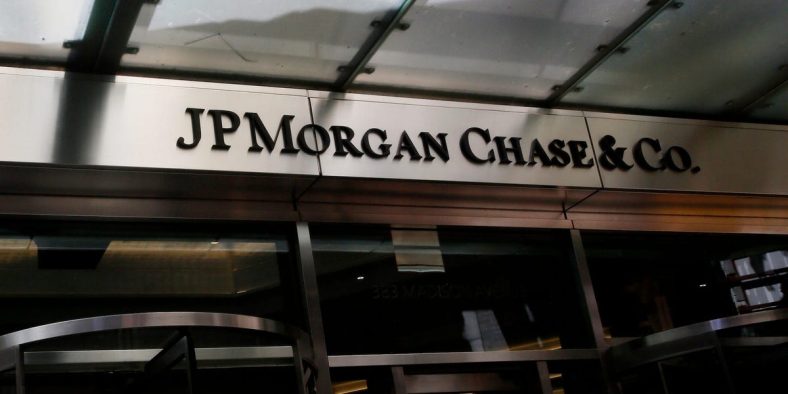
19 Republican states accused JPMorgan of closing bank accounts on political or religious grounds.
In a letter to CEO Jamie Dimon, they say the bank asked questions about religion and politics.
The attorneys general wanted JPMorgan to participate in a diversity survey linked to free speech.
Thanks for signing up!
Access your favorite topics in a personalized feed while you’re on the go.
Republican attorneys general from 19 states have accused JPMorgan Chase of closing accounts and discriminating against customers due to their political or religious beliefs, a report says.
In a letter sent to JPMorgan CEO Jamie Dimon and reviewed by The Wall Street Journal, Republicans representing 19 states said the bank had canceled major organizations’ checking accounts and had asked screening questions focused on religion and politics before reinstating them.
The attorneys general said JPMorgan “abruptly closed” the checking account of the National Committee for Religious Freedom (NCRF), a non-profit, before a letter informing it about the decision had been delivered.
The complaint said that an employee at the bank eventually told the group that JPMorgan would restore the NCRF’s account if it provided a list of its donors, a list of the political candidates it intended to support, and details of the criteria used to determine its support and endorsements.
“The bank’s brazen attempt to condition critical services on a customer passing some unarticulated religious or political litmus test flies in the face of Chase’s antidiscrimination policies. Worse, it flies in the face of basic American values of fairness and equality,” the signatories of the letter said.
The letter was signed by Daniel Cameron of Kentucky and Steve Marshall of Alabama, and co-signed by their counterparts in States including Florida, Georgia and Texas.
In March, treasurers from 14 Republican states also wrote to Dimon with similar claims, The Journal reported.
JPMorgan was also accused of declining a proposal to participate in a survey for the Viewpoint Diversity Score Business Index, which measured a company’s respect for “freedom of expression and freedom of religion or belief as a standard part of doing business,” per its website. JPMorgan received a score of 15% for the index in 2022.
Further, the letter claimed JPMorgan asked the Securities and Exchange Commission to ignore a proposal for the bank to disclose its policy for closing accounts.
A JPMorgan representative told The Journal: “We have never and would never exit a client relationship due to their political or religious affiliation.”
JPMorgan didn’t immediately respond to a request for comment from Insider, made outside normal working hours.
More than 3 million content creators are now signed up to subscription-based platform OnlyFans.
CEO Ami Gan said it’s identified Latin America and Australia as future growth markets.
Gan said there’d been a “huge uptick” in creators joining last year, with the total up almost 40%.
Thanks for signing up!
Access your favorite topics in a personalized feed while you’re on the go.
The number of creators signed up to OnlyFans surged by about 40% last year, bringing the total to more than 3 million for the subscription platform that mostly features adult content.
“We’ve noticed a huge uptick in creators as well as fans joining the platform and we attribute that to OnlyFans is very much a global business, we’re in over 100 countries,” CEO Ami Gan told the Web Summit in Rio de Janeiro last week.
The company is now setting its sights on Latin America and Australia to further increase its numbers.
“We’re looking at growth for the business and Latin America is a huge part of that,” Gan said. “We’re seeing Latin America is a massive growth region for us and see that opportunity for creators to get exposure to a global audience.”
Gan said OnlyFans, which had revenues of close to $1 billion in 2021, has also identified Australia and some parts of Europe as growth regions too.
The owner of OnlyFans, Leo Radvinsky, has made more than $500 million from the platform since 2020. He took control of its parent company, Fenix International, in 2018 for an undisclosed amount two years after it was founded by British entrepreneur Tim Stokely.
Gan, who joined the company in 2020, had been chief marketing officer before she was tapped as CEO in late 2021 when Stokely sold his stake and stepped down.
Are you an OnlyFans employee or have insight to share? Contact Jyoti Mann at jmann@insider.com or Twitter DM at @jyoti_mann1
At this stage, it’s uncertain who this could be. An early frontrunner is Linda Yaccarino, an advertising executive who has resigned from her role at NBCUniversal, CNBC reported on Friday.
Regardless of who it is, the incoming CEO will be left with a big mess to sort out after Musk’s chaotic run at the company.
Five big challenges
After seeing through his $44 billion takeover of Twitter, Musk has had a decidedly bumpy reign that has left his successor with four fundamental challenges to overcome.
The first is Twitter’s finances. Musk’s takeover of Twitter was fueled in part by a $13 billion debt package that has lumped the company with a real financial burden. Musk repeatedly said Twitter was weeks away from bankruptcy after taking charge, making revenue a top priority.
For any new CEO, that means finding a way of turning Twitter into a revenue-generating machine. The company’s 2021 earnings – its last full-year results before being delisted – showed it was hugely loss-making with a net loss of $221.4 million.
Musk has introduced new measures to improve this dicey situation, by getting users to pay for services like verification. Musk is handing out blue checks for free given the poor takeup for the subscription service, so his successor will need backup plans. It is unclear how much money Musk has made from this to date.
The second challenge facing the new CEO is the battle to hold onto advertisers – a battle that will face its defining moment as Twitter enters its Tucker Carlson era.
The former Fox News host, who was dismissed last month, announced this week that he would be launching a new show on Twitter. Given his notoriety for controversy, that could be a fatal double-edged sword for Twitter’s new chief.
On the other hand, the potential for Carlson’s broadsides to slip into the conspiratorial and vitriolic will greatly test the patience of advertisers. Half of Twitter’s top 100 advertisers paused ads a month after Musk’s takeover; the same could happen again.
The third challenge is competition. Musk’s penchant for rubbing people the wrong way has led several opportunists to recognize the frustration users and advertisers have had in recent months by introducing them to rival platforms.
Some, like Mastodon, a decentralized social-media service, have struggled to attract significant numbers given its clunkiness and long waitlist to join. Others, however, are proving more effective.
Newsletter platform Substack, meanwhile, has launched a Twitter-style feature called Notes, while earning a following from former Musk confidants such as journalist Matt Taibbi.
For Twitter’s new CEO, the threat these platforms pose is very real. One egregious slip of the tongue from Carlson or any potential guests on his new Twitter show could see users – and lucrative ad execs – flocking towards any number of other tweeting alternatives.
The fourth challenge, of course, is Musk himself. The billionaire’s shift towards a “hardcore” culture at the company did not sit well with many employees. Despite relinquishing CEO duties, he plans on retaining control as executive chair and chief technology officer.
The outsized influence of Musk will put pressure on the final challenge: deciding what Twitter actually is. Musk’s chaotic approach to moderation and verification has turned news organizations cold – despite those organizations being at the heart of Twitter.
NPR, which had its Twitter account labeled as “state-affiliated media,” has not tweeted since April 12. If news organizations are continuously maligned, Twitter’s new CEO will need to solve an identity crisis.
Whoever it is that replaces Musk, they can only hope he doesn’t add even more to their plate. Anything can happen in six weeks.
Our experts answer readers’ home-buying questions and write unbiased product reviews (here’s how we assess mortgages). In some cases, we receive a commission from our partners; however, our opinions are our own.
In 2021 the average refinance closing costs in the US were $2,375 without taxes, according to data from financial tech company ClosingCorp.
According to the Federal Reserve, typical closing costs are about 3% to 6% of your mortgage’s principal.
Your refinancing costs will vary based on where you live, the value of your home, and your new and old lender’s requirements.
Thanks for signing up!
Access your favorite topics in a personalized feed while you’re on the go.
But the refinancing process can be expensive. Refinancing essentially replaces your old mortgage with a new one, and that typically means paying closing costs all over again.
How much does it cost to refinance?
When you refinance, you may pay a little less in closing costs than what you paid on your original loan. According to data from ClosingCorp, average closing costs on a mortgage refinance were $2,375 in 2021, excluding any recordation or other specialty taxes. ClosingCorp didn’t disclose the national average refinance closing costs with taxes for 2021.
By contrast, the average home purchase closing costs without taxes were $3,860 in 2021. This means that borrowers who are refinancing pay a little less for their mortgages than those who are purchasing a new home.
One of the big factors that will influence the price you’ll pay on your home’s refinance is where you live. Your home’s location will have a big impact on the closing costs, since your closing costs involve taxes and your home’s value.
According to data from ClosingCorp, the state you live in will change how much you pay at closing. These were the average closing costs with taxes in each state in 2021.
Closing costs are higher in some states than in others. In New York, for example, where both property values and taxes are high, average refinance closing costs are over $10,000. In Missouri, however, where both property taxes and values are relatively low, average closing costs are $1,405.
Typical refinance closing costs
Refinancing closing costs aren’t just one fee — there are several expenses that make up closing costs. Much of the money you pay at closing covers your mortgage lender’s fees and any services that were used in the process of underwriting and closing on your loan. Some of your costs may also go to taxes.
Here’s a list of some of the fees you can expect to see in your refinance process, along with estimates of of what each will cost according to data from the Federal Reserve.
Taxes:
You may owe property taxes when you close on your refinance. Costs vary based on where you live, and your home’s value. According to Bank of America, six months of property taxes are generally due at closing.
Application fee:
Applying for another mortgage will cost you. This fee typically isn’t refundable.
Loan origination fee:
Cost range: Up to 1.5% of the loan’s principal
Not all lenders charge this fee, but some do. It could be a costly addition to your closing costs — a $200,000 mortgage balance with a 1.5% origination fee would add $3,000 to your closing costs.
Appraisal fee:
Cost range: $300 to $700, if needed
If your home hasn’t been appraised recently, you may need to pay for an appraisal. This process involves a licensed appraiser, who will assess your home and determine its fair market value.
Title search and insurance:
Lenders search for your home’s title to make sure you’re the owner, and check for any liens you have on the home. If there’s a mistake on the title that would jeopardize their investment, the title insurance provides protection to the lender.
Survey fee:
Cost range: $150 to $400, if needed.
If your home hasn’t had a survey recently, your lender could require one. This essentially verifies that your home and all of its structures are where the title says they are.
Attorney review and closing fee:
Cost range: $500 to $1,000
The company or lawyer that conducted your home’s closing will need to be paid for their work, and this will become part of your closing expenses.
Prepayment penalty:
Cost range: One to six months’ interest payments, if applicable.
Some lenders charge prepayment penalties on loans paid off before expected. Since a mortgage refinance will essentially pay off your old loan before your expected payoff date, your old lender could charge a prepayment penalty.
Not all loans have a prepayment penalty. Ask your lender if your current mortgage has a prepayment penalty, and if so, how much it is.
How to spend less on refinancing
There are ways to reduce the cost of refinancing your home, including:
Negotiate
While there are some costs your lender probably can’t budge on, such as appraisal fees, others might be open to negotiation. These include application and origination fees.
Ask your refinance lender if there is any leeway on these costs.
Shop around
For certain closing costs, such as your title search fee, you’re allowed to choose your service providers rather than going with the default ones the lender chooses. The services you’re allowed to shop for will be listed on your loan estimate — the Consumer Financial Protection Bureau has an example on its website.
No-closing-cost refinance
It’s also possible to refinance without paying closing costs up front. Instead, you’ll pay for the costs over the life of the loan.
Lenders make up for the closing costs in two ways, according to the Consumer Financial Protection Bureau. Some lenders will charge higher interest rates for borrowers who opt for loans without closing costs. Other lenders will add the closing costs to the loan’s principal, increasing the total amount you owe, and the total amount you’ll pay interest on.
While closing costs might seem high, it’s generally cheaper to pay them up front, even if you’re paying them a second time around while refinancing.
Our experts answer readers’ banking questions and write unbiased product reviews (here’s how we assess banking products). In some cases, we receive a commission from our partners; however, our opinions are our own. Terms apply to offers listed on this page.
Waive the $10 monthly service fee by making one direct deposit per month, OR making one bill payment per month, OR maintaining an average monthly balance of $1,500 in linked accounts
Waive $12 monthly fee when you make one direct deposit AND one bill payment per month, OR maintain average monthly balance of $1,500 in linked accounts
Earn up to $2,000 cash bonus when you open a new eligible Citi Priority Checking Account with required activities
No Citi fees at non-Citi ATMs
$30 monthly service fee waived when you maintain a combined average monthly balance of $30,000+ in eligible linked deposit, retirement and investment accounts
You may qualify for up to $200/year in membership and subscription rebates
You must have $200,000 combined in Citi bank accounts, and linked retirement/investment accounts to be a Citigold member
BBB gives Citi an F in trustworthiness
Highlights
Earn up to $2,000 cash bonus when you open a new eligible Citigold® Checking Account with required activities
No Citi fees at non-Citi ATMs
No monthly service fee when you maintain a combined average monthly balance of $200,000+ in eligible linked deposit, retirement and investment accounts
0.00% Annual Percentage Yield
Within 20 days of opening, deposit $200,000 new-to-Citibank funds
Maintain a minimum balance of $200,000 for 60 consecutive calendar days
Citi offers six tiers of checking accounts. The higher the tier, the more features you can access, such as out-of-network ATM fee reimbursements and check-writing privileges.
But as you level up, it becomes more difficult to either waive the monthly service fee or qualify to open an account in the first place.
On the bright side, Citi doesn’t require an opening deposit for any of its checking accounts, which gives it a leg up over many other brick-and-mortar banks. It’s also fairly easy to waive the monthly fees for its lowest-tier checking account, the Citi Access Account.
You may pay a monthly fee, depending on a variety of factors
Only available in certain states
BBB gives Citi an F in trustworthiness
Highlights
Monthly fee depending on whether you link to a checking account, and which checking account you choose
You may qualify to have the monthly fee waived, depending on which checking/savings account you have
No opening deposit
Compounding interest to maximize your savings
Only available in CA, CT, DC, FL, IL, MD, NJ, NV, NY, SD, VA, and Puerto Rico
Access to 650 branches
Additional Reading
Read our review
When you sign up for a “package,” you can choose either a Citi Savings or Citi® Accelerate Savings account to go with your checking account.
This is where things can get confusing. There are only two types of savings accounts, but you’ll pay different fees depending on which package you sign up for.
Citi® Accelerate Savings is a high-yield savings account that pays a competitive rate, and it’s clearly superior to Citi Savings — but you can only open an account if you’re a resident of certain markets.
$500 to $2,500 opening deposit, depending on your state of residence
Must visit a branch to deposit more than $10,000
BBB gives Citi an F in trustworthiness
Highlights
Terms ranging from 3 months to 5 years
Early withdrawal penalties ranging from 90 to 180 days interest
Earn 1.10% APY on a 6-month CD; Earn 4.05% to 4.75% APY on a 9-month; Earn 2.00% to 3.00% APY on an 11-month CD; Earn 4.05% APY on an 1-year CD or 18-month CD
Earn 0.05% APY on other CD terms between 3 months and 10 months; Earn 0.10% APY on other CD terms between 13 months and 15 months and 30 months; Earn 2.50% APY on other CD terms between 2 years and 5 years
Earn 0.05% APY during your first 10 months, 0.10% APY for months 11 through 20, and 0.15% APY on months 21 though 30
For CD terms of 1 year or greater, the early withdrawal penalty is 180 days of simple interest
Interest compounded daily and deposited monthly
FDIC insured
Additional Reading
Read our review
Citi offers three types of CDs: Citi Fixed Rate CDs, Citi Step Up CDs, and Citi No Penalty CDs.
While the bank’s abundance of checking and savings account options can be staggering, its CD options are easier to follow. Step Up CDs allow you to earn a higher interest rate at a specified date, while no-penalty CDs do not charge you early withdrawal penalties if you take out money from your account before the term ends.
If you’re searching for a competitive interest rate, a 1-year or 18-month Citi Fixed Rate CD might be worth considering.
$200 cash back, fulfilled as 20,000 ThankYou® Points, after you spend $1,500 on purchases in the first six months of account opening
0% intro APR on balance transfers for 21 months (transfers must be completed within four months of account opening) and on purchases for 12 months, then 17.99% – 28.74% variable APR
60,000 bonus ThankYou® Points after you spend $4,000 in purchases within the first three months of account opening, plus earn a total of 10 ThankYou® Points per dollar on hotel, car rentals, and attractions (excluding air travel) booked on the Citi Travel℠ portal through 6/30/2024
0% intro APR on balance transfers for 18 months, then 18.99% – 28.99% variable APR
0% intro APR on balance transfers for 21 months (transfers must be completed within four months of account opening) and on purchases for 12 months, then 18.99% – 29.74% variable APR
25,000 bonus points after spending $1,500 in purchases in three months from account opening
$99, waived for first 12 months
50,000 American Airlines AAdvantage® bonus miles after spending $2,500 in purchases within the first three months of account opening
10,000 American Airlines miles and a $50 statement credit after you spend $500 on purchases in the first three months of account opening
50,000 bonus miles after making $5,000 in purchases within the first three months of account opening
$200 cash back, fulfilled as 20,000 ThankYou® Points, after you spend $1,500 on purchases in the first six months of account opening
Rewards
Earn 5% cash back on purchases in your top eligible spend category each billing cycle, up to the first $500 spent, 1% cash back thereafter. Earn unlimited 1% cash back on all other purchases.
Intro offer
$200 cash back, fulfilled as 20,000 ThankYou® Points, after you spend $1,500 on purchases in the first six months of account opening
Rewards
Earn 5% cash back on purchases in your top eligible spend category each billing cycle, up to the first $500 spent, 1% cash back thereafter. Earn unlimited 1% cash back on all other purchases.
Citi Custom Cash℠ Card
Details
Rewards
Earn 5% cash back on purchases in your top eligible spend category each billing cycle, up to the first $500 spent, 1% cash back thereafter. Earn unlimited 1% cash back on all other purchases.
Intro offer
$200 cash back, fulfilled as 20,000 ThankYou® Points, after you spend $1,500 on purchases in the first six months of account opening
Recommended Credit
Good to Excellent
Regular Annual Percentage Rate (APR)
18.99% – 28.99% Variable
Intro Annual Percentage Rate (APR)
0% intro APR on balance transfers and purchases for 15 months
Editor’s Rating
4/5
Our editor’s ratings analyze fees, bonuses, rewards, and benefits to highlight the simplest and most valuable credit cards available.
Show more
Pros & Cons
Flexibility to customize rewards by earning 5% cash back on up to $500 per billing cycle in your top spending category (from a list)
Generous welcome offer for a no-annual-fee card
No rotating bonus categories to sign up for or track
Earn valuable Citi ThankYou points which you can redeem for cash back, travel, gift cards, merchandise, and more
Only earns 1% back outside of $500 in top spending category each billing cycle
Foreign transaction fee of 3%
Highlights
Earn $200 cash back after you spend $1,500 on purchases in the first 6 months of account opening. This bonus offer will be fulfilled as 20,000 ThankYou® Points, which can be redeemed for $200 cash back.
0% Intro APR on balance transfers and purchases for 15 months. After that, the variable APR will be 18.99% – 28.99%, based on your creditworthiness.
Earn 5% cash back on purchases in your top eligible spend category each billing cycle, up to the first $500 spent, 1% cash back thereafter. Also, earn unlimited 1% cash back on all other purchases.
No rotating bonus categories to sign up for – as your spending changes each billing cycle, your earn adjusts automatically when you spend in any of the eligible categories.
No Annual Fee
Citi will only issue one Citi Custom Cash℠ Card account per person.
0% intro APR on balance transfers for 21 months (transfers must be completed within four months of account opening) and on purchases for 12 months, then 17.99% – 28.74% variable APR
Citi® Diamond Preferred® Card
Intro offer
0% intro APR on balance transfers for 21 months (transfers must be completed within four months of account opening) and on purchases for 12 months, then 17.99% – 28.74% variable APR
Apply online at Citibank’s website.
Citi® Diamond Preferred® Card
Apply online at Citibank’s website.
Details
Intro offer
0% intro APR on balance transfers for 21 months (transfers must be completed within four months of account opening) and on purchases for 12 months, then 17.99% – 28.74% variable APR
Recommended Credit
Good to Excellent
Regular Annual Percentage Rate (APR)
17.99% – 28.74% Variable
Intro Annual Percentage Rate (APR)
0% intro APR on balance transfers for 21 months (transfers must be completed within four months of account opening) and on purchases for 12 months
Editor’s Rating
3.33/5
Our editor’s ratings analyze fees, bonuses, rewards, and benefits to highlight the simplest and most valuable credit cards available.
Show more
Pros & Cons
Very long intro APR period for balance transfers
No annual fee
Charges a balance transfer fee
No rewards (but that’s not the point of this card)
Highlights
0% Intro APR for 21 months on balance transfers from date of first transfer and 0% Intro APR for 12 months on purchases from date of account opening. After that the variable APR will be 17.99% – 28.74%, based on your creditworthiness. Balance transfers must be completed within 4 months of account opening.
There is a balance transfer fee of either $5 or 5% of the amount of each transfer, whichever is greater
Get free access to your FICO® Score online.
With Citi Entertainment®, get special access to purchase tickets to thousands of events, including concerts, sporting events, dining experiences and more.
60,000 bonus ThankYou® Points after you spend $4,000 in purchases within the first three months of account opening, plus earn a total of 10 ThankYou® Points per dollar on hotel, car rentals, and attractions (excluding air travel) booked on the Citi Travel℠ portal through 6/30/2024
Rewards
Earn 3x ThankYou® points on restaurant, supermarket, gas station, air travel, and hotel purchases. Earn 1x ThankYou® points on all other purchases.
Intro offer
60,000 bonus ThankYou® Points after you spend $4,000 in purchases within the first three months of account opening, plus earn a total of 10 ThankYou® Points per dollar on hotel, car rentals, and attractions (excluding air travel) booked on the Citi Travel℠ portal through 6/30/2024
Rewards
Earn 3x ThankYou® points on restaurant, supermarket, gas station, air travel, and hotel purchases. Earn 1x ThankYou® points on all other purchases.
Apply online at Citibank’s website.
Citi Premier® Card
Apply online at Citibank’s website.
Details
Rewards
Earn 3x ThankYou® points on restaurant, supermarket, gas station, air travel, and hotel purchases. Earn 1x ThankYou® points on all other purchases.
Intro offer
60,000 bonus ThankYou® Points after you spend $4,000 in purchases within the first three months of account opening, plus earn a total of 10 ThankYou® Points per dollar on hotel, car rentals, and attractions (excluding air travel) booked on the Citi Travel℠ portal through 6/30/2024
Recommended Credit
Good to Excellent
Regular Annual Percentage Rate (APR)
20.99% – 28.99% Variable
Editor’s Rating
4.1/5
Our editor’s ratings analyze fees, bonuses, rewards, and benefits to highlight the simplest and most valuable credit cards available.
Show more
Pros & Cons
Strong bonus
Generous bonus categories
Doesn’t offer much in the way of statement credits or other perks
Citi ThankYou Rewards may not be as convenient as other points for US-based travelers
Highlights
Earn 60,000 bonus ThankYou® Points after you spend $4,000 in purchases within the first 3 months of account opening. Plus, for a limited time, earn a total of 10 ThankYou® Points per $1 spent on hotel, car rentals, and attractions (excluding air travel) booked on the Citi Travel℠ portal through June 30, 2024.
Earn 3 Points per $1 spent at Gas Stations, Air Travel and Other Hotels
Earn 3 Points per $1 spent at Restaurants and Supermarkets
Earn 1 Point per $1 spent on all other purchases
Annual Hotel Savings Benefit
60,000 ThankYou® Points are redeemable for $600 in gift cards or travel rewards at thankyou.com
No expiration and no limit to the amount of points you can earn with this card
0% intro APR on balance transfers for 18 months, then 18.99% – 28.99% variable APR
Rewards
Earn 2% on every purchase with unlimited 1% cash back when you buy, plus an additional 1% as you pay for those purchases.
Intro offer
0% intro APR on balance transfers for 18 months, then 18.99% – 28.99% variable APR
Rewards
Earn 2% on every purchase with unlimited 1% cash back when you buy, plus an additional 1% as you pay for those purchases.
Apply online at Citibank’s website.
Citi® Double Cash Card
Apply online at Citibank’s website.
Details
Rewards
Earn 2% on every purchase with unlimited 1% cash back when you buy, plus an additional 1% as you pay for those purchases.
Intro offer
0% intro APR on balance transfers for 18 months, then 18.99% – 28.99% variable APR
Recommended Credit
Good to Excellent
Recommended credit score. Note that credit card lenders may use many different variations of credit score models when considering your application.
Show more
Regular Annual Percentage Rate (APR)
18.99% – 28.99% Variable
Intro Annual Percentage Rate (APR)
0% intro APR on balance transfers for 18 months
Editor’s Rating
3.65/5
Our editor’s ratings analyze fees, bonuses, rewards, and benefits to highlight the simplest and most valuable credit cards available.
Show more
Pros & Cons
No annual fee
Simple earning structure without confusing bonus categories
Some cards earn higher rates of cash back on rotating categories
While it has an introductory APR offer, that’s only on balance transfers, not purchases, so you can’t use it to fund a major expense without interest
Highlights
Earn 2% on every purchase with unlimited 1% cash back when you buy, plus an additional 1% as you pay for those purchases.
To earn cash back, pay at least the minimum due on time.
Balance Transfer Only Offer: 0% intro APR on Balance Transfers for 18 months. After that, the variable APR will be 18.99% – 28.99%, based on your creditworthiness.
Balance Transfers do not earn cash back. Intro APR does not apply to purchases.
If you transfer a balance, interest will be charged on your purchases unless you pay your entire balance (including balance transfers) by the due date each month.
There is an intro balance transfer fee of 3% of each transfer (minimum $5) completed within the first 4 months of account opening. After that, your fee will be 5% of each transfer (minimum $5).
0% intro APR on balance transfers for 21 months (transfers must be completed within four months of account opening) and on purchases for 12 months, then 18.99% – 29.74% variable APR
Intro offer
0% intro APR on balance transfers for 21 months (transfers must be completed within four months of account opening) and on purchases for 12 months, then 18.99% – 29.74% variable APR
Citi Simplicity® Card
Details
Annual Fee
$0
The information related to the Citi Simplicity® Card has been collected by Business Insider and has not been reviewed by the issuer.
Show more
Intro offer
0% intro APR on balance transfers for 21 months (transfers must be completed within four months of account opening) and on purchases for 12 months, then 18.99% – 29.74% variable APR
Recommended Credit
Good to Excellent
Regular Annual Percentage Rate (APR)
18.99% – 29.74% Variable
Intro Annual Percentage Rate (APR)
0% intro APR on balance transfers for 21 months (transfers must be completed within four months of account opening) and on purchases for 12 months
Editor’s Rating
3.33/5
Our editor’s ratings analyze fees, bonuses, rewards, and benefits to highlight the simplest and most valuable credit cards available.
Show more
Pros & Cons
Offers one of the longest intro APR periods for balance transfers (21 months)
No late fees or penalty APR for late payments
Higher balance transfer fee than some other cards
Doesn’t offer rewards, so you may want to upgrade to another card once you’re done paying off your debt
Highlights
The information related to the Citi Simplicity® Card has been collected by Business Insider and has not been reviewed by the issuer.
Low intro APR for 21 months on balance transfers and 12 months on purchases.
0% Intro APR on balance transfers for 21 months from date of first transfer. After that, the variable APR will be 18.99% – 29.74%, based on your creditworthiness. All transfers must be completed in the first 4 months.
0% Intro APR on purchases for 12 months from date of account opening. After that, the variable APR will be 18.99% – 29.74%, based on your creditworthiness.
25,000 bonus points after spending $1,500 in purchases in three months from account opening
Rewards
Earn 5x ThankYou® points on hotel, car rentals, and attractions (excluding air travel) booked on the Citi Travel℠ portal (offer ends June 30, 2024), Earn 2x ThankYou® points supermarkets and gas stations (for the first $6,000 per year and then 1x ThankYou® point). Earn 1x ThankYou® points on all other purchases.
Intro offer
25,000 bonus points after spending $1,500 in purchases in three months from account opening
Rewards
Earn 5x ThankYou® points on hotel, car rentals, and attractions (excluding air travel) booked on the Citi Travel℠ portal (offer ends June 30, 2024), Earn 2x ThankYou® points supermarkets and gas stations (for the first $6,000 per year and then 1x ThankYou® point). Earn 1x ThankYou® points on all other purchases.
Read our complete card review.
Citi Rewards+® Card
Read our complete card review.
Details
Rewards
Earn 5x ThankYou® points on hotel, car rentals, and attractions (excluding air travel) booked on the Citi Travel℠ portal (offer ends June 30, 2024), Earn 2x ThankYou® points supermarkets and gas stations (for the first $6,000 per year and then 1x ThankYou® point). Earn 1x ThankYou® points on all other purchases.
Intro offer
25,000 bonus points after spending $1,500 in purchases in three months from account opening
Recommended Credit
Good to Excellent
Regular Annual Percentage Rate (APR)
18.49% – 28.49% Variable
Intro Annual Percentage Rate (APR)
0% intro APR on balance transfers for 15 months from date of first transfer and on purchases from date of account opening
Pros & Cons
Citi rounds up rewards to the nearest 10 points on every purchase
Long introductory APR on purchases and balance transfers
No annual fee
2x earning at supermarkets and gas stations is capped at $6,000 in purchases per year
Other Citi cards have welcome bonuses that are more generous
Foreign transaction fees
Highlights
The information related to the Citi Rewards+® Card has been collected by Business Insider and has not been reviewed by the issuer.
Earn 25,000 bonus points after spending $1,500 in purchases in three months from account opening
0% Intro APR on balance transfers for 15 months from date of first transfer and on purchases from date of account opening. After that, the variable APR will be 18.49% – 28.49%, based on your creditworthiness. There is an intro balance transfer fee of 3% of each transfer (minimum $5) completed within the first 4 months of account opening. After that, your fee will be 5% of each transfer (minimum $5).
Earn 5X ThankYou® points on hotel, car rentals, and attractions (excluding air travel) booked on the Citi Travel℠ portal (offer ends June 30, 2024)
Earn 2X ThankYou® Points at Supermarkets and Gas Stations for the first $6,000 per year and then 1X Points thereafter. Plus, earn 1X ThankYou® Points on All Other Purchases.
The Citi Rewards+® Card – the only credit card that automatically rounds up to the nearest 10 points on every purchase – with no cap.
Earn 4% cash back on eligible gas and EV charging purchases for the first $7,000 per year (then 1% thereafter). Earn 3% cash back on restaurants and eligible travel purchases. Earn 2% cash back on all other purchases from Costco and Costco.com. Earn 1% cash back on all other purchases.
Costco Anywhere Visa® Card by Citi
Rewards
Earn 4% cash back on eligible gas and EV charging purchases for the first $7,000 per year (then 1% thereafter). Earn 3% cash back on restaurants and eligible travel purchases. Earn 2% cash back on all other purchases from Costco and Costco.com. Earn 1% cash back on all other purchases.
Apply online at Citibank’s website.
Costco Anywhere Visa® Card by Citi
Apply online at Citibank’s website.
Details
Rewards
Earn 4% cash back on eligible gas and EV charging purchases for the first $7,000 per year (then 1% thereafter). Earn 3% cash back on restaurants and eligible travel purchases. Earn 2% cash back on all other purchases from Costco and Costco.com. Earn 1% cash back on all other purchases.
Recommended Credit
Excellent
Regular Annual Percentage Rate (APR)
20.24% Variable
Editor’s Rating
3/5
Our editor’s ratings analyze fees, bonuses, rewards, and benefits to highlight the simplest and most valuable credit cards available.
Show more
Pros & Cons
Generous cash-back categories, especially for gas purchases
No foreign transaction fee
You can only receive rewards once per year
You need to visit a Costco location to redeem rewards for cash back instead of merchandise
Highlights
Discover one of Citi’s best cash back rewards cards designed exclusively for Costco members
4% cash back on eligible gas and EV charging purchases for the first $7,000 per year and then 1% thereafter
3% cash back on restaurants and eligible travel purchases
2% cash back on all other purchases from Costco and Costco.com
1% cash back on all other purchases
No annual fee with your paid Costco membership and enjoy no foreign transaction fees on purchases
Receive an annual credit card reward certificate, which is redeemable for cash or merchandise at U.S. Costco warehouses, including Puerto Rico
Citi® / AAdvantage® Platinum Select® World Elite Mastercard®
$99, waived for first 12 months
Annual Fee
Intro offer
50,000 American Airlines AAdvantage® bonus miles after spending $2,500 in purchases within the first three months of account opening
Rewards
Earn 2 AAdvantage® miles for every $1 spent at gas stations and restaurants, and on eligible American Airlines purchases. Earn 1x mile for every $1 spent on other purchases.
Citi® / AAdvantage® Platinum Select® World Elite Mastercard®
$99, waived for first 12 months
Annual Fee
Intro offer
50,000 American Airlines AAdvantage® bonus miles after spending $2,500 in purchases within the first three months of account opening
Rewards
Earn 2 AAdvantage® miles for every $1 spent at gas stations and restaurants, and on eligible American Airlines purchases. Earn 1x mile for every $1 spent on other purchases.
$99, waived for first 12 months
Annual Fee
Apply online at Citibank’s website.
Citi® / AAdvantage® Platinum Select® World Elite Mastercard®
Apply online at Citibank’s website.
Details
Rewards
Earn 2 AAdvantage® miles for every $1 spent at gas stations and restaurants, and on eligible American Airlines purchases. Earn 1x mile for every $1 spent on other purchases.
Annual Fee
$99, waived for first 12 months
Intro offer
50,000 American Airlines AAdvantage® bonus miles after spending $2,500 in purchases within the first three months of account opening
Recommended Credit
Good to Excellent
Regular Annual Percentage Rate (APR)
20.99% – 29.99% variable
Editor’s Rating
3.95/5
Our editor’s ratings are primarily based on 3 things: simplicity, affordability, and value. Our credit card editor takes those factors into account, and comes up with a rating to best reflect how the card performs in that criteria – relative to other products we’ve reviewed.
Show more
Pros & Cons
Bonus categories help you earn miles on everyday purchases
First checked bag free on domestic American Airlines flights
$125 American Airlines flight discount is nice, but you need to spend $20,000 in a cardmember year to earn it
Highlights
Earn 50,000 American Airlines AAdvantage® bonus miles after spending $2,500 in purchases within the first 3 months of account opening
Earn 2 AAdvantage® miles for every $1 spent at gas stations and restaurants, and on eligible American Airlines purchases
Earn 1 Loyalty Point for every 1 eligible AAdvantage® mile earned from purchases
Earn a $125 American Airlines Flight Discount after you spend $20,000 or more in purchases during your card membership year and renew your card
No Foreign Transaction Fees
First checked bag is free on domestic American Airlines itineraries for you and up to four companions traveling with you on the same reservation
Enjoy preferred boarding on American Airlines flights
10,000 American Airlines miles and a $50 statement credit after you spend $500 on purchases in the first three months of account opening
Rewards
Earn 2x miles for every $1 spent at grocery stores. Earn 2x miles for every $1 spent on eligible American Airlines purchases. Earn 1x mile for every $1 spent on other purchases.
American Airlines AAdvantage® MileUp®
Intro offer
10,000 American Airlines miles and a $50 statement credit after you spend $500 on purchases in the first three months of account opening
Rewards
Earn 2x miles for every $1 spent at grocery stores. Earn 2x miles for every $1 spent on eligible American Airlines purchases. Earn 1x mile for every $1 spent on other purchases.
Read our complete card review
American Airlines AAdvantage® MileUp®
Read our complete card review
Details
Rewards
Earn 2x miles for every $1 spent at grocery stores. Earn 2x miles for every $1 spent on eligible American Airlines purchases. Earn 1x mile for every $1 spent on other purchases.
Intro offer
10,000 American Airlines miles and a $50 statement credit after you spend $500 on purchases in the first three months of account opening
Recommended Credit
Excellent
Regular Annual Percentage Rate (APR)
20.99% – 29.99% Variable
Pros & Cons
Earn American Airlines AAdvantage miles with no annual fee
Rack up double miles at grocery stores in addition to American Airlines purchases
Modest sign-up bonus is much lower than other American Airlines cards
No meaningful frequent flyer benefits
You’ll pay foreign transaction fees on purchases made abroad
Highlights
The information related to the American Airlines AAdvantage® MileUp® card has been collected by Business Insider and has not been reviewed by the issuer.
Earn 10,000 American Airlines AAdvantage® bonus miles and receive a $50 statement credit after making $500 in purchases within the first 3 months of account opening
No Annual Fee
Earn 2 AAdvantage® miles for each $1 spent at grocery stores, including grocery delivery services
Earn 2 AAdvantage® miles for every $1 spent on eligible American Airlines purchases
Earn 1 AAdvantage® mile for every $1 spent on other purchases
Earn 1 Loyalty Point for every 1 eligible AAdvantage® mile earned from purchases
Save 25% on inflight food and beverage purchases when you use your card on American Airlines flights
Citi® / AAdvantage® Executive World Elite Mastercard®
Intro offer
50,000 bonus miles after making $5,000 in purchases within the first three months of account opening
Rewards
Earn 2x miles for every $1 spent on eligible American Airlines purchases. Earn 1x mile for every $1 spent on other purchases
Citi® / AAdvantage® Executive World Elite Mastercard®
Intro offer
50,000 bonus miles after making $5,000 in purchases within the first three months of account opening
Rewards
Earn 2x miles for every $1 spent on eligible American Airlines purchases. Earn 1x mile for every $1 spent on other purchases
Citi® / AAdvantage® Executive World Elite Mastercard®
This is a terrific card for frequent American Airlines flyers who can take advantage of its included Admirals Club membership and other day-of-travel perks to offset the high annual fee. Authorized users also get Admirals Club access, so there’s extra value to be had there, too. However, it’s not the best card for earning AA miles on everyday spending, and the lack of travel protections isn’t ideal for an airline credit card.
Details
Rewards
Earn 2x miles for every $1 spent on eligible American Airlines purchases. Earn 1x mile for every $1 spent on other purchases
Intro offer
50,000 bonus miles after making $5,000 in purchases within the first three months of account opening
Recommended Credit
Excellent
Regular Annual Percentage Rate (APR)
20.99% – 29.99% Variable
Pros & Cons
Full Admirals Club membership gets you (and authorized users) access to American Airlines lounges
Lots of American Airlines benefits, including priority boarding and check-in and a free checked bag for you and up to eight travel companions
High annual fee
Only earns bonus miles on American Airlines purchases
Highlights
The information related to the Citi® / AAdvantage® Executive World Elite Mastercard® Card has been collected by Business Insider and has not been reviewed by the issuer.
Earn 50,000 American Airlines AAdvantage® bonus miles after making $5,000 in purchases within the first three months of account opening
Admirals Club® membership for you and access for up to two guests or immediate family members traveling with you
No Foreign Transaction Fees on purchases
Earn 2 AAdvantage® miles for every $1 spent on eligible American Airlines purchases and 1 AAdvantage® mile for every $1 spent on other purchases
Earn 1 Loyalty Point for every 1 eligible AAdvantage® mile earned from purchases
First checked bag is free on domestic American Airlines itineraries for you and up to 8 companions traveling with you on the same reservation
Citi has a variety of credit cards, including travel credit cards, balance transfer credit cards, cash-back credit cards, and credit cards with 0% APR.
Earn 4% cash back on eligible gas and EV charging purchases for the first $7,000 per year (then 1% thereafter). Earn 3% cash back on restaurants and eligible travel purchases. Earn 2% cash back on all other purchases from Costco and Costco.com. Earn 1% cash back on all other purchases.
Costco Anywhere Visa® Business Card by Citi
Rewards
Earn 4% cash back on eligible gas and EV charging purchases for the first $7,000 per year (then 1% thereafter). Earn 3% cash back on restaurants and eligible travel purchases. Earn 2% cash back on all other purchases from Costco and Costco.com. Earn 1% cash back on all other purchases.
Read our complete card review
Costco Anywhere Visa® Business Card by Citi
Read our complete card review
Details
Rewards
Earn 4% cash back on eligible gas and EV charging purchases for the first $7,000 per year (then 1% thereafter). Earn 3% cash back on restaurants and eligible travel purchases. Earn 2% cash back on all other purchases from Costco and Costco.com. Earn 1% cash back on all other purchases.
Recommended Credit
Excellent
Regular Annual Percentage Rate (APR)
20.24% (Variable)
Editor’s Rating
3/5
Our editor’s ratings are primarily based on 3 things: simplicity, affordability, and value. Our credit card editor takes those factors into account, and comes up with a rating to best reflect how the card performs in that criteria – relative to other products we’ve reviewed.
Show more
Pros & Cons
Generous bonus cash-back categories, especially for eligible gas purchases
No annual fee (though you need to have a Costco membership)
You can only redeem rewards once per year
Not the best cash-back card if you don’t shop at Costco
Highlights
The information related to the Costco Anywhere Visa® Business Card by Citi has been collected by Business Insider and has not been reviewed by the issuer.
4% cash back on eligible gas and EV charging purchases for the first $7,000 per year and then 1% thereafter
3% cash back on restaurants and eligible travel purchases
2% cash back on all other purchases from Costco and Costco.com
1% cash back on all other purchases
No annual fee with your paid Costco membership and enjoy no foreign transaction fees on purchases
Whether you’re traveling for business or pleasure, enjoy no foreign transaction fees on purchases
Receive an annual credit card reward certificate, which is redeemable for cash or merchandise at U.S. Costco warehouses, including Puerto Rico
65,000 American Airlines AAdvantage® bonus miles after spending $4,000 in purchases within the first 4 months of account opening
Rewards
Earn 2x miles for every $1 spent on cable and satellite providers. Earn 2x miles for every $1 spent on eligible American Airlines purchases. Earn 2x miles for every $1 spent at gas stations. Earn 2x miles for every $1 spent on select telecommunications merchants. Earn 2x miles for every $1 spent on car rentals. Earn 1x mile for every $1 spent on other purchases.
65,000 American Airlines AAdvantage® bonus miles after spending $4,000 in purchases within the first 4 months of account opening
Rewards
Earn 2x miles for every $1 spent on cable and satellite providers. Earn 2x miles for every $1 spent on eligible American Airlines purchases. Earn 2x miles for every $1 spent at gas stations. Earn 2x miles for every $1 spent on select telecommunications merchants. Earn 2x miles for every $1 spent on car rentals. Earn 1x mile for every $1 spent on other purchases.
Earn 2x miles for every $1 spent on cable and satellite providers. Earn 2x miles for every $1 spent on eligible American Airlines purchases. Earn 2x miles for every $1 spent at gas stations. Earn 2x miles for every $1 spent on select telecommunications merchants. Earn 2x miles for every $1 spent on car rentals. Earn 1x mile for every $1 spent on other purchases.
Annual Fee
$99, waived for first 12 months
Intro offer
65,000 American Airlines AAdvantage® bonus miles after spending $4,000 in purchases within the first 4 months of account opening
Recommended Credit
Excellent
Regular Annual Percentage Rate (APR)
20.99% – 29.99% Variable
Editor’s Rating
4/5
Our editor’s ratings are primarily based on 3 things: simplicity, affordability, and value. Our credit card editor takes those factors into account, and comes up with a rating to best reflect how the card performs in that criteria – relative to other products we’ve reviewed.
Show more
Pros & Cons
Lots of bonus categories for earning miles on business-related purchases
Annual fee is waived the first year
Offers a free checked bag on American Airlines flights
Smaller businesses may have trouble meeting the $30,000 spending threshold to earn the companion certificate
Highlights
Designed for businesses
Earn 65,000 American Airlines AAdvantage® bonus miles after spending $4,000 in purchases within the first 4 months of account opening.
First checked bag is free on domestic American Airlines itineraries to reduce travel costs and boost your bottom line.
25% savings on American Airlines inflight Wi-Fi when you use your card
Enjoy preferred boarding on American Airlines flights
Earn 2 AAdvantage® miles per $1 spent on eligible American Airlines purchases, and on purchases at telecommunications merchants, cable and satellite providers, car rental merchants and at gas stations
Earn 1 AAdvantage® mile per $1 spent on other purchases
Earn 1 Loyalty Point for every 1 eligible AAdvantage® mile earned from purchases
$25 late fee, and Citi also ups the interest rate by 2% for borrowers 60 days behind on repaying their loan
Money within five business days via check
Must have a Citi deposit account open for at least 12 months, as well as an annual income of at least $10,500 to qualify for a Citi loan
12 to 60 month term length range
Citi Personal Loans may be worthwhile if you already bank with the company. To be eligible for a personal loan at Citi, you must earn a yearly income of $10,500 or more, meet Citi’s creditworthiness criteria, and have an eligible Citi bank account that has been open for at least 12 months.
Special pricing available for deposit account customers
HomeRun mortgages let borrowers qualify with non-traditional credit
Low-income borrowers in eligible areas can get up to $5,000 in closing cost assistance
Can’t see customized rates online
Application process isn’t completely online — you’ll need to speak over the phone first
Highlights
Offers mortgages nationwide
You can complete your application online after speaking to a mortgage representative
Citibank’s HomeRun mortgage allows eligible borrowers to put as little as 3% down with no mortgage insurance
Minimum credit score and down payment displayed are for conforming mortgages
Additional Reading
Read our review
Citi offers several types of home loans, including conforming, jumbo, FHA, VA and HomeRun mortgages. The HomeRun mortgage could be a good choice if you’re looking for an affordable mortgage option. Through the HomeRun mortgage program, customers may make a down payment as low as 3% with no mortgage insurance requirement.
Citi is a national bank with over 650 branches sprinkled around the US, including California, Connecticut, Florida, Illinois, Maryland, Nevada, New Jersey, New York, South Dakota, Virginia, and Washington, DC. You’ll also have access to over 65,000 fee-free ATMs nationwide, plus free ATMs all over the world.
Citi groups its accounts into “packages,” so you can have one checking and savings account in a package. Although there are technically only two savings accounts, the terms of your savings account depend on which package you choose.
Citi’s customer service is available 24/7 over the phone, and you can chat online from 6 a.m. to 10 p.m. ET. The bank also has an easy-to-use mobile app, which has 4.9 out of 5 stars in the Apple store and 4.8 stars in the Google Play store.
Your Citi accounts are FDIC insured for up to $250,000, or $500,000 for joint accounts.
Is Citi Trustworthy?
The Better Business Bureau gives Citi an F rating because it’s received a high volume of customer complaints on the BBB website and it has failed to respond to five customer complaints.
If Citi’s history worries you, you can find other banks with great scores from the BBB. But keep in mind that a strong BBB score does not guarantee that your relationship with the bank will be good. Make sure to also talk to friends and family or read customer reviews online to see if a bank might be right for you.
Citi: Frequently Asked Questions (FAQ)
Citi has a variety of home loans and credit cards. It also may be a good option if you’d like to open a online high-yield savings account with a national brand. Citi® Accelerate Savings pays more than the average savings account. That said, it’s only available in certain markets.
You also might like Citi if you’re eligible to waive monthly service fees. If you open the lowest-tier checking account — the Citi Access Account — it has a $10 monthly service fee. The monthly service fee can be waived if you meet certain requirements.
Yes, Citi bank accounts are FDIC-insured for up to $250,000 per depositor.
Savings and checking accounts do not require a minimum opening deposit. If you’d like to open a certificate of deposit, you’ll need at least $500.
Methodology: How We Reviewed Citi
For our Citi review, we rate bank products and services using our editorial standards.
At Personal Finance Insider, we rate products on a scale from zero to five stars. For bank accounts, we review different features for distinct types of bank accounts. For example, we’ll look at early withdrawal penalties and CD variety specifically for CDs. Meanwhile, for checking accounts, we’ll factor in the ATM network size and fees, as well as its overdraft protection options.
We’ll consider factors like annual fees and sign-up bonuses for credit cards, and term lengths for loans. In general, we also look at customer service and ethics.
How Citi Compares
We’ve compared Citi to two other national banks: PNC Bank and Wells Fargo.
Citi Review vs. PNC Bank Review
Citi and PNC Bank are national banks with branches throughout the US. PNC Bank has roughly 2,600 locations, while Citi has over 650 branches.
If you don’t live in a state with a Citi or PNC branch, you may explore each bank’s online-only bank accounts. Both banks have online high-yield savings accounts that are available to residents of states where there aren’t any branches.
If you’re eligible for both high-yield savings accounts, PNC High Yield Savings℠ Account pays a higher interest rate than Citi® Accelerate Savings. However, keep in mind rates can fluctuate so this could change in the future.
Citi offers a greater variety of credit cards than PNC Bank. However, PNC Bank offers more types of home loans than Citi.
Citi Review vs. Wells Fargo Review
If you’d like to keep all of your bank accounts in one institution, then the Citi package system may be worth exploring. The Citi® Accelerate Savings account offers a high interest rate in certain US states. If you live in a state like California or New York, you won’t be eligible to open an account, though.
Wells Fargo doesn’t have package systems, so you might favor this bank if you’re planning to open only one account.
You also might prefer Wells Fargo if you’d like to get a personal loan. Wells Fargo is featured as a top pick in our best personal loans guide.
Evelyn He is a compliance associate at Insider who supports the Personal Finance Insider team. Personal Finance Insider is Insider’s personal finance section that incorporates affiliate and commerce partnerships into the news, insights, and advice about money that Insider readers already know and love. The compliance team’s mission is to provide readers with stories that are fact-checked and current, so they can make informed financial decisions. The team also works to minimize risk for partners by making sure language is clear, precise, and fully compliant with regulatory and partner marketing guidelines that align with the editorial team. Before joining Insider, she served in various legal and compliance roles in different industries, including the legal and pharmaceutical industries. Evelyn obtained her M.S. degree in Marketing at Boston University in 2022. Prior to combining and consolidating her knowledge of law and business, she spent one year finishing 1L courses at Suffolk University Law School to further her legal knowledge. She has also completed MBA business law courses while working on her Bachelor of Business Administration in Management at the University of Massachusetts, Amherst. Outside of work, she enjoys spending time with her 14-year-old Shih Tzu named Money, and her 4-year-old Bichon named Tibber.
Earn 5.05% APY for 3 months after making a successful referral, then 4.55%.
Up to $5M in FDIC insurance through partner banks.
Invest in the market in minutes.
Putin’s military alliance is beset by new tensions following Russia’s faltering invasion of Ukraine.
Some member states have snubbed Putin, have declined to offer support, or have turned to the West.
CSTO, Russia’s equivalent of NATO, was never a powerhouse, but relations have become more strained.
Thanks for signing up!
Access your favorite topics in a personalized feed while you’re on the go.
Russian President Vladimir Putin has his own version of the NATO military alliance, made up of post-Soviet states.
But the Collective Security Treaty Organization (CSTO), which was never as powerful or cohesive as Russia would have liked, has been increasingly creaking since Russia launched its invasion of Ukraine, experts told Insider.
Some of its members have made unprecedented public snubs against Putin, and experts say they are conscious of Russia’s poor military performance over the past year, with questions over how well Russia could protect them.
Some may even fear becoming future Russian targets.
Jaroslava Barbieri, an expert in Russia and post-Soviet states at the University of Birmingham, told Insider that the CSTO is “almost like an attempt to imitate NATO, but in the post-Soviet space.”
But, she said, it’s now “really showing cracks.”
Snubs from allies
As Putin has become more isolated since the invasion of Ukraine in February 2022, CSTO members have made up some of his few remaining allies, with close cultural, historical, and military ties, and economies that heavily rely on Russia.
In addition to Russia, the CSTO consists of Armenia, Kazakhstan, Belarus, Kyrgyzstan, and Tajikistan, all once part of the Soviet Union.
But some have committed a series of apparent snubs against Putin since the invasion began.
These include Tajikistan’s president demanding more respect, despite his country’s small size, in front of Putin in October; Kazakhstan looking for closer ties with the West, and denying Russia’s request to send troops at the start of the invasion; and Armenia’s prime minister criticizing the effectiveness of the CSTO to Putin’s face and physically distancing himself from Putin at an alliance members’ leaders group photo in November.
Armenia’s prime minister and Russia’s president among other Collective Security Treaty Organization (CSTO) leaders in Yerevan, Armenia, on November 23, 2022.
KAREN MINASYAN / AFP via Getty Images; Insider
Other snubs included Kazakhstan sending aid to Ukraine, Armenia and Kazakhstan voting in favour of a UN resolution that noted the “aggression by the Russian Federation against Ukraine” in April 2023, and Armenia turning to France for help with a regional conflict, after being frustrated by the CSTO’s response.
Peter Frankopan, an expert on Russian and Balkans history at Oxford University, told Insider that the countries seem visibly unhappy with Russia: “It is certainly true that Putin looks like his status has been downgraded.”
And Frankopan said the apparent snubs appear calculated. “It is bold; but it is not done without thought or care. It would not seem to me unreasonable to suppose that there have been detailed backroom discussions,” he added.
Putin wants his own NATO
Putin has positioned NATO as his biggest enemy, justifying the brutal invasion of Ukraine in part by saying he was trying to stop its expansion toward Russia’s borders.
Ironically, the invasion has only strengthened NATO, with nearby Finland joining, effectively doubling the length of the Russia-NATO border.
One of NATO’s key tenants is the idea of collective defence: If one member is attacked, it is as if all are.
The CSTO has a similar agreement. But the workings of the CSTO cast doubt on whether it could ever reasonably compete with NATO.
In September 2022, Armenia called on CSTO for help during border clashes with Azerbaijan. The alliance limited its response to sending its secretary-general and offering to form a working group.
Armenia’s prime minister called the response “depressing” and said it was “hugely damaging to the CSTO’s image both in our country and abroad.”
Russian service members during military drills carried out by the Collective Security Treaty Organisation (CSTO) at the Harb-Maidon training ground, Tajikistan, October 2021.
REUTERS/Didor Sadulloev
Poor protections
That response was part of a pattern.
Anais Marin, an expert on Russia and Belarus and an associate fellow at Chatham House, told Insider that Armenia not getting the military assistance it asked for only “further discredited the organization.”
She noted Armenia subsequently cancelled planned in-country CSTO drills in January 2023.
Marin also noted that Kyrgyzstan and Tajikistan “tested, and evidenced, the limits of the CSTO when the alliance declined to intervene” in September 2022 border clashes between the countries, in which more than 100 people died.
“Member states appeared as unwilling to offer military support,” she said, adding that Russian peace-keeping troops, not CSTO ones, were deployed to secure the cease-fire.
University of Birmingham’s Barbieri said that the lack of CSTO response had likely led Armenia to a rethink.
“I would say that there are very serious conversations going on inside Armenia whether they should remain a member of the CSTO at all,” she said.
Russian President Vladimir Putin.
ILYA PITALEV/SPUTNIK/AFP via Getty Images
And Marin said that there was tension among the CSTO even before the invasion of Ukraine.
She described Armenia as “a very close ally of Russia,” one that is “extremely dependent on Russia both economically and in terms of military security.”
But, she said, it has had a “noticeable growth in distrust towards the Kremlin” in recent years, and has “developed quite some resentment against Russia for what it perceives amounted to failing to help a friend in need” during fighting with Azerbaijan in 2020.
The value of the organization has also been criticised by Kyrgyzstan for an even longer time, she added.
And Frankopan said that countries had likely stopped trusting Russia’s military abilities. “I think most states learned not to think about Russia as a protector state,” he said.
Russia’s military struggles in Ukraine have only fueled doubts.
Cadets of a military academy attend the funeral of Dmitry Menshikov, a mercenary for the private Russian military company Wagner Group, killed in Ukraine, in the Alley of Heroes at a cemetery in Saint Petersburg, Russia December 24, 202
REUTERS/Igor Russak
Worse relations since the Ukraine invasion
Russia expected to conquer Ukraine in days. Instead, more than a year later its army is bogged down in the east, hemorrhaging soldiers and equipment as its reputation plummets.
Barbieri said Russia’s regional reputation as a security provider “is in tatters.”
She added that the invasion of Ukraine was the last straw “in the sense that Russia is seen no longer as providing security, but as a destabilizer, spoiler, of security in the region.”
Marin suggested that the CSTO had become “a marginal actor in the eyes of most of its member states already before the war, but it further lost its relevance throughout 2022.”
She said the invasion resulted in “fear, and growing distrust towards the Kremlin” — except in Belarus, which is widely seen as a Russian puppet state, and has helped in the invasion.
She added that it’s “noteworthy that Russia did not ask for CSTO support at any stage of its ‘special military operation.’”
Marin also said that CSTO members don’t seem interested in taking big risks to protect the alliance’s future.
“Should Russia be militarily defeated in Ukraine, the CSTO is unlikely to survive,” she said.
A Ukrainian serviceman stands amid destroyed Russian tanks in Bucha, on the outskirts of Kyiv, Ukraine, April 6, 2022.
AP Photo/Felipe Dana, File
Russia a ‘toxic partner’
According to Frankopan, regional backlash to Russia’s invasion of Ukraine could be happening for multiple reasons, including ideological objections to Russia’s brutal tactics.
But he and Marin said tensions also likely stem from self-interested fears and frustrations: that they too could become targets, as well as how the invasion has made everyday life harder.
Frankopan noted that pro-Kremin figures have suggested on state TV the annexation of parts of Kazakhstan, and the war has driven up energy and food prices.
Marin said the Ukraine invasion had made Russia a “rather toxic partner” to most of its post-Soviet neighbours.
And CSTO members are also dealing with an influx of Russia immigrants fleeing military call up, she said.
Even so, while other post-Soviet countries have aligned themselves closely with the West and NATO, CSTO members remain tangled with, and to some extent dependent on Russia, with no formal split likely.
Barbieri noted that “there will still be pragmatic alliances” between the nations.
Marin went further. She said the alliance is losing relevance and legitimacy in the eyes of most of its members, but that Russia will retain its influence.
ussian President Vladimir Putin, center, speaks to a soldier as he visits a military training center of the Western Military District for mobilized reservists in the Ryazan region of Russia, on Oct. 20, 2022.
Mikhail Klimentyev/Sputnik/Kemlin Pool Photo via AP, File
“It would be wrong to assume that Russia is losing ground in its post-Soviet neighbourhood, Moscow retains multiple means to exert considerable leverage in most of these countries’ domestic affairs,” she said.
Frankopan also said that dissatisfaction with Russia could easily change. “This pendulum can swing in both directions, and in the right or wrong conditions, policy can be adapted or even reversed,” he said.
Meanwhile, despite international condemnation and repeated battlefield humiliations, Russia looks set to continue its war in Ukraine, and there are no signs that Putin will be removed from power.
But, Barbieri said, if the war and Putin continue as they have, Russia’s power over CSTO allies will continue to weaken.
“Its ability to be a leader in the region will become weaker and weaker and it will be surrounded more and more by other states dictating the terms to Russia and this is really not something that Putin’s regime can accept,” she said.
It was also unlikely to be the outcome Putin was looking for when he launched his invasion of Ukraine.
A hedge fund manager was awarded $203 million in damages after being defamed by former neighbor Peter Nygard.
Disgraced fashion mogul Nygard accused Louis Bacon of arson, insider trading and links to the KKK.
The decade-long dispute began following a quarrel over a driveway Nygard and Bacon shared.
Thanks for signing up!
Access your favorite topics in a personalized feed while you’re on the go.
A hedge fund billionaire has been awarded $203 million after a New York court ruled he was defamed by his former Bahamas neighbor Peter Nygard following a decade-long feud ignited by a shared driveway.
Nygard, a disgraced fashion mogul facing several sex trafficking charges, was ordered by a New York court-appointed judge to pay the biggest defamation settlement in the state’s history to Moore Capital Management founder Louis Bacon after peddling several wild allegations.
Arguments between Bacon and Nygard began when the two were neighbours in the gated Lyford Cay community on Clifton Bay in the Bahamas.
Bacon complained that Nygard, who used a driveway owned by Bacon, held several disruptive parties at his residence, while Nygard accused Bacon of scuppering his redevelopment plans after a fire, per the Financial Times.
This gradually escalated into increasingly vicious attacks by Canadian fashion mogul Nygard, with Bacon’s lawyers saying he personally spent $15 million on a smear campaign against Bacon.
In the initial complaint filed in 2015, Bacon said Nygard had hired journalists to peddle conspiracies about the hedge fund manager, including that Bacon had participated in insider trading, that he was linked to the death of his house manager, that he was responsible for a fire at Nygard’s property, and that he was involved in the Ku Klux Klan.
“Nygard and his sidekicks have alleged on a number of occasions that ancestors of mine living in the 19th and 18th centuries, whom I of course, never knew, were associated with racist groups or slaveholding,” Bacon wrote at the time.
According to the FT, Judge former U.S. District Judge Layn Phillips said the “overwhelming” and “truly stunning” nature of the evidence brought forward warranted the record sum.
“Any one of these would have been a significant assault on his character; the combination of all four depicted him as an evildoer of the highest order,” the referee said in his ruling, per the Wall Street Journal.
Lawyers told the court Bacon had spent more than $50 million in legal fees bringing several defamation cases against Nygard.
The settlement is a massive figure for an individual defamation case. By comparison, Fox News recently settled its mammoth defamation case brought by Dominion for a comparable $787.5 million.
Hi, I’m Matt Turner, the editor in chief of business at Insider. Welcome back to Insider Today’s Sunday edition, a roundup of some of our top stories of the week.
On the agenda today:
But first: The big takeaways from the Milken Institute Global Conference in Beverly Hills.
If this was forwarded to you, sign up here. Download Insider’s app here.
Reporters’ guide to Milken
Darren Woods, CEO of ExxonMobil, listens as U.S. Senator Joe Manchin (D-WV) speaks at the 2023 Milken Institute Global Conference
Mike Blake/Reuters
The big-money set jetted into LA last week for the Milken Global Conference. The Beverly Hilton was once again bustling with billionaires, with some stopping in the lobby to check out the Bombardier display showing off the executive cabin seating on one of its private jets.
Oyedele: There was a lot of anger directed at the Fed, given the impact of rate hikes on some investments and regional banks. But no one likes the person that takes away the punch bowl.
Biggest opportunity
Campbell: The pullback in lending by banks is raising the hopes of those in the private credit industry. More than one investor said that the most recent vintage of private loans will be the most profitable in years.
Behind the scenes
Bergman: Most of the real action of the conference takes place at invite-only private parties. At a Monday night event at what used to be Bette Davis’ party villa in West Hollywood, guests such as late-night host Jimmy Kimmel and Kim Lew, who manages the endowment of Columbia University, mingled poolside, nibbling on sushi hand rolls and chocolate-chip cookies.
This marks an abrupt end of Shopify’s nearly four-year foray into fulfillment — and its attempt to take on Amazon. Insiders say it was the right idea, but the wrong execution.
For nearly a year, Jeff Palkevich had a steady stream of strangers arriving at his home, looking for an Airbnb that wasn’t there.
It turns out Palkevich was caught in the middle of a “bait and switch” — a method often used to avoid short-term-rental laws. It involves an Airbnb host providing one address in the listing, but then notifying the guests at the last minute that the property is actually somewhere else. Often, guests end up at a stranger’s home.
Health-tech experts Andrew Moore, Peter Lee, Kay Firth-Butterfield, Reid Blackman, and Christopher Ross gathered to discuss the implications of generative AI in healthcare at the conference HIMSS on April 18, 2023.
HIMSS
Many sectors are grappling with the potential of generative artificial intelligence — and healthcare is no exception.
Hospitals are desperate to use the technology to help patients and doctors, but they’re pressing into uncharted territory. They’re now moving forward with their own experiments, trying to strike the right balance between speed and safety.
It goes by many names: an administrative fee, a transaction fee, even a “regulatory compliance” fee. When you sell or buy a house, it can pop up on a closing statement, with charges up to almost $1,000.
“It just has to be looked at as a junk fee,” Stephen Brobeck, a senior fellow at the Consumer Federation of America, told Insider. “They can get away with it, so they charge it.”
Zulie Rane is a content creator who has more than 80,000 followers on Medium.
Rane says that the first dollar is the hardest to earn online, and then tried five ways to do it.
She made money with affiliate links, by playing games, and by becoming a paid digital guinea pig.
Thanks for signing up!
Access your favorite topics in a personalized feed while you’re on the go.
I’m done.
I’m done with these garbage YouTube tutorials that claim to show you how to “easily earn $300 per day just by clicking links/typing words/using Google.” They’re always clickbait, and I always hate them.
So I decided to write an actual actionable guide on how to earn your first dollar online. And crucially, I’ve tested all of these. These all really work. I included screenshots as proof.
It’s obviously possible to earn a lot more than just a dollar, but I find for many beginners, it’s a mindset shift. Once you earn your first dollar, you can go on to earn your second, hundredth, thousandth, and so on. But that first dollar is the hardest.
So let’s get into five ways to earn your first dollar online — that I have tested
What do you need to earn your first dollar online?
To earn your first dollar online, you will typically need a few things, aside from an internet connection:
An audience. This can be readers subscribed to your newsletter or an existing audience on a platform like Instagram you access through an algorithm.
A product. This is what you’re going to sell.
A seller. This is who’s paying you for selling the thing to an audience.
You can spoof the “audience” element to some degree. For example, if I know about SEO or virality, I can post a video to YouTube that will get me sales through the pre-existing YouTube audience, even if it’s my very first video online and I don’t have any followers.
But the other two are non-negotiable.
Let’s look at five uncommon ways to earn your very first dollar online. In each section, I’ll say what the audience, product, and seller are. I’ll also explain how to maximize your earnings. These are listed in order of easiness.
1. Play games on your phone
It sounds too good to be true, isn’t it? And yet I earned $1.50 (as Amazon gift cards) by playing Farmville-style games on my phone.
Now admittedly, this isn’t a lot of money. But if you’re just looking to get your feet wet with the idea of earning money online, playing games is a decent way to do it.
Here’s the proof:
In case that’s too small to read, it says, “Congrats on your $0.50 USD gift card!” And there are three emails.
The business model is to get more people playing the game so the developers earn money either through selling in-game currency or by getting you to watch ads.
I earned three 50-cent Amazon gift cards. (I spent them on cat toys, of course.)
You can maximize your earnings by just playing a ton of games. Pick ones you like, and just enjoy yourself.
2. Be a paid digital guinea pig
Back in my college days, one of my all-time favorite websites was User Testing. I just logged back in today to ensure it’s still viable and was pleased to be able to take two tests and earn twenty bucks in just a few minutes.
All you have to do is join, fill out your profile, take screening tests, and then run through the tasks they set you up if you’re approved. Today, I did one on an email marketing tool, and another on some kind of digital phone pass.
Audience: you.
Selling: your user experience.
Buyer: Companies with new websites/apps they want to be tested.
Another tiny screenshot showing a pending payout of $10 from UserTesting.
Zulie Rane
Here’s how to maximize your earnings:
Always keep your browser open. It makes a “ding” noise when there’s a new test.
Download the app and extra browsers to maximize your odds of qualifying.
Talk out loud during the test. Companies like it when they understand what you’re thinking.
Be honest. You’ll have to be screened for these tests. Don’t lie to try to better fit the options.
This is one of my favorite options. You’ll never make millions, but it’s a lot of fun and it’s good money. I made $20 in thirty minutes, which works out to a decent hourly rate.
3. Get people to click on links
No, don’t worry, you’re not a hacker. These aren’t shady links. Basically, it works like this:
Say a company called Pet Supplies Co wants to promote its new YouTube video.
The company wants people to click on its video, so it can sell a new line of cat food.
The company hires a bunch of creators to post the link online.
I nab my custom, trackable URL from Pet Supplies Co, maybe something like youtube.com/participles/zulie_video.
I post an article talking about how much I love Pet Supplies Co’s new YouTube video because of the cute cats in it.
You click on the video.
That click is tracked through my custom link.
I earn a very small amount of money, maybe like $0.10, just for that click.
Nine other people do that.
I earn $1.00.
In short, you are using an audience (whether your own, or using SEO, or social media algorithms) to sell clicks to a company that wants attention.
Pet Supplies Co will work with some kind of middleman that connects creators like me to companies like Pet Supplies Co. In the past, I’ve used GetYrl, but other alternatives include Adsy or Shrinkearn.
A nice big screenshot for once, shows an earning of $1.89.
Zulie Rane
You can maximize this by:
Posting the link in a lot of different places.
Posting the link in a piece of content you hope will go viral.
It’s not a lot of money, but it can be your first dollar online.
4. Go affiliate
In the previous example, you don’t have to make any sales. You just have to get clicks. The tradeoff is you don’t have to get anyone to buy anything, but you earn less money because a click is obviously less valuable than a purchase.
Affiliate links use the same mechanisms, but go a step further — you’re asked to actually get readers to buy something. The benefit is the rates are normally higher.
For example, my favorite affiliate program is Bookshop.org. You get a 10% commission for every purchase made through your affiliate link.
Here’s the proof:
Screenshot of Bookshop’s affiliate program, an earning of $2.70.
Zulie Rane
You will share this link with your audience of interested readers. You are selling book recommendations. You are being paid by Bookshop, in exchange for sending book buyers to them.
The best way to maximize this is to niche down. You can find affiliate programs in pretty much any niche. The closer the niche fit, the more money you’ll earn.
Post content in your niche and include links. When people buy, you’ll earn a commission.
Fashion: Shein, 10%-20%. You’d have to make a sale of $5-$10 to get your first dollar.
Stationery: Paper Culture, 10%-12%. You’d have to make a sale of $8–$10 to get your first dollar.
General: Amazon, “up to” 10%. You’d have to make a sale of at least $10 to get your first dollar.
There are tons. Search your favorite brand + “affiliate program” and see what comes up.
Note: always disclose when something is an affiliate link. It’s the law!
5. Build a (small) email list and sell something
If you’ve tried options 1–4, you’re ready for option 5. You are going to build a small email list, create something that solves a problem, and sell it.
This is the hardest one, but also the most 1) rewarding and 2) scalable income source.
There’s this misconception that you need a huge email list to make money. But you don’t. Really, you just need one subscriber.
Zulie Rane
Here’s how it works:
Build a list. You can do this by posting content on any platform (blog, YouTube, Instagram) and encouraging people to sign up for your newsletter. You can use ConvertKit — it’s free for the first 1,000 subs.
Find out a problem your readers have. You can do this by asking them. Read your comments, send a poll, or just ask someone to hop on the phone with you.
Build something. Maybe it’s an ebook. Maybe it’s a PDF template. Maybe it’s a thirty-minute consultation call. You can make it literally $1, just to get that first buck in the bank.
Market it. Send an email or two or eight to your subscribers. Let them know about your thing, why you think it’s going to help them, and what they’ll be able to do once they’ve bought your thing.
How to maximize this income: This works best if you really mean it. You have to really feel like you found a problem that you can solve. You’re not just trying to separate a reader from their money — you’re helping them in a way only you can.
Audience: Your newsletter
Selling: Your product
Seller: You
Want to earn your first dollar online?
Stay away from too-good-to-be-true scams. These five methods may not make you wealthy, but they all work to get your first dollar online. That’s the toughest step.
Once you’ve earned your first dollar, you can look for ways to scale up. I recommend:
Hopefully, you’ll be able to leave user testing and playing games for pennies behind as you move forward toward more profitable ways to earn money online.
John Hennessy, chairman of Google’s parent company Alphabet, has previously said that a search on Google’s own chatbot Bard costs 10 times as much as a regular search.
Though OpenAI has strengthened its financial position with Microsoft’s backing, growing demand for its chatbot — which became the fastest-growing consumer app in history after tallying 100 million monthly active users within two months — will add further cost pressure.
Earlier this week, OpenAI CEO Sam Altman alluded to rising costs, suggesting that it was “going to be the most capital-intensive startup in Silicon Valley history,” The Information reported.
The report suggested that Altman has “privately suggested” that OpenAI could try to raise around $100 billion in the coming years as it works towards developing artificial general intelligence (AGI) – AI as powerful as the human brain.
The popularity of generative AI tools such as ChatGPT have grown rapidly in recent months as users have found the technology can offer several benefits such as boosts to productivity. Investors are likewise lured by the prospect of the technology upending multiple industries.
OpenAI’s revenue is projected to rise significantly this year, with expectations that revenue will hit $200 million this year before climbing to $1 billion in 2024, according to Reuters.
OpenAI did not immediately respond to Insider’s request for comment.